
If you’ve been searching for the right audio or reading tool for your toddler or young child, you’ve probably come across the Yoto Mini vs LeapFrog Interactive Reader debate. Both devices are popular, both are aimed at young learners, and both promise to build vocabulary, comprehension, and a love for stories. But they’re actually quite different in how they work — and which one fits your child depends on a few things worth understanding first.
This guide breaks down both devices honestly, with no marketing fluff, so you can actually decide what’s right for your household.
What Is the Yoto Mini and Who Is It For?
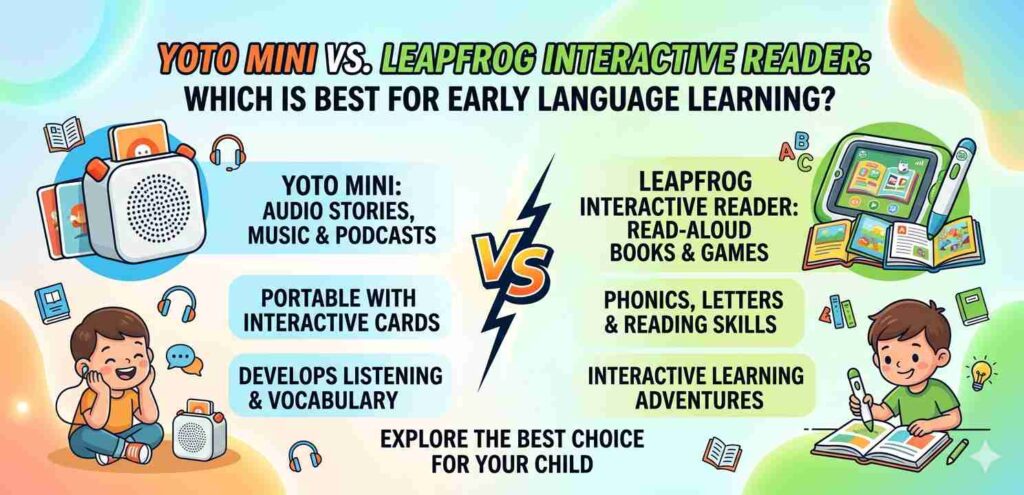
The Yoto Mini is a compact, screen-free audio player designed for children aged roughly three and up. It plays audio content through small physical cards — you slot in a card and the device plays whatever’s on it, whether that’s a story, a podcast, a music album, or educational content.
It’s intentionally simple. There’s no screen, no touchscreen games, no ads. The idea is that children can control their own listening independently. Even a three-year-old can slot in a card and press play without help from an adult.
The device has a small pixel display on the front that shows simple characters or images tied to the card, which kids find surprisingly engaging. Volume is controlled by physical buttons, and it runs on a rechargeable battery.
Parents who prefer reducing screen time tend to love the Yoto Mini for exactly this reason — it gives kids agency over entertainment without handing them a glowing tablet.
What Is the LeapFrog Interactive Reader?
The LeapFrog Interactive Reader is a pen-based reading system. Children use a stylus or reading pen to tap words and images on physical LeapFrog books, and the device reads those words aloud, explains meanings, plays sounds, and quizzes children on what they’ve just learned.
It’s more interactive in a hands-on, tactile sense. Children aren’t just passively listening — they’re pointing at words, hearing pronunciations, and engaging with the text directly. It’s been designed specifically for building phonics, word recognition, and reading comprehension in children aged around four to eight.
The system requires LeapFrog’s own branded books to work properly, as the books have embedded dots or codes the pen reads. There’s no subscription needed, but you do need to keep buying compatible books to expand the library.
Yoto Mini vs LeapFrog Interactive Reader: Core Differences
Before going deeper into language learning specifically, it helps to lay out the most important differences between these two devices.
Content Format and Delivery
With Yoto Mini, content is delivered through audio cards. The child puts in a card and listens. It’s passive in the sense that there’s no required interaction — the story just plays. Some cards have chapter navigation, and children can skip forward or back, but the experience is fundamentally about listening.
With LeapFrog, the child must physically interact — tapping words with the pen. This makes it more active and directly tied to reading development. But it also means a child who isn’t quite ready to hold a pen and follow along on a page may find it frustrating.
Screen Time
This is one of the clearest differences in the Yoto Mini vs LeapFrog Interactive Reader conversation. Yoto Mini is screen-free entirely. LeapFrog’s Interactive Reader doesn’t have a built-in screen either, but the books are the visual component, and some LeapFrog reading systems include interactive screens or connect to tablets for extended play.
If avoiding screens is a priority in your home, Yoto Mini is the easier choice.
Age Range
Yoto Mini works well from around age three. Toddlers can handle the cards and press play without much adult guidance. LeapFrog’s reading system tends to make more sense around age four to five, when a child is beginning to associate written words with sounds and meaning.
Early Language Learning: Which Device Actually Helps More?
This is the real question, and the answer isn’t simple — because “early language learning” covers a lot of ground.
Vocabulary Building
Both devices support vocabulary growth, but in different ways. Listening to audiobooks and stories on Yoto Mini exposes children to rich, varied language. Research consistently shows that read-aloud exposure — even just listening to stories — builds vocabulary naturally over time.
The LeapFrog pen-reading approach is more targeted. When a child taps a word and hears it pronounced clearly, then hears it used in context, that’s direct vocabulary instruction. It’s a more deliberate method.
For very young children who aren’t yet reading, Yoto Mini may actually be more useful because the experience is accessible and enjoyable without requiring literacy skills. For children already starting to read, LeapFrog provides something Yoto Mini doesn’t — direct engagement with printed words.
Phonics and Decoding
If your priority is helping your child learn to sound out words and decode text, LeapFrog has a real advantage here. The pen-based reading approach directly supports phonemic awareness and phonics in a way that pure audio listening doesn’t.
Yoto Mini doesn’t teach phonics. It exposes children to language and stories, which supports literacy development broadly — but it’s not a phonics program.
Comprehension and Storytelling
For narrative comprehension and imaginative engagement with stories, Yoto Mini is genuinely excellent. The audio card library includes high-quality books, original podcasts for children, and curated educational content. Many of the stories are professionally narrated with sound design.
LeapFrog books tend to be simpler in narrative scope since they’re built around the interactive word-tapping mechanic, which can slow the pace of storytelling.
Content Libraries: What’s Available?
The Yoto Mini vs LeapFrog Interactive Reader comparison gets interesting when you look at available content.
Yoto’s card library is substantial and growing. It includes titles like Roald Dahl audiobooks, Peppa Pig, classic fairy tales, language learning cards in French and Spanish, meditation and sleep content, and more. You can also create your own custom cards using the Yoto app, which is a genuinely useful feature for adding music, family recordings, or content from Audible.
LeapFrog’s book library is solid for early readers, with phonics-focused titles, alphabet and counting books, and beginner reading series. But it’s more limited in scope — it’s specifically educational rather than broadly entertaining.
If your child is a big story lover, Yoto’s catalog will likely satisfy them more. If your goal is structured literacy development, LeapFrog’s purpose-built books do that job well.
Durability and Practicality for Kids
Both devices are built for children, but they have different durability profiles.
Yoto Mini is compact and reasonably rugged. The cards can be bent or lost — that’s probably the biggest practical issue. Parents often recommend storing cards in a small case or wallet. The device itself holds up well to normal child handling.
LeapFrog’s pen-based reader is also pretty durable, though the stylus tip can wear down over time and may need replacing. The books, being physical books, can be torn or marked on — but they’re also relatively cheap to replace individually.
Price and Long-Term Cost
At purchase, Yoto Mini is priced in the range of $40–$60 depending on the retailer and any bundles. Individual cards typically cost $5–$15 each. If you build up a large card library, costs can add up, but the cards are reusable and shareable.
LeapFrog’s reading systems vary in price, with starter kits often around $25–$40 and individual books ranging from $10–$20. Again, the ongoing cost depends on how many books you add.
Neither device requires a subscription for basic use, which is worth noting — some competitors do lock content behind monthly fees.
What Parents Actually Say
Most parents who’ve used both devices tend to describe the Yoto Mini vs LeapFrog Interactive Reader choice as complementary rather than either/or. Yoto Mini gets used constantly — for bedtime stories, quiet time, car rides. LeapFrog gets used more intentionally, during literacy practice sessions or when working on phonics.
Parents of younger toddlers (two to four) tend to lean toward Yoto Mini because children can use it independently and it doesn’t require reading ability. Parents of children ages five and up who are actively learning to read often find LeapFrog more directly useful as a learning tool.
Which One Should You Actually Buy?
Choose Yoto Mini if your child is under five, if you want a screen-free audio device they can use independently, or if you primarily want to build a love of stories and listening habits. It’s also the better choice if you want flexible content beyond structured learning — music, podcasts, sleep content.
Choose LeapFrog Interactive Reader if your child is four or older and starting to recognize written words, if you want a hands-on phonics and reading support tool, or if structured early literacy practice is your main goal.
For many families, having both isn’t unreasonable — they serve different purposes and both support language growth in children. You can find Yoto Mini on Yoto’s official store and explore LeapFrog’s reading systems at LeapFrog’s website.
For more context on how audiobooks support early literacy, the American Academy of Pediatrics has helpful guidance on shared reading and audio engagement for young children.
Final Conclusion
When it comes down to Yoto Mini vs LeapFrog Interactive Reader, there’s no universal winner — the better device is the one that fits where your child is developmentally right now. Yoto Mini excels at building listening habits, vocabulary through immersive audio storytelling, and giving young children joyful independence with content. LeapFrog’s interactive approach shines for direct phonics practice and early reading support.
Both devices are well-made, reasonably priced, and genuinely useful for early language development. The best approach? Think about your child’s current age, their reading readiness, and what kind of engagement they respond to — and then choose from there.