

If you’ve ever noticed your toddler repeating a jingle from a TV ad word for word — but struggling to say “please” on command — you’ve already witnessed something important. Songs and rhymes that teach toddlers new words work differently than regular conversation. They stick.
There’s a reason for this. The rhythm and repetition in songs create patterns in a child’s brain. When the same sounds come around again and again in a predictable sequence, little brains start to anticipate them. That anticipation is actually part of learning.
You don’t need to be a singer. You don’t need a piano or a music degree. You just need a few good songs and the willingness to repeat them (a lot).
How Songs and Rhymes That Teach Toddlers New Words Actually Work
Before jumping into the list, it helps to understand why this method is so effective — especially compared to flashcards or drills.
When a toddler hears a word in a song, it arrives inside a package: melody, rhythm, rhyme, and often a physical action. That multi-sensory delivery means the word gets stored in more than one place in the brain. It’s more memorable, more retrievable, and more fun to repeat.
Songs and rhymes that teach toddlers new words also reduce pressure. A child who feels anxious about “getting it right” often shuts down. But when the same vocabulary appears inside a song they enjoy, they absorb it naturally — without realizing they’re learning at all.
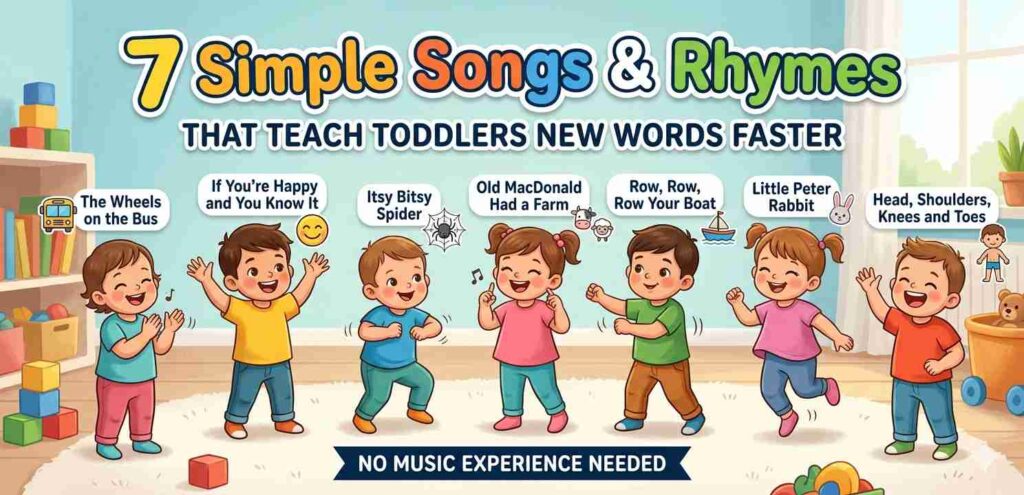
1. “Old MacDonald Had a Farm”
This one has been around forever for a reason — it genuinely works.
Every verse introduces a new animal name and the sound it makes. So in one short song, a toddler picks up words like “duck,” “cow,” “sheep,” and “pig” in a format that’s totally repeatable. The E-I-E-I-O refrain gives their mouth a workout too.
How to Use It Effectively
Don’t just sing it once. Point to pictures or toy animals as you name them. Pause before the animal sound and let your child fill it in. That moment of anticipation — where they know what’s coming — is powerful for memory.
You can also swap in less common animals over time. “Old MacDonald had a farm, and on that farm he had a… penguin.” Toddlers find this hilarious, and laughing while learning is always a win.
2. “Head, Shoulders, Knees and Toes”
Body part vocabulary is genuinely useful for toddlers. They need to describe pain, discomfort, feelings — all things tied to body awareness.
This is one of the most effective songs and rhymes that teach toddlers new words related to the human body. The physical component (touching each body part as you name it) adds a kinesthetic layer that pure songs can’t replicate.
Go slowly at first. Speed comes later. Many parents rush through it, but the learning happens in the slower, deliberate versions.
3. “The Wheels on the Bus”
Transportation words, action words, and community helper vocabulary — all in one song. “Wipers,” “driver,” “baby,” “mummy,” “horn” — these aren’t flashy words, but they’re everyday words that build real communicative ability.
What makes this song particularly strong as one of the songs and rhymes that teach toddlers new words is how expandable it is. You’re not stuck with the original verses. Add your own:
- “The wheels on the bus go round and round” → change to “The dog on the bus goes woof woof woof”
- “The children on the bus go up and down” → try “The elephant on the bus goes stomp stomp stomp”
Creating new verses with your child turns passive listening into active language creation. That’s a huge leap.
4. “Twinkle Twinkle Little Star”
Yes, it’s simple. That’s the point.
Simple songs and rhymes that teach toddlers new words are often more effective than complex ones because repetition is easier to achieve. A short, singable song gets sung more often — and frequency of exposure is one of the biggest factors in early vocabulary development.
“Twinkle Twinkle” introduces abstract vocabulary like “wonder,” “world,” “sky,” and “diamond.” These aren’t concrete nouns like “cup” or “dog” — they’re concepts. Introducing conceptual language early through song builds a foundation that later supports reading comprehension.
Pair it with nighttime stargazing (even just looking out a window) for extra context.
5. “If You’re Happy and You Know It”
Emotional vocabulary is one of the most underrated areas of early language development. Children who can name their feelings handle big emotions better. This song is a doorway into that vocabulary.
The original uses “happy.” But you can substitute other emotion words: “If you’re sleepy and you know it, close your eyes.” “If you’re silly and you know it, make a face.”
As one of the more interactive songs and rhymes that teach toddlers new words, this one also builds a bridge between words and physical expression — which is exactly how toddlers learn best.
6. Simple Nursery Rhymes: “Baa Baa Black Sheep” and “Jack and Jill”
These short rhymes might seem too simple to be educational. They’re not.
The rhyming structure in these poems helps children hear the way words relate to each other phonetically. “Black/back,” “Jill/hill,” “pail/fail” — these sound patterns are early phonics awareness. Research consistently links nursery rhyme exposure to later reading success. (See this overview from the National Literacy Trust for more detail on that connection.)
Rhymes are slightly different from songs, but they belong in the same toolkit. Songs and rhymes that teach toddlers new words work together — not separately.
Don’t worry about explaining meaning. Just repeat them. Comprehension builds gradually.
7. “Five Little Ducks” (and Other Counting Songs)
This one does double duty: it teaches number words and narrative vocabulary simultaneously. “Went out one day,” “over the hills and far away,” “Mother Duck said quack quack quack” — there’s storytelling embedded in it.
Counting songs are among the most practical songs and rhymes that teach toddlers new words because they combine mathematical concepts with language in a way that feels entirely natural. Toddlers aren’t aware they’re learning numbers and vocabulary at the same time. They just know they enjoy it.
Use fingers to count down. Pause before “none came back” for dramatic effect. Ham it up — toddlers love exaggerated emotion.
How Often Should You Sing With Your Toddler?
There’s no strict schedule, but consistency matters more than duration. Fifteen minutes of singing spread across a day (in the car, at bath time, before naps) is more effective than one long session.
Songs and rhymes that teach toddlers new words work partly because of spaced repetition — hearing the same words in different contexts at different times of day. A word heard in the morning during “Wheels on the Bus” and again at bedtime during “Twinkle Twinkle” is more likely to stick than a word heard ten times in a row.
Common Mistakes Parents Make (And Easy Fixes)
Singing too fast. Toddlers need time to process. Slow it down, especially with new songs.
Skipping the actions. Physical movement is a powerful memory anchor. Don’t cut it.
Giving up too early. Toddlers may hear a song 20–30 times before they start singing along. That’s normal, not a sign it isn’t working.
Only using screens. Passive screen-based singing has some benefit, but it doesn’t match the impact of a real person singing directly to a child. Face-to-face interaction is where the real language learning happens. The American Academy of Pediatrics has consistently emphasized this in their media guidelines for young children.
Songs Versus Books: Do They Compete?
Not at all. Songs and rhymes that teach toddlers new words work differently from picture books — but they complement each other beautifully. Books give context and illustration; songs give rhythm and repetition. A child who hears “duck” in “Old MacDonald” and then sees a duck in a board book is building a much richer word representation.
If you want to extend the learning from songs, try browsing our guide on picture books for early vocabulary building to find books that pair well with the songs above.
You might also find it helpful to read about how toddler talk milestones work by age so you can track progress without unnecessary worry.
Final Conclusion
Teaching a toddler new words doesn’t have to feel like a task. Songs and rhymes that teach toddlers new words do the heavy lifting almost automatically — through repetition, rhythm, and the natural joy that music brings.
You don’t need perfect pitch. You don’t need fancy instruments. You need “Old MacDonald,” some enthusiasm, and the patience to sing the same song for the 47th time without losing your mind entirely.
Pick two or three songs from this list and start today. Rotate in new ones gradually. Pay attention to which ones make your child’s eyes light up — those are the ones doing the most work.
Language learning at this age is less about drilling and more about immersing. Music is one of the most human, accessible, and joyful ways to do that