
If you’ve been spending any time around early childhood education lately, you’ve probably heard the phrase play-based learning more than once. Parents, preschool teachers, pediatricians — everyone seems to be talking about it. But what does it actually mean? And is there real evidence behind the hype, or is it just another trending parenting buzzword?
Let me walk you through what play-based learning actually is, how it looks in real life with toddlers, and why experts are increasingly treating it as the gold standard for children under five.
Understanding Play-Based Learning: What It Actually Means
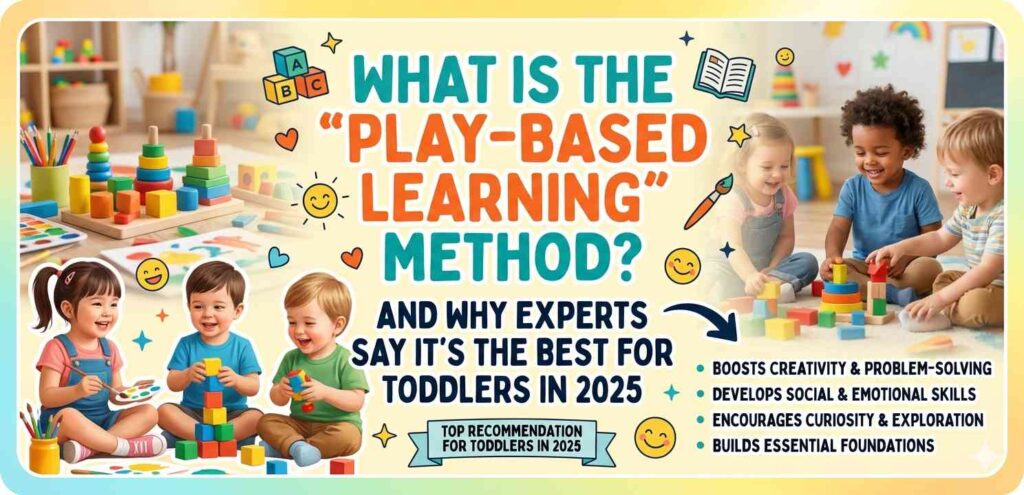
Play-based learning is an educational approach where children develop important skills — cognitive, social, emotional, and physical — through play activities rather than formal instruction. It’s not about sitting a toddler in front of a worksheet or making them repeat the alphabet over and over.
Instead, a child playing with wooden blocks is discovering geometry. A toddler pretending to “cook” with toy vegetables is building vocabulary and imagination. That’s the core idea — learning happens naturally through doing, exploring, and playing.
This approach is quite different from direct instruction, where a teacher or parent actively delivers knowledge. With play-based learning, children take the lead, and adults create the right environment to support discovery.
Why 2025 Is a Turning Point for This Approach
There’s been a significant shift in how early childhood educators and researchers think about toddler development. For a long time, the pressure to make children “school-ready” pushed a lot of preschools toward structured, academic-style learning even for two and three-year-olds.
But recent findings — and a growing pile of longitudinal studies — have pushed back hard against that approach.
The American Academy of Pediatrics released updated guidance in the last few years emphasizing that play is not a break from learning. It is the learning. In 2025, this position is more mainstream than ever, with curriculum designers, school boards, and parenting communities actively rebuilding early childhood programs around play-based learning principles.
How Play-Based Learning Works in Real Life
For a 2-Year-Old
Imagine a toddler playing with a set of stackable cups. They’re figuring out size, sequence, and cause-and-effect entirely on their own. When the tower falls, they try again. That persistence? That’s early problem-solving in action.
Play-based learning at this age doesn’t need fancy toys or a special curriculum. A sandbox, some cups of water, a pile of soft blocks — these are enough. The child’s natural curiosity does the heavy lifting.
For a 3- to 4-Year-Old
At this age, play becomes more social. Children start playing with others instead of just beside them. This is where play-based learning gets especially powerful.
Role-playing games — like “playing house” or pretending to be a shopkeeper — teach language, negotiation, empathy, and turn-taking. These are skills no worksheet can replicate. The emotional intelligence a child builds during these interactions forms a foundation that lasts well into adulthood.
What Makes It Different From “Just Playing”
This is a question a lot of parents ask, and it’s a fair one. Isn’t children playing just… children playing?
The key difference is intentionality on the adult’s part. In a play-based learning environment, the setup matters. An educator or parent arranges activities and materials thoughtfully, observes carefully, and sometimes introduces gentle prompts to extend thinking.
For example, if a child is playing with toy animals, a parent might ask, “Where do you think the lion lives?” That simple question turns free play into an exploratory conversation about habitats. The child is still playing — but now they’re also building knowledge.
This is sometimes called “guided play,” and it sits somewhere between pure free play and structured instruction. Research consistently shows it produces better outcomes than either extreme alone.
The Science Behind Play-Based Learning
The evidence supporting play-based learning isn’t just anecdotal. Researchers at Harvard’s Center on the Developing Child have shown that the “serve and return” interactions that happen during play — where a child does something and an adult responds — are critical for building neural connections in the developing brain.
You can read more about this research at the Harvard Center on the Developing Child.
Other studies show that children who experience high-quality play-based learning environments in early childhood demonstrate stronger executive function skills — things like impulse control, working memory, and mental flexibility — than peers in more rigid, instruction-heavy settings.
These are not small differences. They show up in academic achievement, social competence, and even mental health outcomes years later.
Play-Based Learning vs. Academic Drilling: What the Research Shows
There’s a real tension in early childhood education between play and academics. Some parents worry that if their toddler isn’t learning letters and numbers through direct instruction, they’ll fall behind.
But the research points in the opposite direction. A landmark study following children from age 4 into adulthood found that those in play-based preschool programs had significantly better social and emotional outcomes than those in academically-focused programs — and comparable or better academic results by age 10.
Pushing formal academics too early can actually backfire. It can create anxiety, reduce intrinsic motivation, and damage a child’s natural love of learning. Play-based learning, by contrast, keeps that curiosity alive.
The UNICEF Early Childhood Development resources also offer a clear, evidence-backed framework for how play supports early childhood development globally. You can explore it at UNICEF’s Early Childhood Development page.
Common Misconceptions About Play-Based Learning
“It’s Just Babysitting”
This is probably the most common misunderstanding. People sometimes confuse play-based learning with an unstructured free-for-all where children run wild while adults look on passively. That’s not what it is.
A well-designed play-based learning environment involves careful observation, thoughtful material selection, and purposeful interaction. The adult’s role is active — just different from a traditional teacher’s role.
“Children Won’t Learn Enough”
This concern usually comes from parents who want their children prepared for primary school. The evidence says play-based learning actually prepares children better — especially for the self-regulation and collaborative skills that primary schools increasingly demand.
If you’re curious about what balanced early education looks like, check out [this related guide on choosing the right preschool approach for your child].
“It Only Works for Some Children”
Play-based learning has shown consistent benefits across income levels, cultures, and learning styles. It’s particularly beneficial for children with developmental delays or sensory sensitivities, because it allows them to engage at their own pace without the pressure of structured performance.
How Parents Can Support Play-Based Learning at Home
You don’t need a specially designed classroom or expensive materials. Here are some practical ways to bring play-based learning into your home:
Create open-ended play spaces. Materials like cardboard boxes, building blocks, clay, and sand invite exploration without a fixed “right way” to use them.
Follow the child’s lead. Instead of directing the play, observe what your toddler gravitates toward and expand on it with questions or new materials.
Limit screen time during play hours. Interactive physical play — with real objects, real textures, real cause-and-effect — builds different neural pathways than passive screen viewing.
Play alongside them, not for them. When you join the play, model curiosity. “I wonder what happens if we add more water?” is a play-based learning moment.
For more on building a stimulating home environment, you might also find [our guide on creating a learning-friendly space for toddlers] helpful.
What Educators Are Saying in 2025
The shift toward play-based learning isn’t just happening in research journals. It’s showing up in policy. Several countries — including Finland, New Zealand, and Singapore — have long built early childhood education systems around play. In 2025, more school systems in South Asia and the Americas are revising their early childhood frameworks to follow suit.
Early childhood educators who’ve made the shift report something consistent: children are more engaged, more confident, and more willing to take on challenges when learning feels like play. That intrinsic motivation is something that’s very hard to cultivate through drills and flashcards.
Final Conclusion
Play-based learning isn’t a trend — it’s a recognition of how young children actually work. Toddlers are natural explorers, and when we give them rich environments, thoughtful support, and the freedom to play, they learn deeply and joyfully. The evidence in 2025 is clearer than ever: play-based learning builds the cognitive, emotional, and social foundations that children carry for life. Whether you’re a parent, a caregiver, or an educator, embracing this approach means working with how children naturally grow — not against it.