
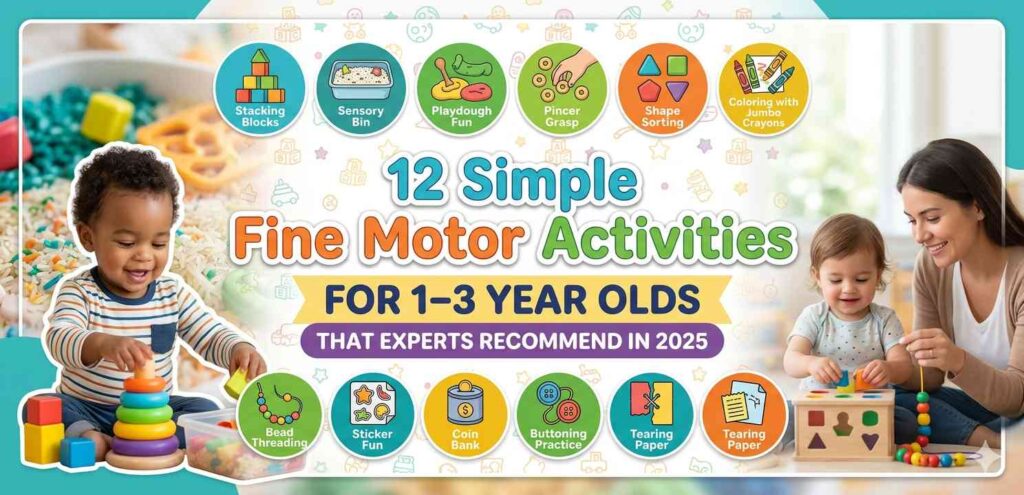

If you have a toddler at home, you already know how fast they develop. One week they can barely hold a spoon, and the next they’re trying to button their own shirt. That kind of hand skill doesn’t just happen — it builds gradually through play. And the best way to support it is through fine motor activities for 1–3 year olds that feel like fun, not structured learning.
This guide covers 12 activities that child development experts and occupational therapists commonly recommend. Each one is simple, low-cost, and designed to match what toddlers are actually ready for at different stages.
What Are Fine Motor Skills and Why Do They Matter?
Fine motor skills involve the small muscles of the hands, fingers, and wrists. These are the same muscles a child uses later to write, cut with scissors, tie shoes, or use a keyboard.
Between ages 1 and 3, a child’s hands are growing stronger and more coordinated every month. Giving them the right kind of practice during this window makes a big difference — not just for school readiness, but for their confidence and independence too.
Most pediatric experts agree that fine motor activities for 1–3 year olds work best when they’re embedded in everyday play. There’s no need for expensive kits or flashy toys.
12 Expert-Recommended Fine Motor Activities for 1–3 Year Olds
1. Tearing and Crumpling Paper
This one sounds almost too simple, but it’s genuinely effective for children around 12–18 months. Give your toddler old newspaper, tissue paper, or scrap paper and let them go at it.
Tearing paper requires the pincer grip — the same grip used for holding a pencil. Crumpling uses palm strength and bilateral coordination (both hands working together). It’s one of those fine motor activities for 1–3 year olds that requires zero setup and zero cleanup skills from the child.
2. Stacking and Nesting Cups
Stacking cups are a classic for a reason. Around 12–15 months, toddlers begin to stack two or three blocks or cups. By 24–30 months, many can manage five or six.
The act of picking up a cup, aligning it with another, and placing it carefully builds wrist rotation and hand-eye coordination. You can use actual stacking toys or just sturdy plastic cups from the kitchen.
3. Playdough Squeezing and Rolling
Playdough is one of the most recommended fine motor activities for 1–3 year olds by occupational therapists. The resistance of the dough builds hand strength without the child even realizing it.
Squeezing, poking, rolling into balls, and flattening with a palm — all of these involve different muscle groups in the hand. You can make a simple salt-flour dough at home if you’re avoiding commercial versions with dyes or additives. Here’s a good homemade playdough recipe for toddlers that’s quick and safe.
4. Water Pouring
Set up a small tray with two cups and a small pitcher. Let your toddler pour water from one container to the other. Yes, it will spill. That’s fine.
Pouring involves grip, wrist control, and attention to what the hands are doing. It’s also one of the most satisfying activities for toddlers because they love cause-and-effect. This activity scales well — start with larger containers for younger toddlers, and move to smaller ones as control improves.
5. Picking Up Small Objects
Dropping small items into a container (like a coin into a piggy bank or a pom-pom into a bottle) is a direct workout for the pincer grasp. Always supervise this closely and use age-appropriate objects to avoid choking hazards.
For children around 18–24 months, try dropping large dried beans or thick buttons into a wide-mouth container. For children closer to 3, you can use smaller items with a narrower opening to increase the challenge. This is among the most targeted fine motor activities for 1–3 year olds for building the grip needed for writing.
6. Finger Painting
Finger painting gives toddlers control over their movements in a way that a brush doesn’t. The sensory input from spreading paint also helps with spatial awareness and pressure control.
Children around age 2 often love making handprints and dragging their fingers in different directions. Let them explore freely rather than trying to direct what they make. The process matters more than the result at this stage.
7. Stringing Large Beads
By around 2.5 to 3 years old, many toddlers are ready to thread large wooden beads onto a thick lace or piece of pipe cleaner. This activity requires both hands working together in a coordinated way, plus patience and visual focus.
Start with beads that have very large holes and a stiff lace (not a floppy string). Occupational therapists often include bead threading among the most effective fine motor activities for 1–3 year olds heading toward preschool age. You can find age-appropriate bead sets through resources like the American Occupational Therapy Association for guidance on what’s developmentally appropriate.
8. Peeling Stickers
Peeling stickers is harder than it looks for little hands. The action of finding the edge of a sticker, gripping it between two fingers, and pulling it off requires precision and coordination.
Once the sticker is free, placing it somewhere specific (on a sheet of paper, on a shape, or on a scene) adds another layer of control. This is a low-mess, portable activity you can do anywhere. Toddler sticker books are designed exactly for this kind of practice.
9. Using Tongs or Tweezers
Around age 2.5 to 3, you can introduce child-safe tongs or tweezers. Give your toddler a bowl of cotton balls or pom-poms and ask them to transfer items from one bowl to another.
This activity directly mimics the grip pattern needed for holding a pencil or crayon. Many preschool readiness programs use tong activities because they build the exact same muscle control. It’s one of those fine motor activities for 1–3 year olds that also builds focus and patience alongside physical skill.
10. Turning Pages in Board Books
Reading together isn’t just a language activity — it’s a hand skill activity too. Turning pages requires the fingers to grip, separate, and lift individual pages. That’s more nuanced than it sounds for a 15-month-old.
Board books are thick and forgiving for younger toddlers. As children approach 3, you can introduce regular picture books where pages are thinner. Encourage them to turn pages themselves rather than doing it for them.
11. Lacing Cards
Lacing cards are flat cards with holes punched around the edges. Children thread a lace through the holes, following a path around the card. This combines hand-eye coordination, bilateral movement, and sequential thinking.
Most experts recommend lacing cards as one of the more advanced fine motor activities for 1–3 year olds, suitable for children closer to 3 years old. You can buy them or make your own by punching holes around a piece of thick cardboard cut into a simple shape.
For a broader look at how fine motor skills connect to school readiness, Zero to Three offers well-researched, parent-friendly articles on early development.
12. Building with Duplo or Large Blocks
Connecting and disconnecting large interlocking blocks like Duplo is more of a fine motor workout than many parents realize. Pushing pieces together requires grip and force; pulling them apart takes even more.
By age 2, most children can start connecting two or three Duplo pieces. By 3, many enjoy building more complex structures. The constant picking up, aligning, and connecting makes this one of the most naturally engaging fine motor activities for 1–3 year olds you can offer at home.
How to Choose the Right Activity for Your Child’s Age
Not every activity on this list suits every age within the 1–3 range. A rough guide:
- 12–18 months: Tearing paper, stacking cups, finger painting, turning board book pages
- 18–24 months: Playdough, water pouring, picking up objects, peeling stickers
- 24–36 months: Tong transfers, bead threading, lacing cards, Duplo building
Every child develops at their own pace, so these are starting points, not rigid rules. If your toddler isn’t interested in an activity, try again in a few weeks rather than pushing through resistance.
Tips for Making These Activities Work at Home
The biggest mistake parents make with fine motor activities for 1–3 year olds is turning them into directed lessons. Toddlers learn through play, not instruction.
Set up the materials, sit nearby, and follow your child’s lead. If they decide to dump the stacking cups instead of stack them, that’s still learning. Avoid correcting how they do things unless there’s a safety issue.
Short sessions work better than long ones. Ten minutes of engaged play is worth more than thirty minutes of distraction and frustration. And rotating activities every few days keeps things fresh — variety is part of what keeps toddlers motivated to explore.
Final Conclusion
Supporting a toddler’s hand development doesn’t require much — just thoughtful, playful opportunities offered regularly. The 12 fine motor activities for 1–3 year olds in this guide are grounded in what child development research actually supports, not trends or gimmicks.
Start with whatever feels most natural for your child’s current stage. Stay consistent without being rigid. And remember that every time your child squeezes playdough, peels a sticker, or stacks a block, they’re building real, lasting skills — one small hand movement at a time.