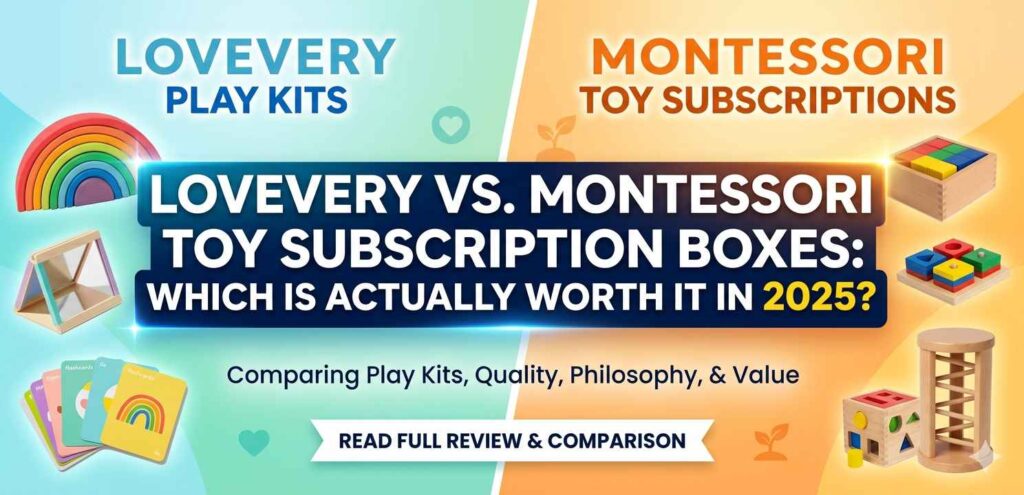

If you’ve spent any time in parenting forums lately, you’ve probably seen heated debates about Lovevery vs Montessori toy subscription boxes. And honestly, it’s a fair fight. Both promise to help your child learn through play. Both cost real money. And both have passionate fans who swear by them.
But here’s the thing — most comparisons online either read like a paid review or skip the details that actually matter when you’re a parent trying to make a smart choice.
So let’s get into it, honestly.
What Are Lovevery and Montessori Toy Subscription Boxes, Actually?
Before comparing them side by side, it helps to understand what each one really is — because they’re not quite the same kind of product.
Lovevery is a single brand that ships play kits every two to three months based on your child’s age. Each kit is designed around a specific developmental stage, from newborn up to around age four. The toys inside are carefully curated, and the company includes a detailed play guide telling you how to use each item.
Montessori toy subscription boxes, on the other hand, isn’t one brand — it’s a category. Companies like Monti Kids, The Montessori Box, and a few others offer subscriptions built around Montessori principles. The philosophy here is about open-ended play, child-led exploration, and natural materials like wood over plastic.
So when people say Lovevery vs Montessori toy subscription boxes, they’re often comparing a single polished product against a broader philosophy packaged as a subscription.
How the Costs Break Down in 2025
Let’s be straightforward about money, because this is where a lot of families make or break their decision.
Lovevery’s play kits typically run between $80 and $120 per box, depending on the stage. On an annual basis, that’s roughly $300 to $500 since the boxes don’t arrive every month.
Montessori-style subscription boxes vary more widely. Monti Kids, one of the more established options, costs around $150 per box but ships less frequently. Budget-friendly Montessori subscriptions exist too, especially from smaller independent sellers, ranging from $40 to $90 per box.
Neither is cheap. But the question isn’t really which is cheaper — it’s which gives you more actual value for your specific child.
The Developmental Philosophy: Where They Actually Differ
This is the heart of the Lovevery vs Montessori toy subscription boxes debate.
Lovevery’s Approach
Lovevery is research-backed, and they’re not shy about saying so. Their kits are designed with input from child development specialists, and each toy targets a specific cognitive or motor skill. The play guide that comes with every kit is genuinely useful — it explains why a toy is included and how to use it at different times during that developmental window.
It’s a more guided experience. Some parents love this because it takes the guesswork out of play. Others feel it’s a bit prescriptive.
The Montessori Philosophy in Subscription Form
Traditional Montessori education is about following the child. The environment is prepared, but the child leads. Materials are usually made from natural substances, designed to isolate one concept at a time — like a stacking toy that’s only about stacking, not about colors or sounds at the same time.
Montessori toy subscriptions try to bottle this philosophy. The best ones send items that are age-appropriate but open-ended. There’s no guide telling you what to do at 9 a.m. on a Tuesday. Your child figures it out.
This approach works brilliantly for some kids. Others — especially those who need a little more scaffolding — can get frustrated quickly.
Age Range and Long-Term Usability
One of the most practical things to consider when looking at Lovevery vs Montessori toy subscription boxes is how long the toys stay relevant.
Lovevery kits are stage-specific. A kit designed for a 4-to-6-month-old will feel largely irrelevant by month nine. This isn’t necessarily a flaw — it’s by design — but it does mean you need to keep subscribing to keep the flow of age-appropriate content going.
Montessori materials, by contrast, are often designed with a wider age window. A simple wooden puzzle or a set of nesting cups can be used in different ways as a child grows. The “shelf life” of each item tends to be longer, which can make individual items feel like better value even if the upfront cost is higher.
Material Quality: What Parents Actually Notice
Both product lines generally favor natural materials over cheap plastic. But there are differences.
Lovevery mixes wood, fabric, and some plastic elements — and the plastic they use is usually BPA-free and well-constructed. Their items feel sturdy and safe. Parents rarely complain about quality falling apart after a few weeks of use.
True Montessori subscriptions tend to lean harder into wood and natural fabrics. The sensory experience is part of the point. Heavy wooden blocks feel different in a toddler’s hand than a hollow plastic one, and that difference is intentional.
If material quality matters a lot to you — and for many parents, it does — then a dedicated Montessori-philosophy subscription box might edge ahead here.
Which One Is Better for Babies vs. Toddlers?
This is a question worth spending time on, because the answer genuinely varies.
For Babies (0–12 Months)
Lovevery has a real edge here. Their newborn and early infant kits are thoughtfully designed and the play guides are especially helpful for first-time parents who aren’t sure what a two-month-old should even be doing with a toy.
The structure feels reassuring when you’re exhausted and just want to know you’re supporting your baby’s development without overthinking everything.
For Toddlers (1–4 Years)
This is where Lovevery vs Montessori toy subscription boxes gets more interesting. Toddlers have strong preferences and opinions. A Montessori approach — giving them materials and letting them explore — can be genuinely magical at this stage.
Some toddlers thrive when given open-ended wooden materials and minimal instruction. Others need more engagement and novelty, which Lovevery’s guided kits can provide.
Honestly, if you have a toddler with a strong independent streak who loves to figure things out, a Montessori subscription might serve them better. If your toddler gets bored quickly and benefits from variety and novelty, Lovevery might hold their attention longer.
What Real Parents Say (Not Just the Five-Star Reviews)
Parents who’ve used both tend to share a few recurring observations.
Many Lovevery fans say the play guide is the real value — it changed how they play with their child, not just what they play with. That’s something no toy alone can do.
Parents who prefer Montessori subscriptions often mention that the toys get used longer. Their child returns to the same wooden items again and again, using them differently as they grow.
The frustration with Lovevery tends to be cost and the feeling that items get “retired” too quickly. The frustration with Montessori boxes is sometimes the opposite — less guidance means parents feel unsure whether they’re using things correctly.
Neither complaint is dealbreaker-level. They’re just trade-offs.
Sustainability and Environmental Consideration
In 2025, more parents are thinking about packaging waste and environmental impact. This matters when comparing Lovevery vs Montessori toy subscription boxes.
Lovevery has made public commitments to reduce plastic packaging, and their play boxes themselves are often repurposed as play spaces. That’s a nice touch. But subscription boxes, by nature, generate shipping packaging regularly.
Many Montessori toy subscription brands are small businesses that use minimal, recyclable packaging. Some even offer options to return or resell materials. It’s not universal, but the ethos often aligns more with sustainability-minded families.
Making the Final Decision: A Simple Framework
Rather than declaring a winner, here’s a practical way to decide what’s right for your family.
Choose Lovevery if:
- You have a baby under 12 months and want structured developmental support
- You’re a first-time parent who values clear guidance
- You prefer a well-known brand with consistent quality control
Choose a Montessori toy subscription if:
- Your child is a toddler with strong independent play tendencies
- You value natural materials and open-ended play above all
- You want toys that stay relevant longer and reduce waste
And if you’re genuinely torn? Many parents have done both — starting with Lovevery in the baby months and transitioning to Montessori-style subscriptions as their child hits the toddler years. It doesn’t have to be one or the other forever.
For more on choosing age-appropriate learning toys, this developmental play guide from Zero to Three is a genuinely useful reference. The American Academy of Pediatrics also has clear guidance on play and learning for parents navigating these decisions.
Final Conclusion
The Lovevery vs Montessori toy subscription boxes question doesn’t have a clean universal answer — and that’s actually fine. What matters is knowing your child, knowing your budget, and being honest about what kind of support you need as a parent.
Lovevery is polished, guided, and particularly strong in the early months. Montessori-philosophy subscriptions offer longer-lasting, open-ended materials that reward patient, exploratory play. Both have real strengths. Neither is perfect.
The best toy is still the one your child actually plays with — and the one that fits your real life, not just an idealized parenting version of it.