

If you’ve ever stood in a grocery store aisle while your two-year-old screamed on the floor because you said no to a cookie, you already know what it feels like when toddlers can’t manage big emotions. It’s exhausting, embarrassing, and honestly — confusing. Because they’re not doing it to ruin your day. Their little brains just haven’t learned how to handle what’s happening inside them yet.
This guide is here to help. No judgment, no complicated theories. Just real, practical steps you can use today to help your toddler manage big emotions before they turn into full-blown meltdowns.
Why Toddlers Struggle to Manage Big Emotions
Before we get into the how, it helps to understand the why. Toddlers are between ages one and three, sometimes four. Their brains are developing at a remarkable pace, but the part responsible for emotional regulation — the prefrontal cortex — won’t be fully developed until they’re in their mid-twenties.
So when your three-year-old loses it because their toast was cut in triangles instead of squares, they’re not being dramatic for fun. They genuinely cannot calm themselves down yet. That’s where you come in.
When toddlers can’t manage big emotions, they go into what some child development experts call “emotional flooding.” Their body gets overwhelmed by the feeling — whether it’s frustration, fear, hunger, or even too much excitement — and they have no off switch. The meltdown is the result, not the cause.
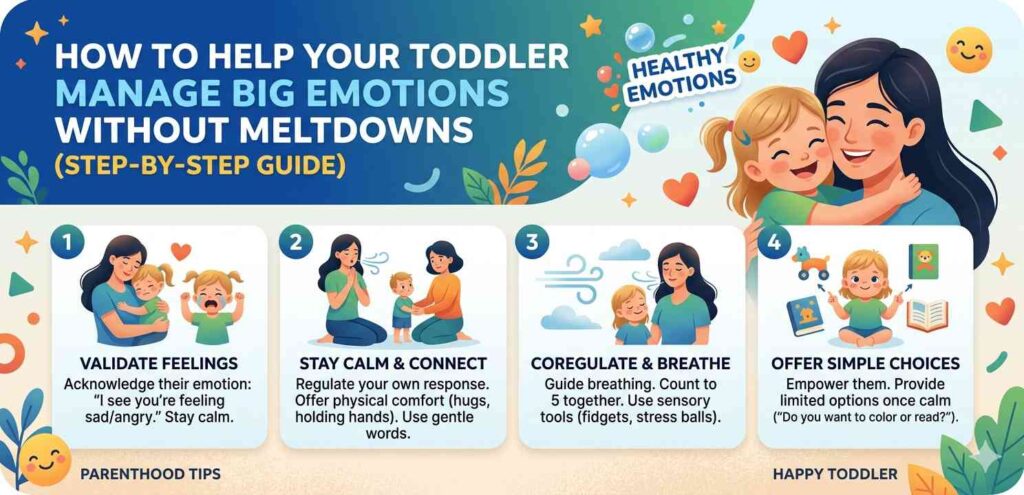
How to Help Your Toddler Manage Big Emotions: Step-by-Step
Step 1: Stay Calm Yourself First
This sounds obvious, but it’s the hardest part. When your toddler is screaming and throwing things, your own stress response kicks in. If you raise your voice or tense up, it actually makes it harder for your child to manage big emotions. Their nervous system looks to yours for cues.
Take a breath. Lower your shoulders. Speak in a slower, quieter voice than feels natural. You’re essentially acting as their external calm until they build their own.
Step 2: Name the Emotion Out Loud
Kids can’t manage what they can’t understand. When you put a word to what they’re feeling, you help them build emotional vocabulary — and that vocabulary becomes a tool they use for life.
Instead of saying “Stop crying,” try:
- “You’re feeling really frustrated right now.”
- “I can see you’re angry because we have to leave the park.”
- “That was scary, wasn’t it?”
Over time, your toddler starts to connect big feelings with words. And words are much easier to deal with than raw, unnamed emotion.
Step 3: Acknowledge Before You Correct
Most parents want to fix the problem first. But when a child is emotionally flooded, logic doesn’t land. Their rational brain is basically offline.
Say your child is crying because they can’t get their shoe on. If you immediately say “You need to calm down, I’ll help you,” they probably won’t hear it. But if you first say “I know, that’s so frustrating — the shoe keeps slipping,” something shifts. They feel seen. And when a toddler feels seen, they start to come back down.
Acknowledge first. Then solve.
Step 4: Give Them a Simple Calming Tool
Teaching toddlers to manage big emotions works better when there’s a concrete, easy-to-remember strategy. You can’t hand a three-year-old a meditation app, but you can teach them a few things that actually work at their level.
Deep belly breathing — Put a stuffed animal on their tummy and have them breathe so the animal “goes up and down.” It’s playful, and it works.
The squeeze and release — Make tight fists, hold for a few seconds, then release. This gives the body a physical outlet for tension without hitting or throwing.
The calm-down corner — Not a punishment corner. A cozy spot with soft things where your child can go (or you go with them) when big feelings show up. Make it feel safe, not isolating.
Practice these when your toddler is already calm. That way, when big emotions hit, the tool is familiar.
Common Triggers That Lead to Toddler Meltdowns
Knowing what causes emotional overwhelm can help you get ahead of it. A few of the most common triggers:
Transitions — Moving from one activity to another is genuinely hard for toddlers. Give a five-minute warning before leaving the park, turning off the TV, or going to bed.
Hunger and tiredness — The classic combo. When blood sugar drops or sleep is missed, even a minor frustration can feel catastrophic.
Too many choices or too much stimulation — A noisy birthday party, a busy shopping mall, or even a screen-heavy afternoon can fill a child’s emotional tank faster than they realize.
Feeling unheard — Toddlers who feel ignored or dismissed throughout the day often end up melting down later. They store it up.
Once you start noticing your child’s personal triggers, you can plan around them instead of reacting after the fact.
What NOT to Do When Your Toddler Is Overwhelmed
Don’t Try to Reason During the Meltdown
Logical explanations — “If you keep crying, we won’t go to the playground tomorrow” — don’t work in the moment. The child’s brain isn’t in a state to process future consequences. Save the conversation for after they’ve calmed down.
Don’t Shame the Emotion
Saying things like “You’re being a baby” or “There’s nothing to cry about” teaches children that their feelings are wrong. That doesn’t help them manage big emotions — it just teaches them to hide feelings, which leads to bigger problems later.
Don’t Give In Just to Stop the Crying
This is a tough one. If your toddler throws a tantrum because they want a second ice cream and you give in to stop the screaming, you’ve taught them that tantrums work. Consistency matters more than avoiding short-term discomfort.
Building Emotional Intelligence Over Time
Helping your toddler manage big emotions isn’t just about surviving today’s meltdown. It’s about building something that will genuinely change how they handle the world.
Read Emotional Stories Together
Books where characters feel sad, angry, scared, or jealous give toddlers language and frameworks for their own inner lives. Look for picture books that talk through how characters handle hard feelings — not just what they feel, but what they do about it.
Create a Feelings Check-In Routine
At dinner or bedtime, ask “What was the biggest feeling you had today?” Make it normal to talk about emotions the same way you’d talk about what they had for lunch. Kids who grow up in households where feelings are discussed openly tend to handle emotional stress much better as they grow older.
Model It Yourself
If you stub your toe and say “Ow, that hurt. I’m feeling really frustrated right now, so I’m going to take a breath,” your toddler watches that. Children learn emotional regulation mostly by watching caregivers, not by being told what to do.
When to Seek Extra Support
Most toddler meltdowns are completely normal. But sometimes the intensity or frequency suggests something else is going on. If your child has multiple explosive meltdowns daily, is hurting themselves or others regularly, or seems unable to recover emotionally even with consistent support, it may be worth talking to your pediatrician.
Some children have sensory processing differences, speech delays, or anxiety that makes it harder to manage big emotions than it is for other kids their age. Getting an early assessment isn’t an overreaction — it’s good parenting.
You can find useful guidance from the American Academy of Pediatrics and Zero to Three, both of which offer research-backed resources specifically for parents of toddlers.
Also, if you’re looking to understand more about toddler development stages, this guide on early childhood milestones and understanding separation anxiety in toddlers might be helpful reads alongside this one.
Final Conclusion
Helping your toddler manage big emotions is one of the most meaningful things you can do in those early years — not just for your sanity, but for their future. Every time you name a feeling, stay calm in a storm, or give them a tool to use, you’re building the emotional foundation they’ll carry for the rest of their life.
It won’t work perfectly every day. Some days will still end with tears on the floor. That’s okay. The goal isn’t a meltdown-free childhood — it’s a child who slowly, surely, learns that feelings are manageable. And a parent who knows they’re not alone in figuring it out.