

Every parent wants their child to be kind, confident, and emotionally strong. But most of us don’t realize that the foundation for all of that starts way before school begins. Building emotional intelligence in kids during the toddler and preschool years is one of the most impactful things a parent can do — and it doesn’t require expensive toys or special programs.
Why Emotional Intelligence in Kids Matters More Than You Think
A child who can name what they feel, handle frustration without melting down, and genuinely care about others — that’s not luck. That’s the result of something being carefully nurtured early on.
Research in child psychology consistently shows that emotional intelligence in kids is a stronger predictor of long-term success than IQ alone. Kids who develop these skills before age 5 tend to do better in school, form healthier friendships, and cope with challenges more effectively.
The reason the early years matter so much is simple: the brain is developing at a rapid rate. Neural pathways for emotional regulation are forming in real time. What children experience and learn between ages 0 and 5 shapes how they’ll process and respond to emotions for years to come.
What Exactly Is Emotional Intelligence?
Before diving into the “how,” it helps to understand the “what.”
Emotional intelligence generally includes four core abilities: recognizing one’s own emotions, managing those emotions, understanding how others feel, and navigating social situations thoughtfully. For a toddler or preschooler, this doesn’t look like deep self-reflection. It looks like being able to say “I’m mad” instead of throwing a toy, or noticing that a friend looks sad and offering a hug.
These small moments are huge. And they’re totally teachable.
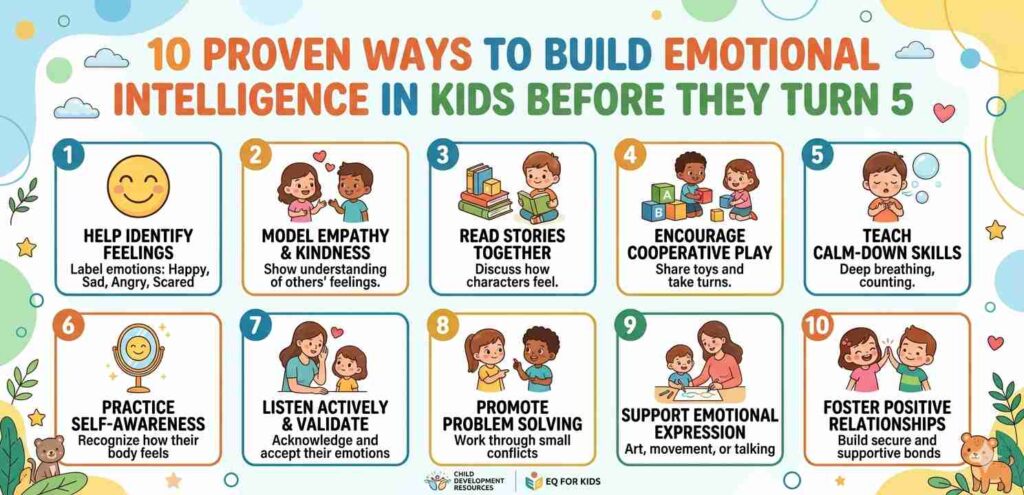
10 Proven Ways to Build Emotional Intelligence in Kids Before They Turn 5
1. Name Emotions Out Loud, Every Day
Children can’t manage what they can’t identify. One of the simplest ways to nurture emotional intelligence in kids is to name feelings as they happen — both yours and theirs.
“You look frustrated that the blocks fell. That makes sense.”
“I’m feeling a little tired today, so I need a quiet moment.”
Doing this consistently builds a child’s emotional vocabulary without any formal lessons. Over time, they start doing it themselves.
2. Validate Feelings Before Offering Solutions
This one trips up a lot of parents, honestly. When a child is upset, our instinct is to fix it fast. But jumping to solutions before acknowledging the feeling often makes things worse.
Try saying, “I can see you’re really disappointed” before moving on to what happens next. That simple pause — that validation — teaches kids that emotions are safe to feel and express. It’s a cornerstone of emotional intelligence in kids at any age.
3. Read Books With Emotional Themes Together
Story time is more powerful than most parents realize. Picture books that show characters feeling jealous, scared, or left out give children a safe space to process similar feelings of their own.
Talk about what characters might be feeling and why. Ask your child what they would do in that situation. This kind of conversation, done regularly, significantly strengthens emotional intelligence in kids because it builds empathy and perspective-taking in a low-pressure setting.
4. Create a “Feelings Check-In” Routine
Young children thrive on predictability. A short daily feelings check-in — even at dinner or before bed — makes emotional awareness a normal part of life.
Keep it simple. “What was the best part of your day? Was there anything that made you feel sad or worried?” You’re not running therapy sessions. You’re just making it normal to talk about feelings. That consistency is everything when it comes to growing emotional intelligence in kids.
5. Model Healthy Emotional Regulation Yourself
Children don’t just hear what we say — they watch what we do. If a parent slams a door when frustrated or shuts down during conflict, kids absorb that as the way emotions work.
When you’re visibly upset, try narrating your own process: “I’m feeling really stressed right now. I’m going to take three slow breaths and then we’ll talk.” This isn’t weakness. It’s one of the most powerful lessons in emotional intelligence in kids — and it comes directly from watching the adults around them.
6. Teach Simple Calming Strategies Early
You can’t expect a four-year-old to just “calm down” without giving them actual tools to do it. The good news is kids this age respond really well to physical strategies.
Belly breathing, counting slowly to five, hugging a stuffed animal, or even running to a “calm corner” in the house — these are all legitimate coping techniques. Teaching them early and practicing them during calm moments (not just meltdowns) helps children develop the self-regulation side of emotional intelligence in kids before they even start kindergarten.
7. Encourage Cooperative Play and Social Problem-Solving
Playdates and group activities naturally create emotional learning moments — turns being taken (or not), toys being grabbed, feelings being hurt. Instead of stepping in immediately to solve every conflict, try coaching from the sideline.
“What do you think your friend is feeling right now? What could you do?” This kind of guided reflection builds both empathy and problem-solving — two huge pillars of emotional intelligence in kids. It also gives children confidence that they can work through social challenges themselves.
Learn more about cooperative play strategies from Zero to Three, an excellent nonprofit resource focused on early childhood development.
8. Avoid Dismissing “Small” Emotions
To an adult, crying over a broken cracker seems ridiculous. To a three-year-old, it’s genuinely devastating. When we brush off or mock these reactions, children learn to hide their feelings rather than process them.
Staying patient in those small moments is harder than it sounds, but it’s worth it. Responding with care — even briefly — teaches children that their emotional world matters. That message is foundational to emotional intelligence in kids and helps them feel safe enough to be honest about bigger feelings later on.
9. Use “Emotion Coaching” During Difficult Moments
Psychologist John Gottman’s research on emotion coaching is worth knowing about. The basic idea is that difficult emotional moments are actually teaching opportunities — not just problems to get through as fast as possible.
When your child is melting down, staying calm, naming what you observe, and helping them work through it (rather than just shutting it down) does something remarkable over time. It builds the emotional circuitry that supports emotional intelligence in kids in a lasting way. You can explore Gottman’s approach further at The Gottman Institute.
10. Celebrate Kindness and Empathy, Not Just Achievement
Children notice what gets praised. If the only thing that gets enthusiastic attention is good grades, athletic wins, or big accomplishments, that’s what they’ll prioritize.
Make a conscious effort to notice and celebrate moments of kindness, empathy, and emotional courage. “You noticed your friend was sad and you went to check on her — that was really thoughtful.” That kind of specific, sincere praise shapes what children value about themselves and others. It tells them that emotional intelligence in kids is something worth being proud of.
Common Mistakes Parents Make (And How to Avoid Them)
Even well-meaning parents can accidentally undermine emotional development. A few things to watch for:
Saying “stop crying” or “you’re fine” — This teaches children to distrust their own emotional signals.
Using emotions as leverage — Saying things like “I’ll be sad if you don’t behave” puts an unfair emotional burden on a young child.
Ignoring your own emotional health — Parents who are constantly overwhelmed or emotionally unavailable pass that stress on, even unintentionally. Supporting your own wellbeing is directly connected to how you support emotional intelligence in kids.
How Schools and Caregivers Can Help
Parents aren’t the only ones in the picture. Preschool teachers and caregivers play a significant role in reinforcing emotional learning. If your child’s school uses a social-emotional learning (SEL) curriculum, that’s a great sign.
You can also speak with teachers about what strategies you’re using at home so everyone stays consistent. Consistency across environments — home, school, grandparents’ house — dramatically strengthens the development of emotional intelligence in kids.
Building These Habits Doesn’t Have to Be Perfect
Here’s something worth saying plainly: you don’t have to do all ten of these things every single day to see results. Missing a check-in, losing your patience, or getting the response wrong sometimes doesn’t undo the progress.
What matters is the overall environment you create — one where feelings are acknowledged, words for emotions exist, and children see the adults around them handling their own emotions with some degree of grace.
That environment, sustained over time, is what truly builds emotional intelligence in kids.
Final Conclusion
The first five years of a child’s life are genuinely remarkable from a developmental standpoint. The habits, patterns, and skills formed during this window stick around in powerful ways.
Building emotional intelligence in kids doesn’t require a perfect parent or a structured curriculum. It requires presence, patience, and the willingness to treat a child’s emotional life as something real and worth taking seriously. Name the feelings, validate the experiences, model what healthy emotional expression looks like, and celebrate the moments of kindness that might otherwise go unnoticed.