
Emotional regulation in children is one of those topics that sounds clinical but is actually very close to everyday life. Every time a child throws a tantrum in a grocery store, cries because a friend didn’t share a toy, or freezes up before a school exam — that’s emotional regulation, or rather, the struggle with it, happening in real time.
Most parents worry about their child’s grades, their reading level, their test scores. IQ still gets a lot of attention. But in 2025, child development researchers and educators are increasingly pointing to something else — something more foundational.
What Emotional Regulation in Children Actually Means
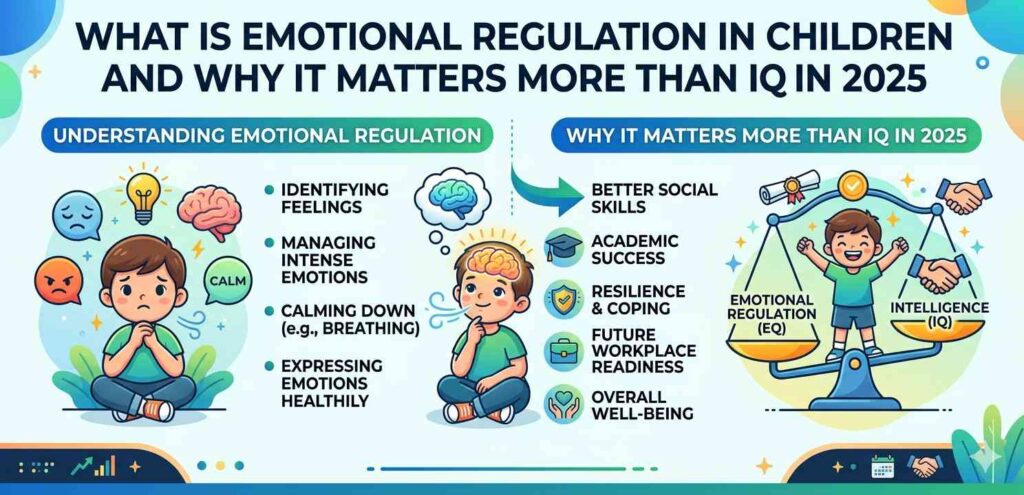
Emotional regulation in children refers to a child’s ability to recognize, understand, and manage their own emotional responses. It’s not about suppressing feelings. It’s about handling them in a way that’s appropriate to the situation.
A seven-year-old who loses a board game and storms off screaming is not a “bad” child. Their brain literally hasn’t finished developing the tools needed to process disappointment. That’s normal. But a child who can take a breath, say “I’m upset because I lost,” and stay in the room — that child is showing signs of developing emotional regulation.
This skill covers a wide range: staying calm under stress, bouncing back from frustration, handling peer conflict without hitting or yelling, managing excitement without losing focus. It sounds simple, but it takes years to develop.
Why Emotional Regulation in Children Is Being Taken More Seriously in 2025
The conversation around emotional regulation in children has shifted significantly in recent years. Post-pandemic data on childhood anxiety, behavioral issues in schools, and social development gaps has pushed this topic from therapy offices into mainstream parenting discussions.
Teachers report that classrooms now include more children who struggle to manage big emotions — not because these kids are “difficult,” but because many missed critical social-emotional learning years during lockdowns. Schools are responding with structured programs. Parents are looking for answers.
Meanwhile, longitudinal research keeps showing the same thing: children who develop strong emotional regulation skills tend to do better academically, have more stable friendships, handle conflict constructively, and maintain better mental health well into adulthood. That’s a more reliable predictor of long-term success than a high IQ score alone.
IQ vs. Emotional Regulation in Children: Why the Comparison Matters
IQ measures cognitive ability — how quickly a child can process information, solve problems, recognize patterns. It’s a real thing, and it matters.
But IQ alone doesn’t tell you how a child will perform under stress. A highly intelligent child who can’t manage exam anxiety may underperform. A child with average IQ who knows how to calm themselves down, refocus, and persist tends to outperform expectations over time.
Emotional regulation in children acts like a multiplier. It amplifies whatever intelligence a child has, by making it accessible — even in difficult moments.
Think about a child who is brilliant at math but shuts down completely when the teacher calls on them unexpectedly. Their IQ doesn’t disappear in that moment, but their ability to access it does. That’s where emotional regulation does the heavy lifting.
What Research Says
Studies from Yale’s Center for Emotional Intelligence and other institutions have consistently found that social-emotional skills — including emotional regulation in children — are better predictors of academic achievement and life satisfaction than IQ scores alone.
A 2023 meta-analysis published in Child Development confirmed that children with stronger emotion regulation skills showed better school readiness, peer relationships, and lower rates of behavioral problems — across different income levels and cultural backgrounds. IQ didn’t predict those outcomes nearly as reliably.
Signs That a Child Is Developing Emotional Regulation
Recognizing progress in emotional regulation in children isn’t always obvious, especially when you’re in the middle of a meltdown at 7 PM on a Tuesday.
But here are signs the skill is developing:
The child starts naming feelings instead of just acting on them — “I’m frustrated” instead of slamming a door. They begin asking for help when overwhelmed rather than shutting down or exploding. After an emotional outburst, they recover more quickly than before. They show awareness that their mood affects others — “I was mean to you earlier, I’m sorry.”
These are small signals. But they’re significant.
How Parents Can Support Emotional Regulation in Children at Home
Supporting emotional regulation in children doesn’t require special training. It starts with small, consistent habits.
Name feelings out loud. When you, as a parent, say “I’m feeling stressed right now, so I’m going to take a few deep breaths,” you’re modeling emotional regulation in real time. Children absorb this more than any lecture.
Avoid dismissing emotions. Saying “stop crying, it’s not a big deal” teaches a child that their emotions are wrong, not manageable. Instead, try: “I can see you’re really upset. Let’s figure out what’s going on.”
Create a calm-down space. Some families have a corner with soft pillows, a stress ball, or a simple feelings chart. It gives the child a place to go when emotions get too big — instead of exploding. This kind of physical anchor helps, especially for younger children.
Stay regulated yourself. This one is hard but important. A parent who responds to a child’s meltdown with their own escalating frustration tends to extend the storm, not shorten it. Emotional regulation in children is partly caught, not just taught.
What Schools Can Do to Build Emotional Regulation in Children
Schools play a huge role here. Programs like Social Emotional Learning (SEL) have been integrated into curricula across many countries with positive results.
The most effective approaches aren’t separate “feelings classes.” They’re woven into everyday classroom culture — teachers checking in at the start of the day, structured ways for students to signal they need support, and consistent language around emotions across the school environment.
Explore how SEL programs are being implemented in schools — the Collaborative for Academic, Social, and Emotional Learning has documented frameworks that are now used in thousands of schools worldwide.
When emotional regulation in children is treated as a school-wide priority, the difference shows — in reduced disciplinary incidents, improved attendance, and better academic engagement.
Common Mistakes That Undermine Emotional Regulation in Children
Even well-meaning parents and teachers sometimes accidentally work against this development.
Over-rescuing is a big one. When adults swoop in every time a child feels uncomfortable, the child never gets the chance to practice managing that discomfort. Frustration tolerance — a core part of emotional regulation in children — only develops through safe exposure to small frustrations.
Punishing emotional expression rather than the behavior is another pitfall. There’s a difference between “you can’t hit your brother” (addressing the behavior) and “stop being so dramatic” (shaming the emotion). The first teaches a boundary. The second teaches the child to hide their feelings, not regulate them.
For a deeper look at the neuroscience behind this, Harvard’s Center on the Developing Child offers accessible, research-based resources that explain why emotional regulation in children develops the way it does — and what disrupts it.
Emotional Regulation in Children With Anxiety, ADHD, or Sensory Needs
Some children face additional challenges. Kids with ADHD often struggle specifically with the “braking” part of regulation — they feel the emotion at full intensity and can’t slow down the reaction fast enough. Children with anxiety tend to be highly regulated in the sense that they’re hyperaware of their emotional states, but they get stuck in loops of worry they can’t exit.
For these children, the same principles apply — but they may need more scaffolding, more practice, and professional support. Occupational therapists, child psychologists, and school counselors can all contribute to building emotional regulation in children with specific needs.
The key message is: these children aren’t failing at regulation. Their nervous systems are working harder, in different conditions.
Emotional Regulation in Children and Long-Term Mental Health
Perhaps the most compelling reason to prioritize emotional regulation in children over pure academic achievement is the long-term mental health connection.
Adults who grew up without support for emotional regulation often struggle to identify their feelings, manage conflict in relationships, or recover from setbacks. These are things IQ doesn’t fix.
Children who grow up knowing how to handle difficult emotions — not perfectly, but well enough — tend to develop resilience. And resilience, in the long arc of a life, turns out to matter enormously.
Final Conclusion
Emotional regulation in children is not a luxury skill or something only struggling kids need to work on. It’s the foundation of how a child interacts with the world — at school, at home, in friendships, and eventually in adulthood.
In 2025, with everything we know about brain development, mental health, and long-term outcomes, continuing to place IQ above emotional skills as the measure of a child’s potential seems increasingly outdated.
The child who can name what they feel, manage it without shutting down or exploding, and reconnect after a hard moment — that child is already ahead. Not because they’re smarter, but because they’re equipped.