
Every parent has had that moment — you’re watching your baby make faces, coo softly, or suddenly point at the dog and make a sound — and you wonder: is this normal? Are they ahead? Behind? Understanding communication milestones can give you a much clearer picture of your child’s development and help you know when to feel reassured or when to ask questions.
This guide walks through what communication milestones look like from birth all the way to age three, in plain, practical terms. No medical jargon, no vague generalizations. Just real, useful information for parents trying to understand what’s happening in front of them.
What Are Communication Milestones, Exactly?
Communication milestones are the developmental markers that show how a child is learning to understand and express language. They cover both receptive communication (what a child understands) and expressive communication (what a child says or does to get their message across).
These aren’t just about words. Eye contact, gestures, babbling, pointing, and facial reactions are all part of communication milestones — especially in the first year. A baby who makes steady eye contact and responds to their name at six months is meeting important milestones, even though they haven’t said a single word yet.
It’s also worth saying upfront: communication milestones are ranges, not exact dates. One baby might say “mama” at 9 months; another might wait until 14 months. Both can be perfectly typical. What matters more than exact timing is the overall pattern of progress.
Why Tracking Communication Milestones Matters
Keeping an eye on communication milestones isn’t about comparing your child to others or creating anxiety. It’s about catching delays early, when intervention tends to be most effective.
Speech-language pathologists and pediatricians agree that early identification of communication delays — before age three — leads to significantly better long-term outcomes. That window matters because the brain’s language pathways are developing rapidly during these years.
So tracking communication milestones is a bit like checking in with a map on a road trip. You’re not looking to hurry the journey. You’re just making sure you’re generally heading the right direction.
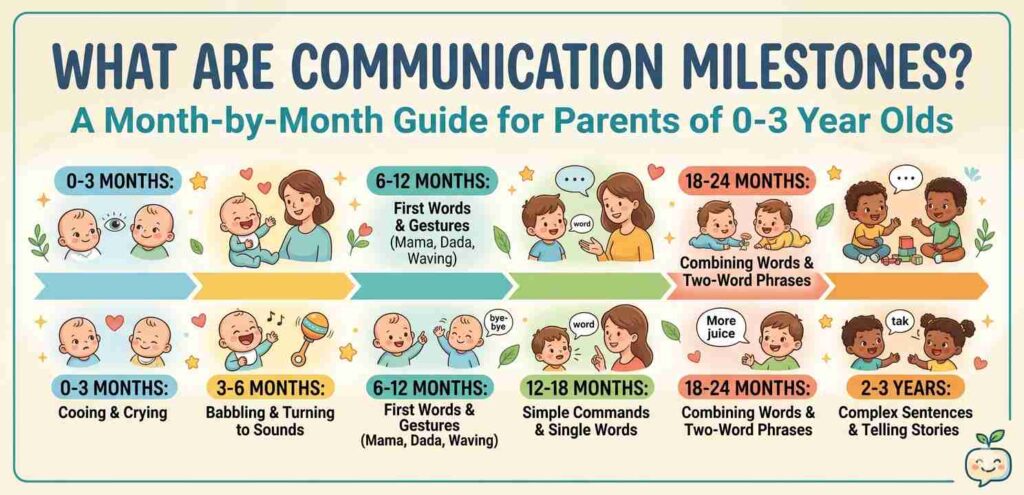
Birth to 3 Months: The First Communication Signals
Newborns communicate from day one — just not in ways most people recognize as “communication.”
What to look for:
- Crying to express hunger, discomfort, or overstimulation (each cry can sound slightly different over time)
- Turning toward familiar voices, especially the parent’s
- Brief eye contact and focusing on faces within 8–12 inches
- Startling in response to sudden sounds
- Small sounds like grunts and sighs
By around 2 months, many babies begin to coo — a soft, vowel-like sound that’s genuinely social. If you coo back, a baby often pauses and then coos again. That back-and-forth is one of the earliest communication milestones, and it matters.
4 to 6 Months: Babbling Begins
This is when things get more interactive and, honestly, a lot more fun.
Key communication milestones at this stage:
- Babbling begins — repeating sounds like “ba,” “da,” “ga”
- Laughing and making sounds of pleasure or displeasure
- Responding to their own name (usually by 6 months)
- Looking toward the source of a sound
- Showing excitement by wriggling or vocalizing when they see something they like
The back-and-forth of sound exchange becomes more pronounced here. Babies start recognizing when someone is “talking to them” versus talking across the room. This social awareness is a critical piece of early communication milestones.
7 to 9 Months: Intentional Communication Emerges
By this point, communication starts to feel more deliberate. Babies are no longer just reacting — they’re trying to tell you things.
What you might notice:
- Imitating sounds and some facial expressions
- Using gestures like reaching, pushing away, or waving
- Varying pitch and tone in babbling — it starts sounding more like real conversation
- Responding to simple words like “no” or their own name
- Looking between an object and a person — early signs of joint attention
Joint attention — where a child looks at something, then looks at you to share the experience — is one of the most important communication milestones at this stage. It’s a building block for language and social development.
10 to 12 Months: First Words on the Horizon
The approach to the first birthday is exciting for parents because this is when many babies say their first real word. But even if no clear words appear yet, a lot is happening.
Communication milestones around 10–12 months:
- Pointing to objects or pictures (a huge milestone)
- Waving bye-bye, shaking head for “no,” clapping
- Using consistent sounds or gestures to mean specific things (“uh uh” for wanting something, reaching with intent)
- Understanding simple instructions like “give me” or “come here”
- First words may appear — common ones include “mama,” “dada,” “no,” “bye”
If your baby isn’t yet pointing by 12 months, that’s something worth mentioning to your pediatrician. Pointing is considered one of the clearest early communication milestones to track.
You might also find it helpful to read more about early language development and what supports it from the National Institute on Deafness and Other Communication Disorders, which has straightforward resources for parents.
12 to 18 Months: Word Explosion Begins (for Some)
Here’s where parents often start to feel a bit anxious. Some toddlers seem to have a new word every day; others are still mostly babbling. Both scenarios can be typical, but this is also the window where delays start to become more visible.
Communication milestones at 12–18 months:
- Most children have at least 1–3 words by 12 months and up to 10–20 words by 18 months
- Points to show interest (not just to request)
- Follows simple two-step directions with gestures (“get your shoe and bring it here”)
- Uses words consistently for specific meanings
- May start combining gestures with words
By 18 months, a child who has fewer than 10–15 words or who isn’t pointing and using gestures regularly is worth checking in with a speech-language pathologist. These aren’t panic signals — they’re just good reasons to get a professional opinion early, while communication milestones are still developing rapidly.
18 to 24 Months: Two-Word Combinations Arrive
This stage is often described as a “language explosion.” The brain is making connections fast.
What to expect:
- Two-word phrases like “more milk,” “daddy go,” “big dog”
- Vocabulary grows to anywhere from 50 to 200+ words by age 2
- Asks simple questions like “that?” or “what’s that?”
- Strangers can understand about 50% of what the child says
- Names familiar people, body parts, common objects
Two-word combinations are a significant marker in communication milestones. If a child reaches age 2 without combining any words, a speech evaluation is generally recommended.
For a well-researched overview of typical development ranges, the American Speech-Language-Hearing Association publishes helpful developmental milestone charts that are easy to read.
24 to 36 Months: Sentences and Conversations
By the third year, the jump in communication is remarkable. Children go from two-word phrases to full sentences, questions, and real back-and-forth conversations.
Communication milestones from 2 to 3 years:
- Sentences of 3–4 words become common (“I want that cookie,” “Where did kitty go?”)
- Vocabulary grows dramatically — many children know 200–1000 words by age 3
- Strangers can understand about 75% of speech by age 3
- Uses words like “me,” “you,” and simple pronouns
- Can follow two- and three-step instructions without gestures
- Asks “why,” “what,” and “where” questions
- Talks about things not happening in the immediate moment
This is also the age where play becomes more language-rich. Pretend play — feeding a doll, talking for toy animals — is a strong sign that language comprehension and imagination are growing together.
Red Flags Worth Discussing With Your Doctor
Knowing communication milestones helps you recognize both typical progress and patterns worth investigating. Here’s a quick reference:
- By 12 months: No babbling, no gestures like pointing or waving, no response to name
- By 16 months: No single words
- By 24 months: No two-word phrases (not counting imitation)
- Any age: Loss of previously acquired language or social skills
These red flags don’t mean something is definitely wrong. They mean it’s worth getting a professional evaluation. Early speech therapy, when needed, can make a significant difference.
You can also explore more about early intervention services through the CDC’s “Learn the Signs. Act Early.” program, which is designed specifically for parents navigating these questions.
Simple Ways to Support Communication Milestones at Home
You don’t need special training or expensive toys to help your child’s language grow. In fact, everyday routines are some of the most powerful tools.
What genuinely helps:
- Talk during everything. Bath time, grocery shopping, cooking — narrate what’s happening. “Now I’m rinsing your hair. Here comes the water!”
- Read together daily. Even board books with minimal text build vocabulary, attention, and the understanding that words have meaning.
- Respond to babbles. When your baby makes a sound, respond like it’s a real conversation. This teaches turn-taking.
- Limit background noise. Constant TV makes it harder for babies to focus on voices.
- Follow their lead. If they’re pointing at the bird, talk about the bird — not what you want to show them.
- Ask questions, then wait. Give children time to respond, even if it takes longer than feels comfortable.
None of these require a lot of effort or money. They just require attention and consistency.
Final Conclusion
Communication milestones aren’t a rigid checklist — they’re a roadmap that helps parents understand the general path of language development from birth through age three. The first sounds a newborn makes, the first time a baby points at something with excitement, the first two-word phrase a toddler strings together — these are all meaningful moments in a larger unfolding process.
Understanding what to expect at each stage lets you celebrate progress and notice when something might need a closer look. If you’re ever uncertain, talking to your child’s pediatrician or a speech-language pathologist is always a reasonable step. Asking early is rarely a bad idea.
Your attention, responsiveness, and everyday conversations are the most important things you can offer your child’s developing language — no special program required.