
Every parent has been there — you schedule a carefully planned playdate with crafts, games, and snacks on a timer, while your kid ends up just chasing the neighbor’s dog around the yard. And somehow, that unplanned chaos seems more fun than anything you organized.
It raises a real question: when it comes to structured playdates vs unstructured free play, which one actually helps children develop stronger social skills? The answer is more layered than most parenting blogs will tell you.
What Are Structured Playdates, Really?
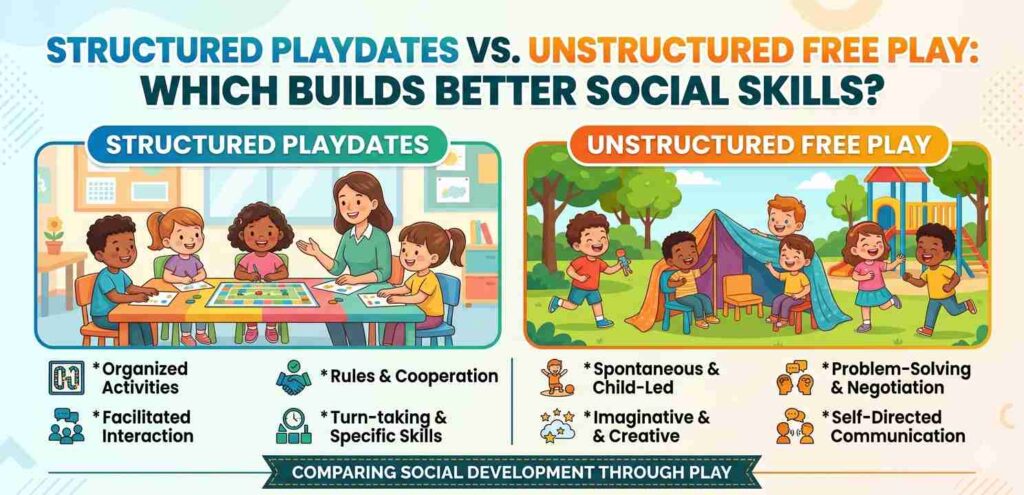
A structured playdate is one where an adult sets the agenda. Think board games with rules, a craft session with specific steps, a cooking activity, or a guided sport. There’s a beginning, a middle, and an end. Someone’s in charge — usually a grown-up — and kids follow a loose or tight set of instructions.
These kinds of setups can feel productive. Parents feel useful. Kids get a clear activity. But what’s actually happening socially underneath all that structure?
How Structured Playdates Teach Social Skills
In a structured setting, children practice turn-taking in a more obvious way. When there’s a board game, you literally wait for your turn. When there’s a craft, you share supplies. These are real social skills — patience, fairness, following shared rules.
Kids also learn how to communicate inside a framework. They ask for help, they negotiate (“Can I go first?”), they figure out how to handle small frustrations when a game doesn’t go their way.
For children who struggle socially — especially kids with anxiety or those who find open social situations overwhelming — structured playdates vs unstructured free play often tilts in favor of structure. Having a defined task removes the pressure of having to “just figure out” how to connect.
What Unstructured Free Play Actually Looks Like
Unstructured free play is the opposite. No agenda, no adult directing the action. Kids decide what to play, how to play it, and what the rules are. It might look like building forts, making up stories, running around, arguing, laughing, inventing games — all of it messy and completely unpredictable.
This is the kind of play most adults remember from their own childhoods. And there’s a reason it sticks.
Why Unstructured Free Play Matters So Much
During unstructured free play, children are doing something remarkable: they’re negotiating reality together. When there’s no adult setting the rules, kids have to create the rules. They have to convince each other, compromise, advocate for themselves, and manage conflict without a referee.
This is where deeper social learning happens. A child who successfully talks a friend into changing a game idea, or who figures out how to re-enter a play group after a small fight, is building social resilience that’s hard to teach in a structured setting.
Research in child development consistently shows that unstructured play strengthens creativity, self-regulation, and the ability to read social cues. These aren’t small things — they’re foundational to healthy relationships throughout life.
The Core Difference in Social Skill Development
So when we talk about structured playdates vs unstructured free play, what’s the real difference in what kids take away?
Structured play tends to build rule-based social skills — following shared guidelines, respecting turn order, handling mild competition, cooperating toward a defined goal. These skills are important, especially in classroom and organized team settings.
Unstructured play tends to build self-generated social skills — initiating connection, resolving conflict without adult help, reading emotions in real time, adapting to unpredictability. These are the skills that carry over into adult friendships and workplaces.
Neither is complete without the other.
Age Matters More Than People Realize
Here’s something that often gets skipped in this conversation: the right balance between structured playdates vs unstructured free play changes depending on how old the child is.
Toddlers and Preschoolers (Ages 2–5)
At this age, children are still learning what “playing together” even means. Parallel play — where two kids play near each other but not really with each other — is completely normal. Unstructured free play is ideal here because it lets them follow their natural developmental pace without pressure.
Too much structure at this stage can actually frustrate kids, because they don’t yet have the cognitive tools to follow complex rules consistently.
School-Age Kids (Ages 6–11)
This is where structured playdates start pulling more weight. Kids this age understand rules, enjoy competition, and can engage meaningfully with cooperative tasks. Structured activities like team games, science experiments, or building projects can spark real conversation and collaboration.
But they still need unstructured time. Without it, they miss out on practicing leadership, negotiation, and the social creativity that only emerges when no one’s telling them what to do.
Tweens and Teens (Ages 12+)
Older kids often resist structured activities — and honestly, that’s developmentally appropriate. Forcing structured playdates at this age can feel condescending. They need the space of unstructured free play (or unstructured hangouts) to figure out who they are in relation to their peers. Social identity is forming, and that needs room to breathe.
When Structured Play Is the Better Choice
There are moments when leaning into structure genuinely helps. If a child is new to a group and doesn’t know how to break in socially, a structured activity gives everyone a shared focus. The game or project becomes the bridge.
Children with social anxiety often do better with structured playdates at first. The defined activity reduces the open-ended social pressure that can feel paralyzing.
Also, structure helps when there’s a significant age gap or personality difference between kids. A game or shared task creates common ground that might not exist naturally.
When Unstructured Play Wins
When kids already have a comfortable relationship, stripping away the structure often deepens it. The most memorable friendships are usually built during unstructured free play — wandering around, making things up, getting bored and then creative.
Unstructured time also teaches kids how to handle boredom, which is genuinely underrated. Boredom is where creativity lives. It’s where kids start inventing things, which is a socially rich activity.
For further reading on why free play is developmentally critical, the American Academy of Pediatrics has published guidance on the importance of play in child development that’s worth reviewing. And for a research-based look at how play shapes the brain, the LEGO Foundation’s research on play offers accessible insights.
What Parents Can Do Practically
You don’t have to pick one approach and stick to it forever. Most child development experts suggest a loose rhythm: start with a brief structured activity (20–30 minutes), then let kids transition into open-ended play on their own.
This works because the structured part helps kids feel settled — they have something to do together right away, which removes the awkward “what do we play?” moment. Then, once they’re comfortable, you step back and let them figure out the rest themselves.
For more ideas on building healthy play habits, you might also want to explore how to support child social development at different ages or learn why play-based learning works better than you think.
Final Conclusion
The debate around structured playdates vs unstructured free play doesn’t have a clean winner — and that’s actually reassuring. Both approaches contribute something real to how children learn to connect with other people.
Structured play gives kids a framework for navigating shared rules and cooperation. Unstructured play gives them the freedom to discover who they are socially, on their own terms. The best thing parents and caregivers can do is offer both, in ways that match the child’s age, personality, and social comfort level.