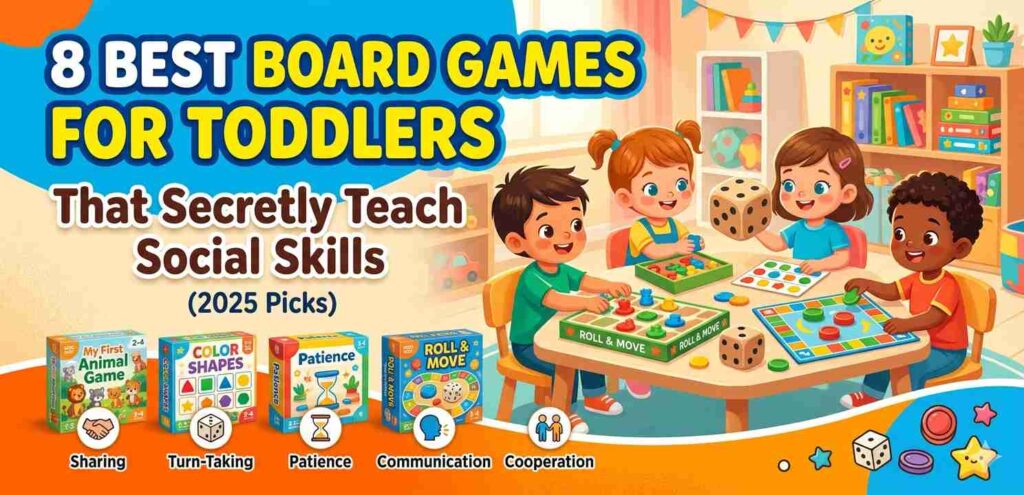

Finding the right board games for toddlers is not as simple as grabbing the most colorful box off the shelf. Most parents focus on the “fun” part — which makes sense — but the best games do something extra. They quietly build real skills: patience, taking turns, communicating frustration, and learning how to win (and lose) gracefully.
And toddlers won’t notice any of that happening. That’s the whole point.
This guide covers 8 games that actually work well for kids aged 2–5, based on real play sessions and what parents consistently report back. No fluff. Just honest picks.
Why Board Games for Toddlers Are More Valuable Than Screen Time
There’s nothing wrong with letting a toddler watch a show when you need a break. But board games for toddlers offer something screens genuinely can’t — real-time human interaction.
When a 3-year-old waits for their turn, they’re practicing impulse control. When they lose a round and have to keep playing anyway, that’s emotional regulation in action. When they cheer for a sibling? Empathy.
These aren’t skills you can download. They develop through repetition, and games give that repetition a structure kids actually enjoy.
What Makes a Good Toddler Board Game?
Before the list, here’s what separates a good pick from one that ends up in the closet after two plays:
- Simple rules — if a 3-year-old needs a 10-minute explanation, it won’t work
- Short play time — 10 to 20 minutes is ideal; toddlers lose focus fast
- Cooperative or low-stakes competition — winning shouldn’t feel devastating
- Sturdy pieces — small parts get lost, thin cards get destroyed
- Replay value — random elements help so it never feels exactly the same
Now, the actual list.
1. Candy Land (Hasbro)
Candy Land is probably the most recognized name in board games for toddlers, and for good reason. There’s no reading involved. No numbers. Kids just flip a card and move to the matching color.
But here’s what’s actually happening underneath: kids learn to wait, to follow a sequence, and to handle the disappointment of getting sent back by Plum Pudding or Lord Licorice. That last part? Genuinely useful.
Best for: Ages 3+ Social skill developed: Taking turns, coping with setbacks
2. Zingo! (ThinkFun)
Zingo is essentially Bingo, but faster and way louder. A sliding “Zinger” dispenses tiles, and kids race to match them to their boards.
It’s one of the better board games for toddlers for building language skills alongside social ones. Kids practice naming objects, calling out what they see, and dealing with the tension of almost winning.
It also works surprisingly well for groups — the competitive energy keeps everyone at the table.
Best for: Ages 3–6 Social skill developed: Communication, healthy competition
3. Hoot Owl Hoot! (Mindware)
This is a cooperative game, which makes it a bit different from most picks on this list. Players work together to get all the owls back to their nest before sunrise.
For toddlers who get really upset when they lose, cooperative board games for toddlers like this one are a great entry point. There’s no “winner” who gets to gloat. Everyone wins, or everyone loses together — which teaches teamwork in a low-pressure setting.
Best for: Ages 4+ Social skill developed: Teamwork, collective problem-solving
4. Hi Ho Cherry-O (Hasbro)
This one’s been around for decades and still holds up. Kids spin a spinner and add or remove cherries from their tree, racing to fill their bucket.
The social lessons here are subtle. When a kid spins “spill the bucket” and loses their cherries, that’s a moment. A real emotional moment. And navigating that — not throwing the board, not crying for 10 minutes — is practice that matters.
Hi Ho Cherry-O is one of those board games for toddlers that looks simple but teaches emotional resilience quietly.
Best for: Ages 3–5 Social skill developed: Emotional regulation, patience
5. My First Orchard (HABA)
HABA makes some genuinely excellent early childhood games, and My First Orchard might be their best. It’s fully cooperative — players work together to harvest fruit before the raven reaches the orchard.
The pieces are chunky wood, which survives toddler handling much better than cardboard. The rules take about 30 seconds to explain.
If you’re looking for board games for toddlers that genuinely hold a 2-year-old’s attention, this is one of the few that actually does it.
Best for: Ages 2–4 Social skill developed: Cooperation, shared goal-setting
6. Sneaky Snacky Squirrel Game (Educational Insights)
The Sneaky Snacky Squirrel Game is a crowd favorite for early childhood educators, and it earns that reputation. Kids spin a spinner, use a squirrel-shaped squeezer to pick up acorns, and fill their log.
The fine motor element is part of the appeal — squeezing that squeezer takes real concentration for small hands.
Among board games for toddlers, this one is unusually good at keeping kids fully engaged rather than just waiting for their turn. Every turn requires actual effort.
Best for: Ages 3–5 Social skill developed: Patience, focus, gentle competitiveness
7. Count Your Chickens (Orchard Toys)
This cooperative game asks players to work together to get all the chicks back to the barn before the game ends. The math and counting elements are light enough that they feel like play rather than learning.
What parents notice after a few sessions with games like this: toddlers start to internalize the idea that helping someone else is part of winning. That shift in perspective — from “I win” to “we win” — is genuinely hard to teach through instruction alone.
Best for: Ages 3–5 Social skill developed: Empathy, turn-taking, early numeracy thinking
8. Pete the Cat: The Groovy Button Game (Briarpatch)
Based on the popular book series, this game has recognizable characters that toddlers already love. Players collect buttons to fill Pete’s shirt, with some cards sending the game in unexpected directions.
The familiarity factor genuinely helps. Toddlers are more willing to sit through the rules (and through losing) when they already have a connection to the characters.
For board games for toddlers who are fans of Pete the Cat books, this is an easy choice.
Best for: Ages 3–6 Social skill developed: Following rules, handling surprises, character connection
Tips for Playing Board Games With Toddlers Without It Falling Apart
Even the best board games for toddlers can turn into chaos if you’re not careful. A few things that actually help:
Set expectations before you start. Tell them: “We’re going to take turns. Sometimes you’ll win, sometimes I’ll win. That’s how games work.”
Don’t make it a big deal when they lose. Overreacting — even with too much sympathy — can make losing feel catastrophic. Keep your tone even.
Let them quit early sometimes. Not every session needs to finish. If they’re done at the 8-minute mark, that’s okay. Forcing it creates a negative association with games.
Play alongside them, not against them when you’re just starting out. Sit at their level. Be enthusiastic but not performative.
Board Games for Toddlers vs. Educational Apps — A Quick Note
A lot of apps claim to teach the same skills. Some are decent. But there’s a structural difference with physical board games for toddlers: the social friction is real.
When a toddler plays a tablet game, there’s no sibling getting the piece they wanted. No parent whose turn is taking too long. No shared excitement when someone wins. Those uncomfortable, joyful, messy moments are exactly where social learning happens.
Apps can supplement. Board games build the foundation.
You can explore more developmental play ideas through Zero to Three’s resource library and the American Academy of Pediatrics play guidelines for age-appropriate activity recommendations.
Final Conclusion
Board games for toddlers are one of those parenting tools that look simple on the outside and do a lot of quiet work underneath. The 8 games in this list aren’t just entertaining — they’re building patience, cooperation, communication, and emotional resilience in kids who have no idea that’s happening.
You don’t need to spend a lot. You don’t need the flashiest box. You just need games with clear rules, manageable frustration levels, and pieces sturdy enough to survive a 3-year-old’s enthusiasm.
Start with one. Play it a few times a week. Watch what happens over a month. The difference is often surprising.