
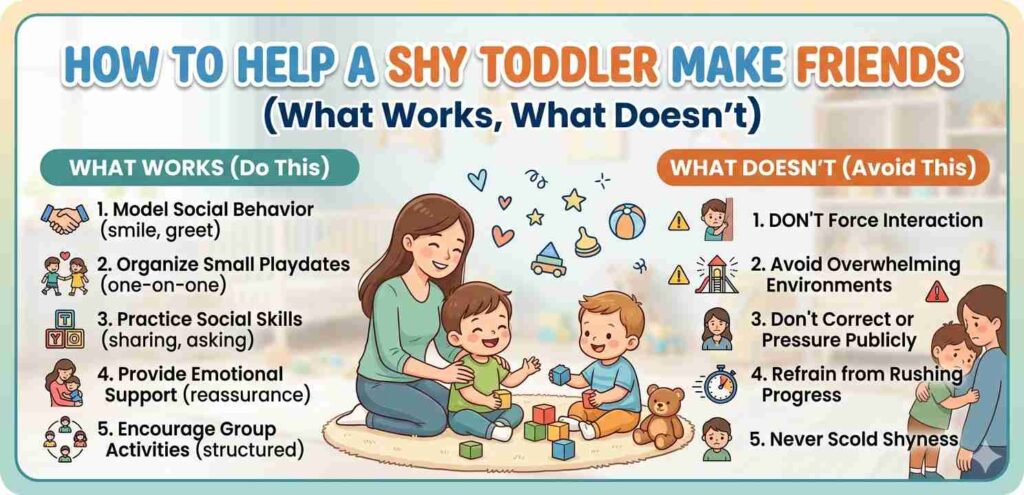

When you watch other kids run up to strangers at the playground without hesitation, and your little one is clinging to your leg, it’s natural to wonder — is this just a phase, or does my child need extra help? Helping a shy toddler make friends is one of the most common challenges parents face, and honestly, most of the advice out there is either too vague or completely wrong.
Understanding Why Some Toddlers Are Shy
Before anything else, it helps to understand shyness at this age. Toddlers between 18 months and 4 years are still building emotional vocabulary. They don’t always know how to say “I feel nervous” — so instead, they freeze, hide, or cry.
Some children are genuinely wired to be more cautious. Developmental psychologists call this “behavioural inhibition,” and it’s pretty common. It doesn’t mean your child is broken or that you’ve done something wrong.
Knowing this matters because the goal is not to make your shy toddler into an extrovert. The goal is to help them feel safe enough to connect.
What Actually Works When Helping a Shy Toddler Make Friends
Start With One-on-One Playdates, Not Group Settings
Big birthday parties and busy playgrounds can feel overwhelming for a shy toddler. The noise, the chaos, too many unfamiliar faces — it’s a lot.
Instead, try setting up a quiet one-on-one playdate with just one other child. Ideally someone who’s calm and a bit younger, because younger kids are often less dominant and easier to warm up to.
When you help a shy toddler make friends in a smaller, calmer setting, you’re reducing the sensory and social load significantly. This gives your child a fighting chance to actually engage instead of shut down.
Let Them Warm Up at Their Own Pace
One of the most damaging things parents do — without realising it — is push their child to interact before they’re ready.
“Go say hi.” “Don’t be shy, go play with them!” These phrases, as well-meaning as they are, tell your child that their feelings are inconvenient. It also puts them on the spot in front of others, which can cause embarrassment and make them more reluctant next time.
Give your child 15–20 minutes of observation time. Let them stand near you and watch the other kids play. Most shy toddlers will gradually inch closer and find an entry point themselves. This is natural social behaviour — not a problem that needs fixing.
Use Parallel Play as a Bridge
Parallel play is when two children play near each other without directly interacting. It might not look like “real” friendship to adults, but for toddlers, it’s actually an important first step.
If you’re trying to help your shy toddler make friends, encourage situations where your child and another child are doing similar activities side by side — like colouring at the same table or playing with sand in adjacent sections of the sandbox.
No pressure to share or talk. Just proximity. It builds comfort, and comfort eventually leads to connection.
Practice Social Scripts at Home
Toddlers often freeze not because they don’t want to interact, but because they don’t know what to say. Social language is a skill — and it can be practised.
Role-play simple situations at home. “What could you say if you want to join a game?” Practise the words: “Can I play too?” or “I like your truck.” Keep it short and low-stakes.
When you prepare a shy toddler to make friends with specific language they can use, you’re giving them a tool to work with instead of leaving them guessing in the moment.
Read Picture Books About Making Friends
This sounds simple, but it genuinely works. Books like The Invisible String, Enemy Pie, or even basic “first friends” board books show toddlers relatable scenarios about meeting new people.
When your child sees a character navigate something similar — feeling nervous, then making a friend anyway — it normalises the experience. You can pause and ask, “How do you think she felt? What could she say?”
It’s low-pressure, conversational, and it plants seeds for real-life situations. Many parents notice that after reading a relevant book, their shy toddler starts referencing it in real social moments.
What Doesn’t Work (And Why)
Labelling Your Child as “Shy” in Front of Them
This one’s important. When you tell other adults “Oh, she’s shy” while your child is standing right there, your child hears it as a permanent identity, not a temporary feeling.
Children at this age are incredibly impressionable. They absorb labels. A toddler who hears “she’s shy” repeatedly starts to believe that’s just who they are — and acts accordingly.
Instead, try something like “She takes a little time to warm up.” It describes the behaviour without defining the child.
Forcing Hugs or Physical Contact With Strangers
Grandparents, family friends, even other kids — toddlers are often pressured into physical affection before they’re comfortable. This actually undermines the very thing you’re trying to build: trust in social situations.
When a child feels forced to hug someone they’re not comfortable with, it teaches them that their body boundaries don’t matter in social settings. That’s the opposite message you want to send.
Let your child lead. A wave is enough. A smile is enough. Physical warmth will come naturally once genuine trust is established.
Over-Facilitating Every Interaction
It’s tempting to hover and narrate everything — “Look, that boy has a ball! Do you want to ask him for a turn?” — but this can actually prevent your child from developing their own social instincts.
When you’re constantly managing the interaction, your child never learns to manage it themselves. Step back a bit. Let there be awkward silences. Let them figure out what to do. Natural social problem-solving happens in those gaps.
Scheduling Too Many Activities Too Soon
Some parents try to help a shy toddler make friends by signing them up for every class and group activity available. Swimming, music, story time, gym class — all at once.
This can backfire. Shy toddlers often need more recovery time between social events than other children. Too much, too fast, and they get overwhelmed and more withdrawn.
One consistent group activity per week is usually enough. Regularity matters more than variety — seeing the same faces again and again helps a shy child build familiarity, which is the foundation of friendship at this age.
Building Confidence Over Time
Celebrate Small Wins
Did your toddler make eye contact with another child today? That’s worth celebrating. Did they say “hi” without prompting? Huge. These micro-moments of social courage matter enormously.
Specific praise works better than generic encouragement. “I noticed you smiled at that girl — that was really brave of you” is far more powerful than “Good job being friendly!”
Keep Your Own Anxiety in Check
Children are emotional sponges. If you’re anxious about whether your child will make friends, they will feel it. Your calm confidence signals to them that the situation is safe.
This is hard, especially when you genuinely worry. But even taking a breath before a playdate and reminding yourself “this is a process, not a test” can shift the energy around the whole experience.
Stay Consistent With Routine Social Exposure
Helping a shy toddler make friends is rarely a one-time fix. It’s about building repeated positive experiences in low-pressure environments over weeks and months.
The child who once cried at drop-off might be the one leading the game six months later — but only if parents stayed patient and kept showing up without pressure. Consistency really is the most underrated strategy here.
When to Talk to a Professional
If your child is genuinely distressed — not just slow to warm up, but visibly anxious, refusing food, having meltdowns before any social event — it may be worth speaking with a paediatrician or a child psychologist.
There’s a difference between introversion and anxiety, and a professional can help you identify it. Early, gentle support at this age can make a significant difference. The American Academy of Pediatrics has useful guidance on social development milestones worth reviewing. You might also explore Zero to Three, a research-based organisation that covers social-emotional development in early childhood in real depth.
For more on building your toddler’s emotional foundation, see our article on building emotional resilience in young children and our guide on managing separation anxiety at daycare.
Final Conclusion
Helping a shy toddler make friends isn’t about pushing them to be someone they’re not. It’s about meeting them where they are — honouring their pace, reducing pressure, and building genuine confidence through repeated, positive, low-stakes experiences.
The strategies that work most reliably are the quieter ones: one-on-one time, parallel play, practised language, patient observation. The ones that backfire are usually the ones driven by parental anxiety — labels, forced interactions, and overscheduling.
Your child’s shyness is not a flaw to correct. It’s a trait to understand. With the right environment and the right support, even the most reserved toddler can learn to reach out, connect, and find their people — in their own time, in their own way.