
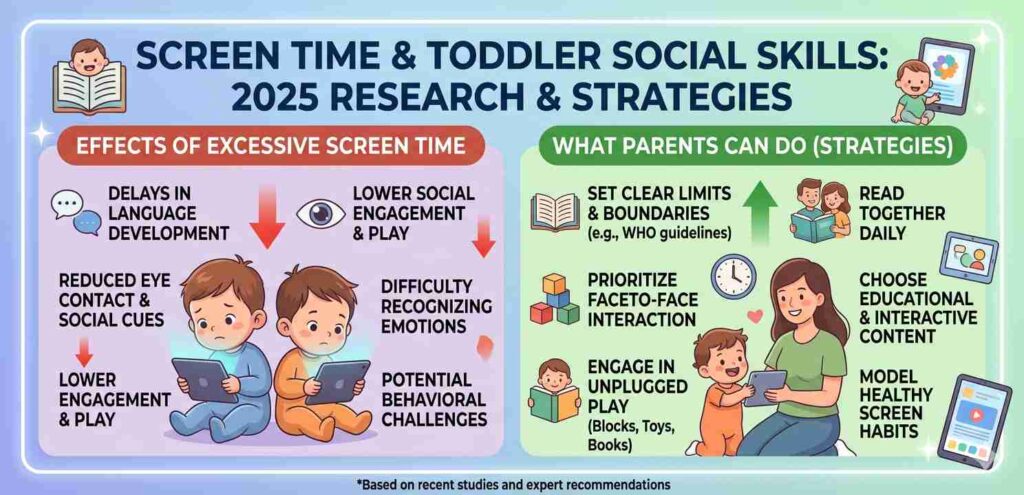

Every parent knows the feeling. You hand your toddler a tablet just to get five minutes of quiet, and it works — a little too well. They go completely silent, eyes locked on the screen. It feels harmless in the moment. But recent studies from 2025 are showing us that screen time affects social skills in toddlers in ways that aren’t always visible right away.
This isn’t about fear or guilt. It’s about understanding what’s actually happening in your child’s brain during those early years and making small but important changes.
What Happens in a Toddler’s Brain During Screen Use
Toddlers between ages one and three are in one of the most intense periods of brain development they’ll ever experience. Every conversation, every shared laugh, every back-and-forth exchange helps wire their social brain.
When a screen replaces those interactions — even partially — it doesn’t just pause development. It can redirect it.
Brain imaging research from 2024 and early 2025 has shown lower activity in the language and empathy regions of toddlers who have higher daily screen exposure. This is especially true for passive screen use, where kids watch videos without any adult engagement.
How Screen Time Affects Social Skills in Toddlers: The Core Problem
So what exactly gets disrupted? Let’s break it down practically.
1. Reduced Eye Contact and Emotional Reading
Social development relies heavily on reading faces. Toddlers learn empathy by watching their parents’ expressions respond to them. Screens don’t do that.
A study published in early 2025 found that toddlers with more than two hours of daily screen time showed noticeably less eye contact during play and fewer attempts to share emotional moments with caregivers. This matters because eye contact is foundational — it’s how children learn turn-taking, emotional cues, and trust.
2. Delayed Language and Conversational Skills
Screen time affects social skills in toddlers partly through language delays. When a child watches a video, there’s no real conversation happening. They hear words but don’t practice using them in a dynamic, responsive environment.
Real language development needs back-and-forth. It needs someone to respond when a toddler says “ball,” to ask “what color is the ball?” and wait for an answer.
Background television — even when kids aren’t directly watching — reduces the number of words parents speak to their children. That’s a hidden but significant factor.
3. Lower Frustration Tolerance in Group Settings
Kids who spend a lot of time on screens often struggle more in playgroups, daycare, or family settings. Screens respond instantly and perfectly — there’s no waiting, no negotiation, no confusion. Real social life is the opposite of that.
Toddlers who are used to instant digital feedback can find genuine social interactions overwhelming or boring. This can look like tantrums, withdrawal, or hitting — not because of a behavior problem, but because their nervous system hasn’t been trained to handle the unpredictability of other people.
What the 2025 Research Actually Says
Several new studies released in 2025 have refined what we know. The findings are more nuanced than older research — and actually more useful for parents.
A large-scale study tracking over 3,000 children from ages one to four found a clear link: screen time affects social skills in toddlers mainly when screen use is unstructured, solitary, and replaces active play or caregiver interaction.
Interestingly, the research also found that toddlers who used screens with a parent — watching together and talking about what they saw — showed fewer negative social outcomes. Co-viewing and conversation seemed to act as a buffer.
The type of content also mattered. Slow-paced, interactive programming (like certain educational shows designed with pauses for responses) had significantly less negative impact than fast-paced entertainment videos.
Signs That Screen Time May Be Affecting Your Toddler’s Social Development
Not every child is affected equally. But there are some signs worth noticing:
- Your toddler seems less interested in other children than they used to be
- They struggle to make eye contact during conversations
- Meltdowns increase dramatically when screens are taken away
- They seem bored or restless during screen-free play
- Language milestones are behind for their age
None of these alone confirms a problem. But together, they’re worth taking seriously and discussing with a pediatrician.
Practical Steps Parents Can Take Right Now
Understanding that screen time affects social skills in toddlers is only useful if it leads somewhere practical. Here’s what actually works.
Set Consistent, Calm Limits
The American Academy of Pediatrics recommends no screens for children under 18 months (except video calls) and limited, high-quality content for toddlers aged two to five. But limits only work when they’re consistent and calm — not used as threats or rewards.
Try building screen-free times into your day naturally: during meals, the first hour after waking up, and the hour before bed. Your child will adjust faster than you expect.
Replace Screens with Social Play, Not Just Any Activity
When you reduce screen time, don’t just hand them a toy and walk away. The goal is social connection. Get on the floor with them. Invite a neighbor’s child over. Read books together and talk about the characters’ feelings.
The research is clear that social interaction — especially with caregivers — is the most powerful tool for building the skills that screen time affects.
Use Screens Together, Not as a Babysitter
If screens are going to be part of your toddler’s life (and realistically, they will be), being present during that time changes everything. Ask questions. Pause the video and point things out. Laugh together.
This shared experience transforms passive viewing into something closer to conversation. It won’t eliminate the impact, but it makes a meaningful difference.
Prioritize Outdoor and Unstructured Play
Unstructured play — playing without rules, goals, or adult direction — is where social skills are actually practiced. When children play freely with others, they negotiate, share, get upset, make up, and try again.
That messy, imperfect process is irreplaceable. No app can replicate it.
A Note on Parental Guilt
It’s worth saying plainly: almost every parent uses screens to get a break sometimes. That’s normal, and one or two relaxed screen sessions a week isn’t going to derail your child’s development.
The concern is pattern, not occasional use. The way screen time affects social skills in toddlers is cumulative and contextual. If you’re engaged with your child most of the time, reading to them, playing with them, taking them outside — then some screen time is fine.
Guilt doesn’t help anyone. Awareness and gradual adjustment do.
When to Talk to a Professional
If you’ve made changes and still notice significant delays in speech, very little interest in other children, or your toddler seems to struggle with basic back-and-forth even with familiar family members — it’s a good idea to speak with your pediatrician or a speech-language pathologist.
Some of what looks like screen-related delay can overlap with other developmental considerations. Early support makes a real difference.
Final Conclusion
The relationship between screen time and toddler development is real, but it’s not a simple doom-and-gloom story. Yes, screen time affects social skills in toddlers — particularly when it’s excessive, solitary, and replaces active human interaction. But parents have more influence than they might think.
Being present during screen time, maintaining consistent limits, and filling daily life with real conversation and play does a lot to offset the risk. You don’t need to be perfect. You just need to stay engaged and stay curious about your child’s development.
Small, consistent changes made early have a compounding effect. The goal isn’t a screen-free childhood — it’s a childhood where connection comes first.