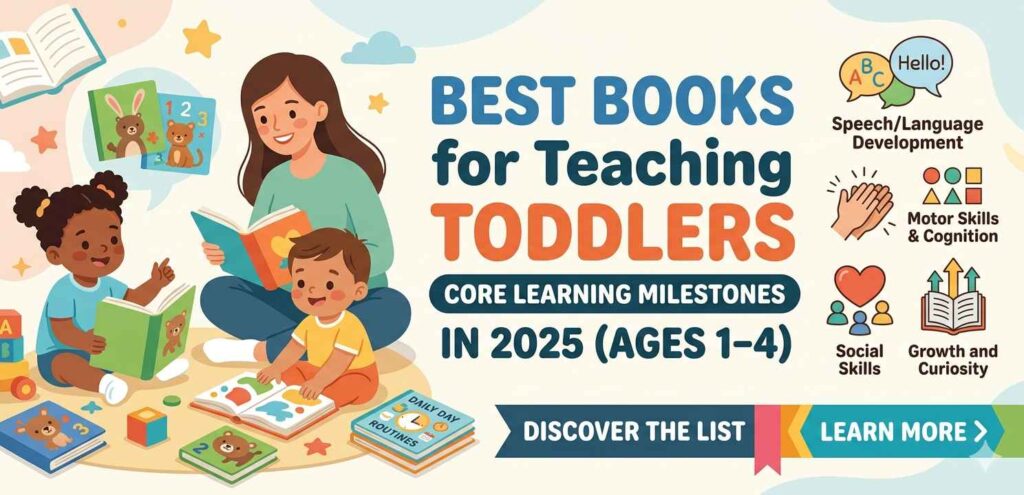

If you’ve ever sat with a one-year-old and watched their eyes light up at a colorful page, you already know something important — books work. The best books for teaching toddlers aren’t just fun to read aloud; they actually shape how little minds understand the world around them.
This guide is for parents, grandparents, and caregivers who want to make smart choices. Whether your child is just starting to babble or is almost ready for preschool, the right book at the right time can make a real difference.
Why Books Matter in the Toddler Years
Between ages one and four, a child’s brain develops faster than at any other point in their life. Language skills, emotional awareness, motor coordination, and basic reasoning all begin forming during this window.
Reading together isn’t just a bedtime ritual. It’s one of the most practical tools for building those early foundations. Studies from the American Academy of Pediatrics consistently show that children who are read to regularly during toddlerhood tend to develop stronger vocabulary and pre-literacy skills. Read more from the AAP here.
The best books for teaching toddlers are designed with these developmental stages in mind — not just pretty illustrations.
What Makes a Good Toddler Learning Book?
Not every colorful book is a good learning book. There are a few things worth looking for:
Simple, clear language — Toddlers absorb what they hear. Books with short sentences and repeated phrases help them predict and participate.
Relevant concepts — Numbers, colors, shapes, feelings, routines. These are the things toddlers actually encounter daily.
Interactive elements — Lift-the-flap, touch-and-feel, and question prompts keep little hands and minds engaged.
Diverse representation — Children respond better when they see familiar faces and situations. A book that reflects real life builds connection.
Best Books for Ages 1–2: Building First Words
At this age, toddlers are absorbing everything. Simple board books with one word per page are genuinely effective.
“First 100 Words” by Roger Priddy
This classic is one of the best books for teaching toddlers their first vocabulary. Bright photographs pair with everyday objects — food, animals, toys, clothing. There’s nothing fancy here, but that’s the point.
Kids at this age don’t need a storyline. They need clear images connected to clear words, repeated often.
“Global Babies” by the Global Fund for Children
This one is worth mentioning because it’s different. Photographs of real babies from around the world, each on a clean page. It teaches a toddler that people look different and that’s completely normal.
For a child’s very first books, this kind of exposure matters more than most parents realize.
Best Books for Ages 2–3: Numbers, Colors, and Shapes
Once a toddler starts stringing words together, they’re ready for slightly more complex ideas.
“Chicka Chicka 1 2 3” by Bill Martin Jr. and Michael Sampson
Numbers feel abstract to little kids. This book makes them feel like characters. The rhythm is fun, the illustrations pop, and kids genuinely want to read it again and again.
Repetition is how toddlers learn. A book they beg for every night is doing its job.
“Mouse Paint” by Ellen Stoll Walsh
Three white mice discover jars of red, yellow, and blue paint. What happens next is a gentle introduction to color mixing that’s surprisingly effective. It’s one of those best books for teaching toddlers about colors that doesn’t feel like a lesson at all.
“The Shape of Things” by Dayle Ann Dodds
Shapes are everywhere once you know how to look. This book connects geometric shapes to real-world objects — a square becomes a house, a circle becomes a sun. It’s a great bridge between abstract concepts and concrete reality.
Best Books for Ages 3–4: Emotions and Social Skills
Around age three, children become very aware of their own feelings — and very confused by them. Books that name emotions give kids a language for what they’re experiencing.
“The Feelings Book” by Todd Parr
Todd Parr’s style is immediately recognizable — bold outlines, bright colors, simple text. This book names a wide range of feelings without judgment. “Sometimes I feel like being brave. Sometimes I feel scared.”
For caregivers looking for the best books for teaching toddlers about emotional intelligence, this one is a consistent recommendation from early childhood educators.
“In My Heart: A Book of Feelings” by Jo Witek
This one goes a step further. It actually describes what different emotions feel like physically — how your chest feels tight when you’re angry, or light when you’re happy. That kind of body-awareness is genuinely useful for toddlers who don’t yet have words for big feelings.
The die-cut heart on each page is a small design touch kids love.
“My Many Colored Days” by Dr. Seuss
Originally written by Seuss but published posthumously, this book uses colors as metaphors for moods. It’s simple, visual, and surprisingly poetic. A good addition to any shelf focused on emotional literacy.
Best Books for Early Language and Storytelling (Ages 2–4)
Language development is arguably the most critical milestone in this age range. The best books for teaching toddlers language aren’t just vocabulary lists — they’re stories.
“Brown Bear, Brown Bear, What Do You See?” by Bill Martin Jr.
If there’s one book that belongs in every toddler’s collection, this might be it. The predictable pattern lets kids fill in the next line before you say it. That moment of anticipation — and then being right — builds confidence and comprehension together.
You can find more recommendations like this on our early literacy resources page and our toddler development reading list.
“Dragons Love Tacos” by Adam Rubin
Humor matters, even with two-year-olds. This book is genuinely funny, slightly absurd, and surprisingly re-readable. Vocabulary like “prefer,” “unfortunately,” and “catastrophe” gets introduced naturally through context.
That’s how language acquisition actually works — in context, not in isolation.
A Note on Screen Time vs. Book Time
There’s a lot of noise about tablets and learning apps for toddlers. Some of them are fine. But the best books for teaching toddlers offer something screens don’t — your voice, your presence, and the physical act of turning a page together.
The American Library Association recommends starting reading from birth, not because babies understand the words, but because the habit itself is what matters.
A ten-minute read-aloud before nap time, done consistently, is worth more than the most sophisticated app.
How to Use These Books Effectively
Owning the books is only half of it. How you read matters.
Read slowly. Pause at pictures. Ask “What’s that?” even when you know the answer.
Let them lead. If a toddler wants to read the same book fourteen times in a row, let them. Repetition is not boredom for toddlers — it’s learning.
Connect to real life. “Look, that’s a dog like the one we saw in the park.” Bridges between the book and the world are where real understanding happens.
Don’t perform. You don’t need silly voices or theatrical delivery. A calm, warm reading voice is enough.
Final Conclusion
Choosing the best books for teaching toddlers doesn’t need to be overwhelming. The books covered here — from first-word board books to emotion-focused stories — each serve a clear developmental purpose for children aged one through four.
What matters most isn’t having a perfect library. It’s reading together regularly, following your child’s curiosity, and letting the books do what they’re designed to do. Start with one or two titles that match your child’s current age and interests. Build from there.