

Every parent has been there — you’re at a playdate, and someone else’s two-year-old is already stringing together full sentences, while your child is still mostly pointing and grunting. That quiet little panic sets in. Is something wrong? Are they just a late talker? Or is this actually a speech delay?
These two terms — late talker vs speech delay — get used interchangeably a lot, but they actually mean different things. And knowing the difference can help you figure out whether to wait it out or take action sooner.
Understanding the Basics: What Is a Late Talker?
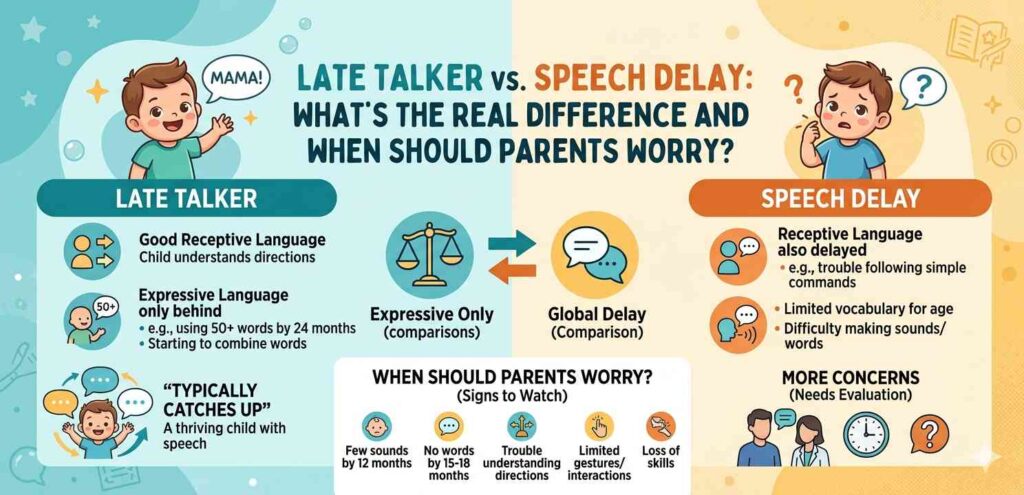
A late talker is a young child — usually between 18 and 30 months — who has fewer words than expected for their age but doesn’t have other developmental concerns. Their understanding of language is usually fine. They follow instructions, respond to their name, make eye contact, and engage socially.
They’re just slower to start talking. That’s the key point.
Late talkers often catch up on their own. Many parents report that their child said very little before age two, then seemed to “unlock” and suddenly started talking in short sentences. It can feel like a switch got flipped.
But not every late talker catches up without help. That’s where things get more complicated.
What Is a Speech Delay — And How Is It Different?
A speech delay is broader. It refers to a child who is noticeably behind in developing spoken language compared to typical milestones — and this may or may not come with other challenges.
In the late talker vs speech delay conversation, the main difference is this: a late talker generally only struggles with expressive language (producing words), while a child with a speech delay may also have difficulty with comprehension, social communication, or even motor skills related to speaking.
Speech delays can be linked to hearing loss, developmental disorders, neurological differences, or sometimes no clear cause at all. That’s why a proper evaluation matters so much.
Typical Language Milestones to Know
Before diving deeper into late talker vs speech delay, it helps to know what’s actually considered typical. Here’s a rough guide:
- 12 months: 1–2 words (like “mama” or “dada”), responds to their name
- 18 months: Around 10–20 words, points to familiar objects
- 24 months: 50+ words, beginning to put two words together (“more juice,” “daddy go”)
- 36 months: 200+ words, speaks in short sentences, strangers can understand them about 75% of the time
These are averages, not strict rules. But they give you a starting framework when thinking about late talker vs speech delay in your own child.
Signs That Your Child Might Be a Late Talker (And Not Something More)
If your child checks most of these boxes, they may simply be a late talker:
- They understand what you say (can follow two-step directions)
- They use gestures like pointing, waving, or reaching
- They make eye contact and seem socially connected
- They babble and attempt to communicate, just with fewer words
- They show curiosity and interest in people and play
Late talkers tend to be communicative kids who just haven’t started using many words yet. They’re engaged. They just haven’t found their verbal voice.
Red Flags That Go Beyond a Late Talker
When thinking about late talker vs speech delay, certain signs suggest you shouldn’t wait. These are worth taking seriously:
- No babbling by 12 months
- No single words by 16 months
- No two-word combinations by 24 months
- Loss of previously acquired language skills at any age
- Doesn’t respond to their name consistently
- Avoids eye contact or struggles with back-and-forth interaction
- Seems to understand very little of what you say
Any regression in language — where a child was saying words and then stopped — is particularly important to flag. That’s not a late talker pattern. That needs professional attention right away.
When Should Parents Actually Worry?
This is probably the question you came here for. The honest answer: trust your gut, but also know the markers.
For late talker vs speech delay, the general guidance from speech-language pathologists is this — if your child is under two and has fewer words than expected but is otherwise developing well socially and cognitively, watchful waiting (with regular check-ins) may be appropriate. But don’t let “wait and see” become an indefinite delay.
If your child is 2.5 years old and still not combining words at all, or if they’re 3 and strangers can’t understand much of what they say, that’s the time to get a speech-language evaluation. The earlier a delay is identified, the better the outcomes with therapy.
You don’t need a pediatrician’s referral in many places — you can contact a speech-language pathologist directly or reach out to your local early intervention program (in the US, services for children under 3 are often free through the Individuals with Disabilities Education Act).
Can a Late Talker Become a Strong Communicator Later?
Yes, and many do. Plenty of children who were late talkers go on to develop perfectly typical language skills by kindergarten. Some even become extremely verbal kids.
But “late talker” is not a guaranteed path to no problems. Research shows that around 20–30% of late talkers continue to show language difficulties as they get older. Those kids benefit enormously from early support.
So in the late talker vs speech delay debate, the message isn’t “don’t worry.” It’s “stay informed and act early if things aren’t progressing.”
What to Do If You’re Concerned
Here’s a practical, realistic approach for worried parents:
1. Track what your child can do. Write down every word, gesture, and communication attempt you notice over a few weeks. This is genuinely helpful for any evaluation.
2. Talk to your pediatrician. Bring your notes. Ask specifically about a speech-language referral, not just general reassurance.
3. Get a formal evaluation. A certified speech-language pathologist can assess both expressive and receptive language. This is the most reliable way to understand what’s actually going on.
4. Look into early intervention. If your child is under 3, early intervention services in your region may offer free assessments and therapy.
5. Keep engaging at home. Read aloud daily. Name everything. Narrate what you’re doing. Get down to their level. These aren’t cures, but they genuinely support language development.
For more detailed information on speech and language milestones, the American Speech-Language-Hearing Association (ASHA) has excellent, well-organized resources for parents. The CDC’s developmental milestone checklist is also a reliable starting point.
The Emotional Side — What Parents Often Don’t Talk About
Worrying about your child’s development is exhausting. There’s a lot of comparison, guilt, and second-guessing that happens in these months. Did I talk to them enough? Did screens cause this? Should I have noticed sooner?
Most of the time, none of that is what caused it. Language development is complex, and there’s genuine variability in how children acquire it.
What matters most now is paying attention and taking thoughtful action if something feels off. Being proactive doesn’t mean you’re catastrophizing — it means you’re a good parent who’s paying attention.
You can also connect with other parents going through similar experiences through online communities or local support groups. Shared experience helps more than most people expect.
Final Conclusion
Late talker vs speech delay — these are two related but distinct situations, and understanding the difference genuinely matters. A late talker is typically a child who is slow to produce words but otherwise developing well. A speech delay may involve deeper language or communication challenges that benefit from professional support.
Watch the milestones, trust what you observe, and don’t let “wait and see” stretch indefinitely. Getting an evaluation early isn’t an overreaction — it’s the smartest thing you can do. Early support, when needed, makes a real difference in outcomes. And if your child does turn out to be simply a late talker who catches up on their own, you’ll have peace of mind knowing you checked.