

Talk to Your Child About Feelings Most parents genuinely want to connect with their kids emotionally. But when a child bursts into tears over a broken crayon or throws a tantrum in the grocery store, many parents freeze. They don’t know what to say, so they say the wrong thing — or nothing at all.
The truth is, nobody teaches us how to talk to our child about feelings. We just wing it, mostly using patterns we picked up from our own parents. And for a lot of us, those patterns weren’t exactly healthy.
This article gives you a clear, step-by-step way to start these conversations — even if it feels awkward at first. Because it will feel awkward. That’s normal.
What Happens When Children Can’t Express Their Feelings
Before we get into the framework, let’s understand why this matters so much.
Children who can’t name or talk about their emotions tend to act them out instead. A five-year-old who doesn’t know what “frustrated” means will just hit their sibling. A ten-year-old who can’t express sadness might withdraw or develop stomach aches before school.
When you consistently talk to your child about feelings, you’re essentially teaching them emotional vocabulary. You’re helping their brain build the connections it needs to pause before reacting. That’s a skill they’ll carry into adulthood.
Research from the American Psychological Association consistently shows that children who are emotionally coached by their parents perform better socially, academically, and even physically. They get sick less often. They have fewer behavioral problems. That’s not small stuff.
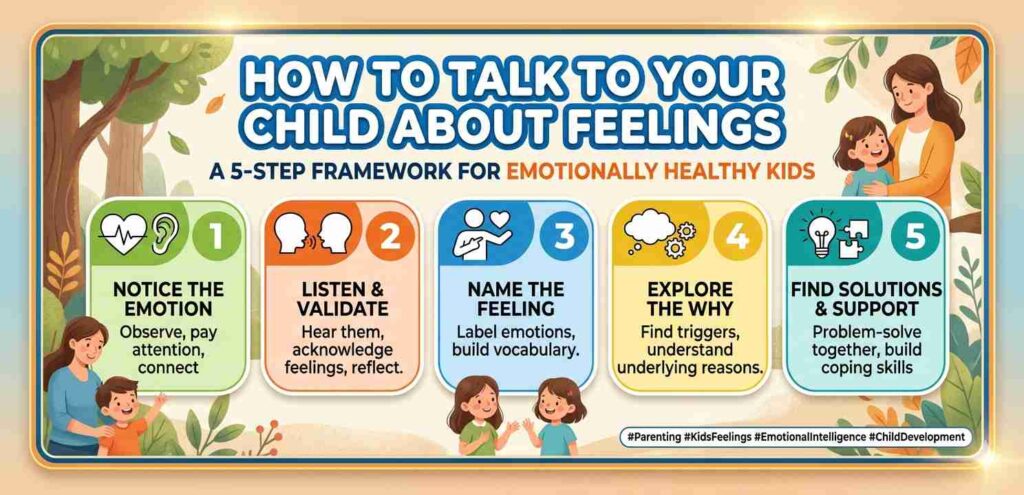
The 5-Step Framework to Talk to Your Child About Feelings
This framework works across different ages — toddlers, school-age kids, and even teenagers. You’ll need to adjust your language, obviously. But the steps stay the same.
Step 1: Notice the Feeling Out Loud
The first step is simple but often skipped. When you see your child feeling something — happy, angry, scared, disappointed — say it out loud.
Don’t wait for them to come to you. You say it first.
Example: “You look really frustrated right now. Is that what’s going on?”
You’re not putting words in their mouth. You’re giving them a starting point. Most kids don’t know what’s happening inside them until someone names it. When you talk to your child about feelings this way, you’re essentially holding up a mirror.
Do this even when the emotion is positive. “You seem really proud of yourself right now” is just as important as naming difficult feelings.
Step 2: Validate Before You Problem-Solve
This is probably the hardest step for most parents, especially those of us who grew up being told to “stop crying” or “toughen up.”
Validation does not mean agreement. It means acknowledgment.
When your child is upset, your first job is not to fix it. Your first job is to say: I see you. What you’re feeling is real.
Wrong approach: “It’s just a toy. Stop crying.” Right approach: “That was your favorite toy. I get why you’re so sad right now.”
When you genuinely talk to your child about feelings without immediately trying to solve the problem, they feel heard. And a child who feels heard is far more likely to calm down naturally.
Step 3: Ask Open-Ended Questions
Once they feel a little settled, gently ask questions that invite them to share more. Avoid yes/no questions — they shut conversations down.
Try questions like:
- “What does that feel like in your body?”
- “When did you first start feeling this way?”
- “Is there something you wish had happened differently?”
These questions do two things: they deepen your child’s self-awareness, and they teach them that you’re genuinely curious — not just trying to manage them.
The goal when you talk to your child about feelings is not to extract information. It’s to create a safe space where they want to keep talking.
Step 4: Teach the “Name It to Tame It” Habit
This phrase comes from child psychiatrist Dr. Dan Siegel, and it’s backed by actual neuroscience. When kids put words to their feelings, the emotional intensity actually decreases. Naming the emotion activates the prefrontal cortex — the rational part of the brain — which helps calm the more reactive limbic system.
You can make this a daily habit. At dinner, ask each family member to name one feeling they had that day. It doesn’t have to be deep. “I felt bored during math class” is a perfectly valid answer.
The more you talk to your child about feelings as a regular part of daily life — not just during crises — the easier it becomes for them to access those words when they need them most.
You can also use tools like emotion wheel charts to help younger children find the right words. The Gottman Institute has some excellent resources for this.
Step 5: Share Your Own Feelings (Appropriately)
This step surprises a lot of parents. But one of the most powerful things you can do is model emotional expression yourself.
Not in a “burden your child with adult problems” kind of way. That crosses a line. But appropriate sharing — saying “I felt nervous before my meeting today” or “I got a little sad when I heard that news” — teaches kids that emotions are normal and that even grown-ups have them.
When children see parents talk to their child about feelings through demonstration and lived example, the lesson lands differently. It becomes real. It becomes something they can picture themselves doing.
Be brief. Be age-appropriate. And then bring the focus back to them.
Common Mistakes Parents Make
Even well-meaning parents fall into patterns that shut emotional conversations down. Here are a few to watch for:
Dismissing feelings: “You’re fine. There’s nothing to be upset about.” This teaches kids their feelings are wrong or shameful.
Jumping to solutions: When your child says they’re scared, don’t immediately say “Here’s what you should do.” Sit with them first.
Comparing emotions: “Other kids don’t cry about this stuff.” This creates shame, not growth.
Only reacting during crises: If the only time you talk to your child about feelings is during a meltdown, they’ll start associating emotional expression with conflict.
Age-by-Age Tips for Emotional Conversations
Toddlers (Ages 2–4)
Use simple, concrete language. “You’re angry because you wanted the red cup.” Emotional vocabulary at this stage is very basic — happy, sad, mad, scared. Use picture books. Daniel Tiger’s Neighborhood does an excellent job of this in a way kids actually enjoy.
School-Age Kids (Ages 5–10)
This is the golden window. Kids this age are curious and open. Use real-life situations — something that happened at school, a scene in a movie — as conversation starters. Practice feelings check-ins at bedtime when they’re relaxed.
Tweens and Teens (Ages 11+)
Don’t force conversations. Teenagers often open up sideways — while you’re driving, cooking, or watching something together. Stay available without hovering. And resist the urge to lecture. When you consistently talk to your child about feelings without judgment over many years, teens are far more likely to come to you when things get really hard.
Building a Home Where Feelings Are Welcome
None of this is a one-time fix. Learning to talk to your child about feelings is an ongoing process — one that will have good days and bad days.
Some conversations will go beautifully. Others will end with your kid storming off to their room. That’s okay. What you’re building is a relationship and a habit, not a perfect script.
The families that do this well aren’t the ones with the most perfect communication. They’re the ones who keep trying, keep showing up, and keep creating small moments of emotional safety — even when it’s messy.
Also read: How to Set Healthy Boundaries With Your Kids Without Being Harsh and Building Self-Esteem in Children: What Really Works for more on raising emotionally grounded kids.
Final Conclusion
Helping your child navigate their inner emotional world is one of the most lasting gifts you can give them. When you make it a consistent practice to talk to your child about feelings — naming emotions, validating their experience, asking good questions, and modeling openness yourself — you’re not just helping them today. You’re shaping how they’ll handle relationships, stress, and life’s harder moments decades from now.
Start small. Start imperfectly. But start.
Even one genuine emotional conversation a week can shift the dynamic in your home. And over months and years, those small moments add up to something really significant.