

Every parent has that moment. You’re watching your toddler stack blocks, babble, or point at a dog across the street — and you wonder: Is this normal? Are they on track? Tracking toddler intellectual milestones is one of the most talked-about yet least understood parts of early parenthood.
The good news? Most toddlers are doing just fine. And there are real, observable signs that show you exactly where your child stands — no lab tests required. This article walks you through 10 of those signs in plain, honest language.
What Are Toddler Intellectual Milestones, Really?
Before we get into the signs, it helps to understand what we’re actually talking about.
Toddler intellectual milestones refer to the cognitive and thinking skills children typically develop between ages 1 and 3. These include memory, problem-solving, language comprehension, cause-and-effect reasoning, and imagination.
They’re not strict deadlines. Think of them more like a general range — a window where most kids show certain abilities. Some children hit them a bit early, others a little later, and both can be completely normal.
Why Tracking These Milestones Actually Matters
You don’t need to become obsessive about it. But having a basic sense of toddler intellectual milestones helps you catch potential delays early, communicate better with your pediatrician, and understand what kind of play and interaction genuinely supports your child’s brain development.
It’s also, honestly, reassuring. When you can see the signs clearly, you worry less.
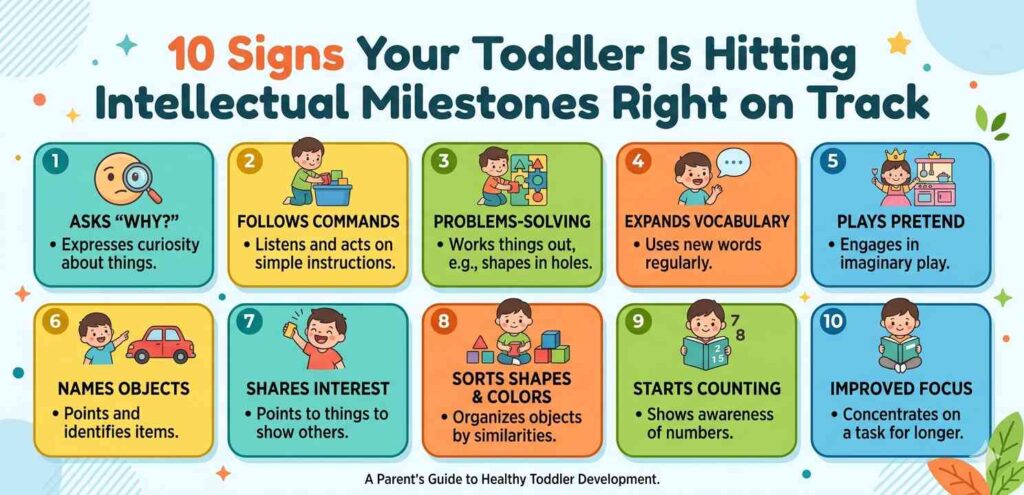
10 Signs Your Toddler Is Hitting Intellectual Milestones Right on Track
1. They Recognize Familiar Faces and Places
One of the earliest toddler intellectual milestones is the ability to recognize people and environments they know. If your 12–18 month old lights up when grandma walks in, or calms down when they see their own bedroom — that’s memory and recognition working as it should.
This isn’t just about love. It’s the brain forming and storing associations, which is foundational for learning.
2. They Point to Show You Things
Pointing might look like a small gesture. But when a toddler points at a bird, a truck, or something on TV to show you, not just to grab it — that’s a major cognitive leap.
This behavior, called declarative pointing, typically appears between 12 and 14 months. It signals that your child understands shared attention — the idea that two people can focus on the same thing together. That’s a genuinely sophisticated concept for a little brain.
3. They Understand Simple Instructions
“Bring me the ball.” “Come here.” “No, not that one.”
If your toddler can follow one-step instructions by around 12–15 months, and two-step instructions by 24 months (“Go get your shoes and put them by the door”), they’re showing solid progress in toddler intellectual milestones related to language comprehension.
Understanding language is actually more advanced than speaking it. Kids absorb meaning before they can produce words.
4. They Engage in Pretend Play
Pretend play is one of the most exciting toddler intellectual milestones to watch unfold. Around 18 months, children start pretending — feeding a stuffed animal, talking on a toy phone, “cooking” in a play kitchen.
This requires imagination, symbolic thinking, and memory. Your toddler is mentally representing something that isn’t literally there. That’s abstract reasoning in its earliest form.
By age 2 to 2.5, pretend play often becomes more elaborate — they’ll assign roles, create mini-stories, and act out scenarios from daily life.
5. They Show Curiosity and Exploration
Does your toddler empty every drawer they can reach? Open and close the same cabinet fifty times? Poke at a puddle with a stick?
This isn’t misbehavior — it’s science. Curiosity and hands-on exploration are core toddler intellectual milestones. Children learn cause and effect primarily through physical interaction with their environment. The toddler who keeps dropping food off a high chair tray isn’t being difficult — they’re running an experiment.
Encouraging this (within safe limits) actually supports brain development. Let them explore.
6. They Begin Solving Simple Problems
Watch your toddler when they want something just out of reach. Do they try to pull a chair over? Stack something to climb on? Ask for help by pointing or vocalizing?
Problem-solving behaviors, even basic ones, are a clear sign that toddler intellectual milestones involving reasoning are developing. Between 18 and 24 months, most children start showing intentional, multi-step thinking to reach a goal.
This is different from just reacting. It involves planning — which is a big deal cognitively.
7. Their Vocabulary Is Growing Steadily
Language development is closely tied to cognitive growth. Most toddlers say their first words around 12 months and have around 50 words by 18 months. By age 2, many children start combining two words (“more juice,” “daddy go,” “big dog”).
A steadily growing vocabulary is one of the clearest outward signs that toddler intellectual milestones are progressing well. The words don’t have to be perfect. “Ba” for ball, “nana” for banana — those count.
What matters is the pattern of growth, not perfection. If new words are appearing regularly, that’s a good sign.
For more on early language development timelines, the CDC’s Developmental Milestones resource is a genuinely useful reference.
8. They Remember Past Events
Memory development is central to toddler intellectual milestones. Around age 2, children start showing what’s called deferred imitation — they’ll repeat something they saw hours or even days ago.
You might notice your toddler mimicking something they saw on TV yesterday, or trying to replicate a game they played with a cousin last week. That’s long-term memory consolidating.
They might also remind you of things: pointing to the park as you drive past, or getting excited when they see the bag you always bring to the swimming pool. These are signs of solid memory formation.
9. They Sort, Match, and Categorize
Sorting toys by color, matching shapes, grouping similar objects together — these activities feel like play, but they represent significant cognitive work.
When toddlers begin organizing the world into categories, it’s a sign their brains are building mental frameworks. This typically becomes visible between 18 and 30 months and is one of the more measurable toddler intellectual milestones you can observe at home.
Simple sorting games and puzzles are great for supporting this. A shape sorter isn’t just a toy — it’s a thinking workout.
You can explore developmentally appropriate activities through resources like Zero to Three, which offers a lot of practical, research-backed guidance for parents.
10. They Show Awareness of Others’ Feelings
Empathy starts earlier than most people think. Between 18 and 24 months, many toddlers begin noticing when someone is sad or hurt and may try to comfort them — offering a toy, patting a crying sibling, or looking worried when a parent seems upset.
This early social-emotional awareness is deeply connected to cognitive development. Understanding that other people have inner states — feelings, thoughts, intentions — is a major toddler intellectual milestone that lays groundwork for later social skills and emotional intelligence.
It doesn’t look like adult empathy, of course. But seeing it emerge in small ways is meaningful.
What If Your Toddler Isn’t Showing Some of These Signs?
First — don’t panic. No two children develop at exactly the same pace.
That said, if your toddler is significantly behind on several toddler intellectual milestones — especially in areas like language, social awareness, or problem-solving — it’s worth a conversation with your pediatrician. Early intervention, when it’s needed, makes a real difference.
Some children have delays that are entirely treatable. Others just have their own timeline. The key is staying observant, not anxious.
Also worth noting: screen time, limited conversation, and low stimulation at home can slow cognitive development. The biggest driver of toddler intellectual milestones is interaction — talking, reading, playing together, exploring the world.
See our related guide on how to create a stimulating home environment for toddlers and our article on reading routines that support early brain development for practical tips.
How to Support Toddler Intellectual Milestones at Home
You don’t need expensive toys or special programs. Here’s what actually helps:
- Talk constantly. Narrate what you’re doing, name objects, ask simple questions even before they can answer back.
- Read together every day. Even just 10 minutes of shared reading builds vocabulary, attention span, and comprehension.
- Let them make choices. “Do you want the red cup or the blue one?” This builds decision-making and reinforces language.
- Allow unstructured play. Boredom and open-ended play are genuinely good for developing brains.
- Be responsive. When your child tries to communicate — verbally or non-verbally — respond. That back-and-forth is where a lot of cognitive growth happens.
None of this is complicated. It’s mostly just being present and engaged.
Final Conclusion
Watching a toddler develop is one of those things that’s both ordinary and remarkable at the same time. Every word they learn, every problem they figure out, every time they point at something to share it with you — that’s their brain doing exactly what it’s supposed to do.
The 10 signs covered here give you a practical lens for understanding toddler intellectual milestones without getting lost in clinical language or unnecessary worry. Trust your observations. Talk to your pediatrician when something concerns you. And most of all, enjoy the process — these early years go faster than anyone warns you.