
Every parent watches their child grow with a mix of wonder and quiet worry. You note the first smile, the first word, the moment they take that wobbly step forward. But what happens when those moments seem to take longer than expected? That is often when the term developmental delay enters the conversation — and it can feel heavy, confusing, even frightening. The truth is, understanding developmental delay early gives children — and families — the best possible chance.
Understanding What Developmental Delay Actually Means
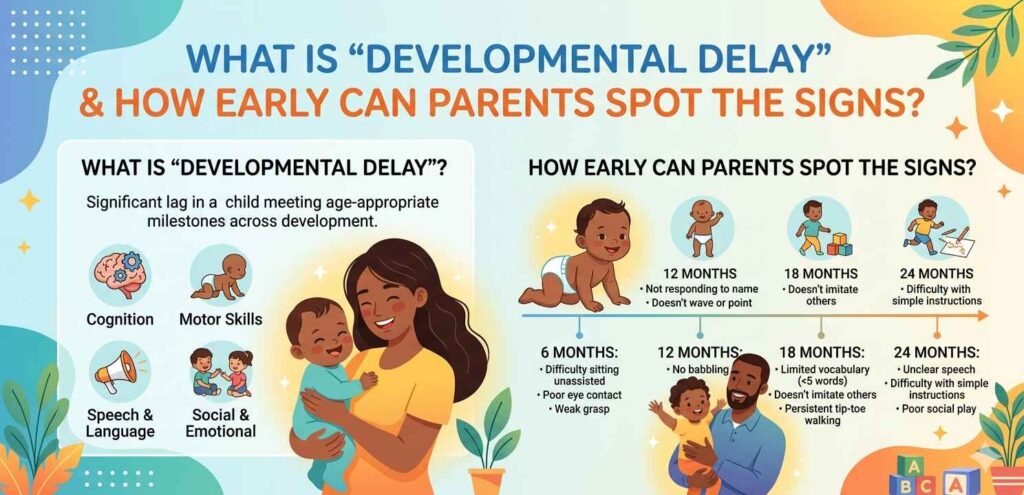
Developmental delay is not a single diagnosis. It is a broad term used when a child does not reach expected developmental milestones within the typical age range. These milestones cover how a child moves, speaks, thinks, and interacts with others.
Think of it this way: most children walk independently somewhere between 9 and 15 months. If a child is still not walking by 18 months, that gap — compared to typical development — is what professionals call a developmental delay.
It is important to say clearly: a delay is not the same as a disability. Some children catch up completely with early support. Others may need longer-term help. But identifying it early is almost always the deciding factor in how well a child progresses.
The Different Types of Developmental Delay
Motor Developmental Delay
This involves movement — both gross motor skills (like sitting, crawling, walking) and fine motor skills (like picking up small objects or holding a crayon). A child with motor developmental delay may seem physically weaker than peers or may struggle with coordination that others their age handle easily.
Speech and Language Delay
One of the most commonly noticed forms. This happens when a child is not using words, combining words, or understanding speech at the level expected for their age. A child who is two years old and has fewer than 50 words, or who does not put two words together, may be showing signs worth evaluating.
Cognitive Developmental Delay
This affects thinking, learning, and problem-solving. A toddler who struggles to understand simple cause-and-effect, match shapes, or remember familiar faces may be experiencing cognitive developmental delay. It does not mean a child is not intelligent — it means their brain may need a different kind of support to process the world.
Social and Emotional Developmental Delay
Children naturally begin reading faces, seeking eye contact, and responding to emotions from very early on. When a child consistently avoids interaction, does not respond to their name, or struggles to form basic attachments, this falls under social-emotional developmental delay and is worth paying close attention to.
Global Developmental Delay
When a child shows delay across two or more of these areas at the same time, it is sometimes referred to as global developmental delay. This is more complex and typically requires thorough evaluation by specialists.
How Early Can Parents Actually Spot the Signs?
Here is the surprising part — signs of developmental delay can appear as early as the first few months of life. You do not have to wait until your child starts school to notice something.
Signs in the First 6 Months
A newborn has limited abilities, but by 3–6 months, most babies are making eye contact, responding to voices, and starting to coo or babble. If a baby at four months does not smile in response to a caregiver’s face, or does not react to familiar sounds, those are early flags.
Babies this age should also be beginning to hold their head up during tummy time. If the neck and upper body seem unusually floppy or stiff, that is worth mentioning to a doctor.
Signs Between 6 and 12 Months
By around 9 months, babies typically babble, respond to their name, and begin pointing at objects or people. A child who shows little interest in faces, does not babble at all, or does not seem to understand “no” may be showing signs of developmental delay.
This is also the age when separation anxiety usually begins. Its total absence can occasionally be as telling as its extreme presence.
Signs in Toddlers (12–36 Months)
This is where developmental delay becomes more visible. By 12 months, most children say at least one meaningful word. By 18 months, they typically walk independently and say 10–20 words. By 24 months, they put two words together.
Watch also for play behavior. Toddlers at 18 months usually engage in simple pretend play — pretending to feed a doll, for example. If a child seems uninterested in imitation games, consistently plays alone without engaging others, or does not follow simple instructions like “come here,” those patterns matter.
What Causes Developmental Delay?
There is rarely one single cause. Developmental delay can result from genetics, premature birth, infections during pregnancy, exposure to certain substances, brain injury, or simply unknown factors. In many cases, no clear cause is ever found — and that is okay. The cause matters less than the response.
Some children show developmental delay without any family history or obvious risk factors. Others are born with conditions that make delay more likely, such as Down syndrome, cerebral palsy, or hearing loss.
What Parents Should Do If They Notice Something
Trust Your Instincts First
No one knows a child better than their caregiver. If something feels off, that feeling is worth taking seriously. You are not overreacting by asking questions.
Talk to a Pediatrician
The first step is always a conversation with your child’s doctor. Pediatricians are trained to screen for developmental delay at routine checkups — typically at 9, 18, 24, and 30 months. If you are concerned between checkups, call and ask for an evaluation.
Standardized tools like the M-CHAT (for autism-related delays) or the ASQ (Ages and Stages Questionnaire) are commonly used at these visits. They are not diagnoses; they are starting points.
Request an Early Intervention Evaluation
In many countries, including India, the US, and the UK, government-funded early intervention programs exist for children under three. In India, organizations under the Rehabilitation Council of India can help families access specialist services. In the US, the CDC’s “Learn the Signs. Act Early.” program provides free developmental milestone tracking and referral guidance.
These programs connect families with speech therapists, occupational therapists, physiotherapists, and special educators — often at no cost or reduced cost.
What Early Intervention Actually Looks Like
Early intervention for developmental delay is not about labeling a child. It is structured, goal-focused support delivered through play and daily routines. A speech therapist might work on sounds during snack time. A physiotherapist might turn floor play into strengthening exercises.
Children’s brains are at their most adaptable in the first three years — this is what researchers call neuroplasticity. The earlier support begins, the more effectively it can shape development. Waiting to “see if they grow out of it” sometimes costs families exactly the time that would have made the biggest difference.
How Schools and Communities Can Help
Once a child passes the early intervention age range (typically 3 years), developmental delay support shifts to preschool and school settings. Individualized education plans (IEPs) or similar frameworks exist in many school systems to ensure children receive appropriate learning support.
Teachers and early childhood educators play a real role here. A good preschool teacher who understands child development can notice patterns that parents — who see their child every day — might overlook simply because they are too close to it.
A Word on the Emotional Side
Getting a developmental delay evaluation is not a comfortable experience for most parents. There is grief involved, sometimes, in learning that your child’s path will look different from what you imagined. There is also relief — because finally having information means finally being able to help.
Many parents describe the early stages as lonely. Finding communities of families going through similar experiences, whether locally or online, can make an enormous difference. This is not a journey any family needs to take alone.
Final Conclusion
Developmental delay is not a verdict. It is a signal — one that, caught early, opens doors rather than closing them. From the first months of life, parents have the ability to observe, ask questions, and seek answers. The most powerful thing any caregiver can do is stay curious about their child’s development and not let discomfort with “what if” prevent them from asking for help.
Early support works. The research on that is clear and consistent. What varies is not whether a child can progress — but how much time they are given to do so with the right backing behind them.