

Every parent watches their child with a mix of wonder and quiet worry. Is she talking enough? Is he making friends? Why does she get so upset over small things? These questions often circle back to one core idea — the 4 domains of child development.
Understanding the 4 domains of child development isn’t just for teachers or pediatricians. As a parent, knowing these four areas gives you a kind of map. It helps you see where your child is thriving and where they might need a little more support.
This guide walks you through all four areas in a way that’s practical, honest, and grounded in what actually happens at home.
What Are the 4 Domains of Child Development?
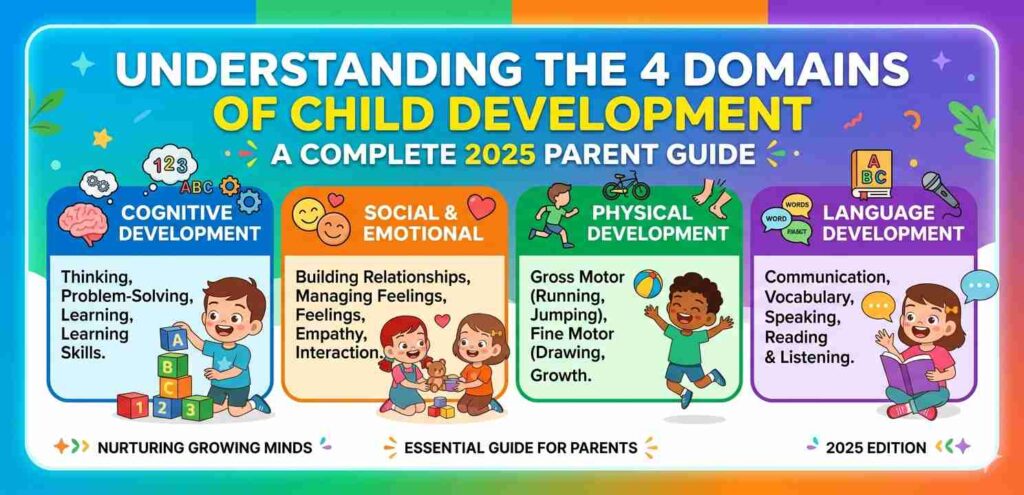
The 4 domains of child development refer to four broad areas in which children grow and change from infancy through adolescence. These are:
- Cognitive Development — how children think and learn
- Social Development — how they relate to others
- Emotional Development — how they understand and manage feelings
- Physical Development — how their bodies grow and move
Each domain is connected to the others. A child who struggles socially often finds it harder to focus cognitively. A child who isn’t sleeping well — a physical issue — can become emotionally reactive. Nothing happens in isolation.
Most child development experts, including those at the CDC’s Developmental Milestones program, organize growth this way because it helps caregivers and professionals track progress more clearly.
Domain 1: Cognitive Development
What It Means in Simple Terms
Cognitive development is about how children think, reason, remember, and solve problems. It’s not just about being “smart” in school. It includes things like a toddler figuring out how to stack blocks, a six-year-old understanding that pouring water from a tall thin glass into a wide short one doesn’t change the amount, or a nine-year-old planning ahead so she finishes homework before dinner.
Jean Piaget, a Swiss psychologist, spent decades studying how children’s thinking changes over time. His work is still widely referenced in schools and pediatric care today. He found that children don’t just know less than adults — they actually think differently. This is one reason you can’t just explain something once to a four-year-old and expect it to stick.
Signs of Healthy Cognitive Development
- Babies recognize familiar faces and voices
- Toddlers start matching shapes and colors
- Preschoolers ask “why” constantly (this can be exhausting, but it’s healthy)
- School-age children can follow multi-step instructions
- Preteens begin thinking more abstractly and hypothetically
What Parents Can Do
Read to your child regularly — even before they can talk. Ask open-ended questions like “What do you think will happen next?” instead of “Did you like the story?” Let children make small decisions so they practice reasoning. Puzzles, building toys, and storytelling are all excellent tools.
If you’re comparing milestones, you can also look at Zero to Three’s resource library for detailed, age-specific cognitive benchmarks.
Domain 2: Social Development
What It Means in Simple Terms
Social development covers how children learn to interact with others — friends, family, strangers, and teachers. It includes communication, sharing, cooperation, empathy, and understanding social rules like taking turns or reading someone’s mood.
Social skills are learned over time, not built in. Even toddlers who seem naturally outgoing still need guidance on how to navigate conflicts or be kind when they don’t feel like it.
One thing parents often miss is that social development starts at home. The way siblings interact, the way parents resolve disagreements, how a family handles stress — all of this shapes a child’s social instincts.
Stages Worth Knowing
- 0–2 years: Babies begin smiling at faces, making eye contact, copying expressions
- 2–4 years: Parallel play (playing near others, not really with them)
- 4–6 years: Cooperative play begins; friendships form but they’re fragile
- 6–10 years: Friendships deepen; peer approval becomes more important
- 10+ years: Peer groups strongly influence identity and values
What Parents Can Do
Don’t rush children to share before they’re developmentally ready. Toddlers genuinely aren’t wired for generosity yet — that comes with time. Arrange playdates in low-stress, familiar environments. Model conflict resolution: let your child see you apologize, compromise, and stay calm under pressure.
Social development is one of the most directly observable of the 4 domains of child development because so much of it plays out right in front of you.
Domain 3: Emotional Development
What It Means in Simple Terms
Emotional development is how children come to recognize, name, understand, and regulate their emotions. A three-year-old having a meltdown in a grocery store isn’t being manipulative — their brain literally cannot regulate big emotions yet. That’s not an excuse; it’s a fact of neuroscience.
This domain is one of the most underestimated of the 4 domains of child development. Many parents focus heavily on cognitive or physical growth, while emotional skills quietly build (or struggle) in the background.
Why Emotional Development Matters Long-Term
Research consistently shows that children with strong emotional regulation tend to do better academically, have more stable friendships, and experience less anxiety as adults. The ability to manage disappointment, tolerate frustration, and bounce back from setbacks — these are life skills, not soft extras.
What Parents Can Do
Name emotions out loud, even from infancy. “You seem frustrated. The toy keeps falling down.” This helps children develop an emotional vocabulary before they can express themselves clearly.
Avoid dismissing emotional reactions. Saying “stop crying, it’s not a big deal” teaches children their emotions are wrong — not how to manage them. Instead, try “I see you’re really upset. Let’s take a breath together.”
Set gentle limits while acknowledging feelings. You can say “I know you’re angry, and it’s still not okay to hit.” Both parts of that sentence matter.
Domain 4: Physical Development
What It Means in Simple Terms
Physical development includes two distinct areas:
- Gross motor skills: Large muscle movements — walking, running, jumping, climbing
- Fine motor skills: Small muscle control — drawing, buttoning a shirt, using scissors, writing
Physical development follows a rough sequence that’s pretty consistent across children, even if the timing varies. Babies hold their heads up before they sit, sit before they stand, and stand before they walk.
Physical Development and the Brain
Here’s something surprising: physical activity directly supports all the other 4 domains of child development. Exercise increases blood flow to the brain, which helps with focus and memory (cognitive). Physical play almost always involves other children, which builds social skills. And accomplishing physical challenges — climbing to the top of the jungle gym — builds confidence and emotional resilience.
This is why unstructured outdoor play, which has sharply declined over the last two decades, is still strongly recommended by pediatric organizations.
What Parents Can Do
Limit screen time, especially in the first three years. Give children plenty of floor time and open space to move. Let them take reasonable physical risks — falling off a low step is how children learn balance. For fine motor skills, clay, finger painting, tearing paper, and threading beads are all great activities that don’t require expensive kits.
Also, pay attention to sleep. Physical growth literally happens during deep sleep, and sleep deprivation affects all four developmental areas at once.
How the 4 Domains Work Together
This is really the heart of it. The 4 domains of child development aren’t separate silos — they constantly influence each other. A child who is behind in language (cognitive/social) may have more emotional meltdowns because he can’t express what he needs. A child who isn’t getting enough movement (physical) often has more trouble sitting and focusing (cognitive).
Good development isn’t about excelling in all four areas at once. It’s about keeping a rough balance, and noticing when one area is pulling significantly behind the others.
For example, if a child is bright academically but has no friends and gets overwhelmed by minor setbacks, it’s worth thinking carefully about social and emotional support — not just praising the test scores.
When to Speak to a Professional
Parents sometimes hesitate to bring up concerns because they don’t want to overreact or seem anxious. But pediatricians would much rather address a concern early than late.
Talk to your child’s doctor if:
- Language isn’t developing at the expected pace
- Social connection seems absent or very limited
- Emotional regulation difficulties are extreme and persistent
- Physical milestones are significantly delayed
Early intervention, when needed, makes a real difference. Many countries offer free developmental screenings through schools or public health programs.
If you want to compare your child’s progress against established benchmarks, resources like the CDC’s developmental milestones tracker offer practical, parent-friendly tools.
Final Conclusion
The 4 domains of child development — cognitive, social, emotional, and physical — give parents a framework to understand their children more clearly. Not as a checklist to worry over, but as a lens to see the whole child.
No two children develop at exactly the same pace, and that’s completely normal. What matters is the general direction of growth and the quality of the environment surrounding that growth. When children feel safe, connected, stimulated, and free to move, they tend to develop well across all four areas.
Keep asking questions, stay observant, and trust your instincts. And when something doesn’t feel right, reach out early — that’s always the right call.