
Every parent has been there — sitting at a birthday party, watching other kids interact, and quietly wondering, “Is my child doing okay socially?” It’s one of those thoughts that shows up uninvited, and honestly, it’s completely normal to have it.
Understanding social milestones for children helps you see your child’s development with more clarity and less worry. These milestones aren’t rigid rules. They’re general patterns that show how children typically learn to relate to others, manage emotions, and understand the world around them.
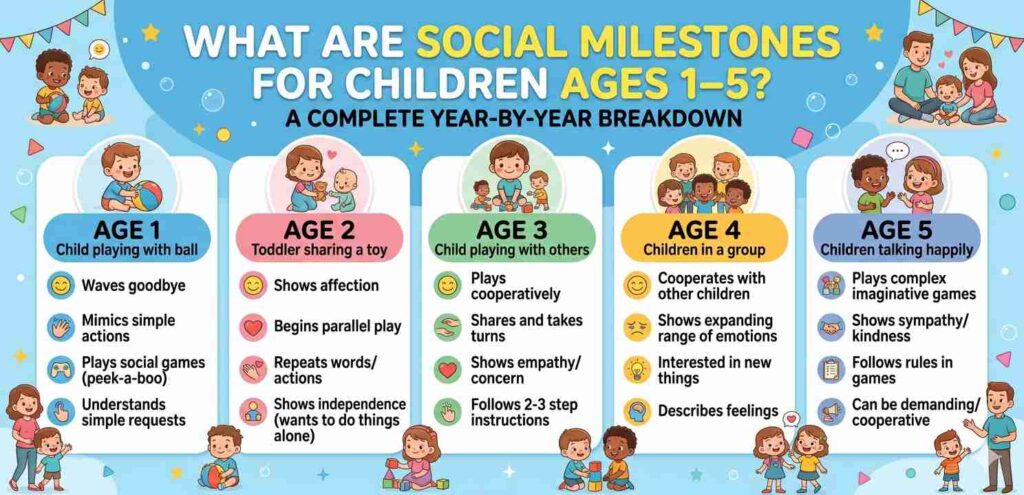
This guide walks through what to expect from ages 1 through 5, year by year.
Why Social Milestones for Children Actually Matter
Before diving into ages, it’s worth understanding why social development even gets its own category. Physical growth is easy to track — height, weight, teeth. But social growth is trickier. It happens in playgroups, during tantrums, in quiet moments with a caregiver.
The social milestones for children in the early years lay the groundwork for everything that comes later — friendships, classroom behavior, empathy, self-regulation. Missing certain milestones consistently isn’t always cause for alarm, but it can signal that a child needs extra support.
Early identification of delays — when handled well — can make a genuinely positive difference.
Age 1: The Beginning of Social Awareness
At around 12 months, babies start showing real social awareness. This is when things get interesting.
What Most 1-Year-Olds Do Socially
- They wave bye-bye (sometimes)
- They look for reactions from caregivers after doing something
- They show toys to others rather than just playing alone with them
- They start showing clear preferences for familiar people over strangers
One key social milestone for children at this age is something called “joint attention.” That’s when a baby follows your gaze or pointing finger to look at the same thing you’re looking at. It seems small, but it’s actually huge. It’s the beginning of shared experience — which is really what all social interaction is built on.
Separation anxiety also peaks around this time. A child who cries when a parent leaves isn’t being dramatic. They’ve formed a real attachment, and that attachment is healthy. It’s actually a sign things are going right.
Age 2: “Mine!” and the Start of Parallel Play
Two-year-olds are famously… a lot. The tantrums, the “no,” the possessiveness. But underneath the chaos, important social milestones for children are happening.
Social Skills at Age 2
At two, most children play next to other children rather than with them. This is called parallel play, and it’s completely age-appropriate. Two toddlers might sit side by side with their own toys, occasionally glancing at each other. That’s actually social learning happening in real time.
They’re also starting to imitate adults more deliberately. A two-year-old who picks up a toy phone and says “hello” is practicing what they’ve observed. This imitation is a core part of social development.
Empathy starts showing up in rudimentary ways too. A toddler might hand a crying friend a toy, or pat someone who seems sad. It’s clumsy and imperfect, but it’s real.
Language is closely tied to these social milestones for children at this stage. Children who have more words tend to handle social situations with slightly more ease — simply because they can communicate what they want.
Age 3: Playing With Others (Sort of)
By age three, something shifts. Children start to genuinely want to play with other kids, not just near them.
Key Social Milestones for Children at Age 3
- Taking turns (with reminders)
- Using words to express frustration instead of just hitting or screaming
- Engaging in simple pretend play with others
- Showing affection toward familiar playmates
- Understanding basic social rules like sharing and saying please
Three is also when friendships start to feel more meaningful to children. A child might mention a specific friend by name and get genuinely excited to see them. That’s new. That’s development happening right there.
Conflict is still frequent. Three-year-olds don’t fully understand compromise yet, and meltdowns over toy disputes are normal. But how adults respond to these conflicts teaches children a lot about how social problems get solved.
If your three-year-old still strongly prefers solo play or shows little interest in other children, it’s worth mentioning to your pediatrician — not to panic, but just to keep track.
Age 4: The Social Explosion
Four-year-olds are often described as “social butterflies” and honestly, that’s pretty accurate. This is one of the most dramatic periods for social milestones for children.
What Develops at Age 4
At four, children start to understand that other people have their own thoughts and feelings — different from their own. Psychologists call this “theory of mind,” and it’s a big deal. It’s what allows children to start feeling genuine empathy, not just reactive sympathy.
They also:
- Form small friend groups and “best friends”
- Start negotiating and bargaining during play
- Notice and talk about others’ emotions (“She’s sad because she fell”)
- Begin understanding simple rules in games
- Test social boundaries more deliberately
Exclusion can also appear at this age, which is painful for parents to witness. “You can’t play with us” is heartbreaking to hear, but it’s part of how four-year-olds figure out group dynamics. The goal isn’t to eliminate conflict — it’s to help children navigate it.
For deeper guidance on supporting emotional development alongside these social milestones for children, the CDC’s Developmental Milestones resource is genuinely useful and backed by research.
Age 5: Getting Ready for the Wider World
By five, most children are either in or about to enter school, and their social world expands dramatically. This is when all those earlier social milestones for children get tested in real, structured environments.
Social Development at Age 5
Five-year-olds generally:
- Cooperate in group activities with more consistency
- Understand basic concepts of fairness
- Can comfort a friend who is upset
- Prefer playing with peers over playing alone
- Show awareness of gender and social norms
- Begin developing a sense of humor and use it socially
A five-year-old might come home from school and talk about who said what, who was mean, who is their best friend now. This social processing is healthy, even when it’s exhausting to listen to after a long day.
One thing worth noting: five-year-olds are highly influenced by the adults around them. They’re watching how parents handle disagreements, how teachers respond to conflict, how emotions get expressed. They’re absorbing all of it.
The American Academy of Pediatrics has solid, straightforward resources on what to expect at this stage — worth bookmarking if you haven’t already.
How Parents Can Support Social Milestones for Children at Every Age
You don’t need elaborate programs or structured classes (though those can help). A lot of what supports social milestones for children happens in everyday life.
Simple Things That Actually Help
Narrate social situations. When your child sees someone crying, say, “She’s sad. I wonder what happened.” This builds emotional vocabulary naturally.
Play with your child. Genuinely play. Get on the floor. Let them lead. This models turn-taking, listening, and cooperation without ever saying those words.
Read books with social themes. Stories where characters navigate friendships, share, or deal with big feelings give children language for their own experiences. You might find our guide on building emotional literacy through books helpful here.
Don’t over-engineer playdates. Children learn from unstructured time with other kids. You don’t need to organize every minute.
Validate feelings, even frustrating ones. A child who learns that feelings are okay to have is better equipped to handle social interactions than one who learns to suppress them.
When to Talk to a Doctor About Social Milestones for Children
Most variation in development is normal. But some patterns are worth raising with a pediatrician:
- No eye contact or very limited eye contact past 12 months
- No interest in other children by age 3
- No pretend play by age 3
- Consistent inability to join or sustain play with peers by age 4–5
- Significant regression in social skills after a period of normal development
These aren’t automatic red flags. They’re just checkpoints. Early support — whether through speech therapy, play therapy, or developmental assessments — works best when it starts early.
For more on developmental tracking, our article on language milestones by age covers a closely related area of development worth reading alongside this one.
Final Conclusion
Social development between ages one and five is messy, nonlinear, and sometimes confusing to watch unfold. But understanding the social milestones for children at each age gives parents a useful map — not a rigid schedule, but a general sense of direction.
From a one-year-old waving shyly at a stranger to a five-year-old navigating the complex politics of a kindergarten classroom, every stage builds on the last. Trust the process, stay present, and ask for help when something feels off.