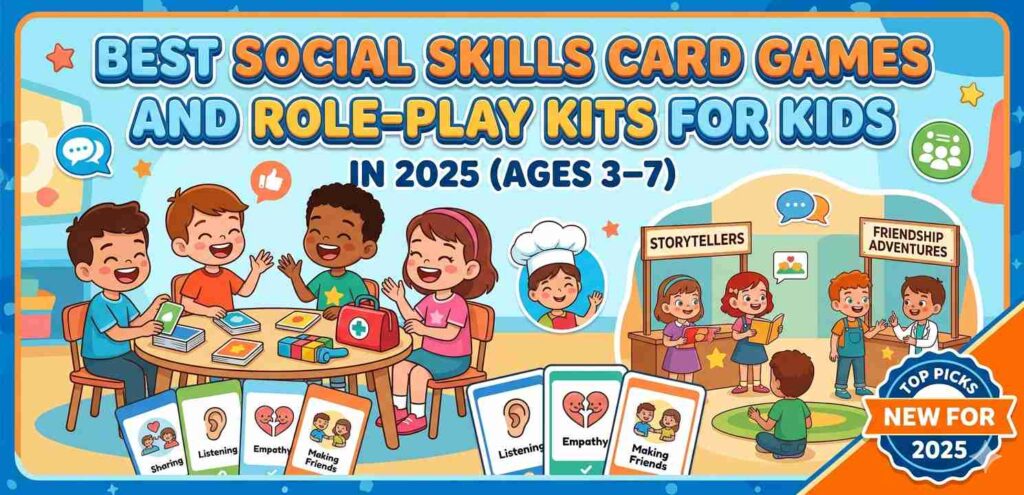

If you’ve been searching for ways to help your toddler or preschooler make friends more easily, handle frustration without meltdowns, or just say “please” and “thank you” without a reminder — you’re definitely not alone. Social skills card games and role-play kits for kids have become one of the most practical tools parents and educators are using in 2025. And honestly, it’s easy to see why.
Young children between ages 3 and 7 are at a stage where their brains are almost like sponges. They absorb everything — the good, the bad, and the awkward. Teaching emotional vocabulary, turn-taking, and empathy during this window makes a real difference later on.
Why Social Skills Need to Be Taught, Not Just Caught
Some parents assume their kids will naturally pick up social cues just by being around other children. That does happen — sometimes. But in classrooms, playgrounds, and even family gatherings, a lot of young kids struggle with things like waiting their turn, recognizing when someone feels sad, or saying sorry and meaning it.
Social skills card games and role-play kits for kids are specifically designed to fill that gap. Instead of abstract lectures from adults, children learn through stories, scenarios, and pretend play — which is actually how kids learn best at this age.
A good kit doesn’t need to feel like school. When it’s fun, kids don’t even realize they’re learning.
What Makes a Good Social Skills Kit for Young Children
Not every kit on the market is worth your money. Before buying, it helps to know what to actually look for.
Age-Appropriate Language and Illustrations
For ages 3–5, cards should use simple pictures and minimal text. A card showing a cartoon child crying with the question “How do you think she feels?” is far more effective than a paragraph explaining emotions.
For ages 6–7, slightly more complexity works well — short scenarios, multiple-choice answers, or story cards with decision points.
Encourages Real Conversation
The best social skills card games and role-play kits for kids don’t just prompt “correct” answers. They invite conversation. A good card might ask, “What would you do if your friend didn’t want to share?” — and then let the child answer in their own words.
That open-ended element is what builds actual communication skills, not just rote responses.
Easy for Parents and Teachers to Facilitate
Let’s be honest — most parents aren’t therapists. A good kit should come with a simple guide that explains how to use the cards or props without needing a background in child psychology. If it takes 30 minutes to read the instructions before every session, most families will stop using it within a week.
Top Social Skills Card Games and Role-Play Kits for Kids in 2025
Here’s a curated look at some of the most effective and well-reviewed options available this year. These are chosen based on age fit, educational value, ease of use, and real-world feedback from parents and educators.
1. The Feelings Detectives Card Set (Ages 3–6)
This one has been popular in preschool classrooms for a few years, and the 2025 updated edition includes new scenario cards focused on group situations — birthday parties, playgrounds, shared meals.
Each card features a simple illustrated scene and a prompt like “What should Maya do next?” Children respond by selecting emotion icons or acting out a solution.
What makes it stand out is how naturally it fits into a morning circle time or bedtime routine. It’s one of the more well-designed social skills card games and role-play kits for kids in the younger age range.
2. PlayPals Role-Play Starter Kit (Ages 4–7)
This kit includes a set of role-play cards, simple costume props (a scarf, a hat, a pair of glasses), and a “feelings wheel” poster. Kids draw a scenario card — like “You’re at the park and a new kid wants to join your game” — and act it out.
Parents or teachers can play characters too, which makes it more dynamic. The costume props seem like a small addition but they really do help kids get into character and take the activity seriously.
It’s particularly good for children who are shy or who tend to avoid group activities, because the “character” gives them a layer of safety.
3. Kind Words Card Game (Ages 5–7)
This card game is designed like a simple turn-based activity. Each player draws a card with a social situation and chooses how to respond — but the clever part is that other players vote on whether the response was “kind,” “unkind,” or “somewhere in the middle.”
The discussion that follows is really where the learning happens. Kids start to hear different perspectives, which is a foundation for empathy.
It’s one of the more structured social skills card games and role-play kits for kids, making it a great fit for early elementary classrooms or family game nights.
4. My Feelings, My Words (Ages 3–5)
This kit focuses specifically on emotional vocabulary. A lot of young children feel overwhelmed but can’t identify why — they just know something feels “bad.” This kit helps them name what they’re feeling: frustrated, nervous, left out, excited, embarrassed.
Cards pair illustrated faces with simple sentence starters like “I feel ___ when ___.” It’s gentle and non-pressuring, which works well for sensitive kids.
Therapists and school counselors have recommended this type of activity for years, and this particular product executes it well for very young children.
5. Brave Conversations Role-Play Deck (Ages 6–7)
This one steps up in complexity. Scenario cards present more nuanced situations — like “Your friend tells you a secret but you think it could hurt someone. What do you do?” — designed to introduce early moral reasoning alongside social skills.
It’s better suited for kids closer to 6 or 7 who are starting to navigate more complex friendships and classroom dynamics.
For this age group, the Brave Conversations deck is one of the strongest social skills card games and role-play kits for kids currently available.
How to Use These Kits at Home Without It Feeling Forced
One mistake a lot of parents make is turning these tools into a “lesson.” Pull out the cards at a random moment, sit the child down, and suddenly it feels like homework. Kids resist that quickly.
Instead, try weaving these activities into existing routines. Before dinner, draw one card and discuss it casually. During a quiet weekend afternoon, suggest a short role-play the same way you’d suggest playing with Legos.
The goal is consistency over intensity. A five-minute activity three or four times a week will do more than an hour-long session once a month.
Also, let your child be wrong sometimes. If they suggest a response that isn’t ideal, don’t jump to correct it immediately. Ask “What do you think might happen if you do that?” and let them reason through it. That’s the actual learning process.
Using These Kits in Preschool and Early Classroom Settings
Teachers working with ages 3–7 often find that social skills card games and role-play kits for kids work best when integrated into morning meetings or transition times. A single scenario card at the start of the day can set a positive tone and give kids language they’ll carry into interactions later.
Pairing role-play kits with classroom read-aloud books about emotions and friendship creates a reinforcing effect. Children see the concepts in stories, then act them out — and that repetition builds genuine understanding.
For children with developmental differences or language delays, visual-heavy kits with minimal text are especially valuable. They allow participation without putting pressure on verbal ability.
For more guidance on supporting social development in early childhood, the resources at Zero to Three are well-researched and freely available. Similarly, Understood.org offers excellent tools for children who are navigating social learning alongside other developmental needs.
What to Avoid When Choosing Social Skills Tools for Young Children
Not every product labeled “educational” delivers real value. A few things to watch for:
Cards that only reward “correct” behavior can teach compliance rather than genuine empathy. Children should feel like their feelings and perspectives are valid — even when they need to be redirected.
Overly complex scenarios for very young children tend to lead to confusion rather than engagement. A 3-year-old doesn’t need to roleplay a workplace conflict.
Also be cautious of kits that are purely digital or app-based. Screen-free interaction is especially important for this age group when building interpersonal skills. The physical act of handing someone a card, making eye contact, and responding in real time is part of what makes these activities work.
Pairing Card Games with Everyday Play
The best outcomes come when social skills tools are paired with natural play. After a session with a feelings card, encourage your child to notice emotions during regular activities — “How do you think that character felt when the blocks fell?” during a cartoon, or “Did you notice Maya looked sad at snack time?” after daycare pickup.
You’re essentially building a running vocabulary for emotions and social situations. Over time, your child starts applying that vocabulary independently — which is the whole point.
Final Conclusion
Helping young children develop genuine social skills is one of the most lasting gifts a parent or educator can give. Social skills card games and role-play kits for kids make that process tangible, fun, and accessible — even for families without any background in child development.
The options available in 2025 are genuinely good. Whether you start with a simple feelings card set for a 3-year-old or a more scenario-based deck for a 6-year-old, the key is showing up consistently and keeping it light. Kids learn best when they don’t feel like they’re being tested.