
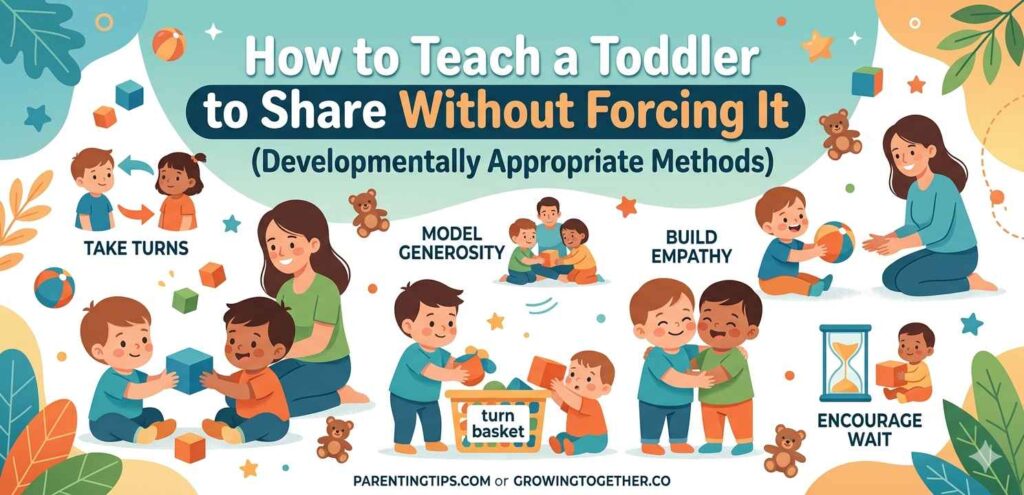

Parenting a toddler is full of surprises, and one of the trickiest challenges is figuring out how to teach a toddler to share without turning every playdate into a battle. If your two-year-old grips a toy like it’s their life savings, you’re not alone — and you’re definitely not failing as a parent.
The good news? Toddlers can learn to share. But the way we go about it matters more than most parents realize.
Why Toddlers Struggle to Share in the First Place
Before diving into methods, it helps to understand what’s actually happening developmentally. Toddlers between ages 1 and 3 are in a stage called parallel play — they play near other children, not really with them. Concepts like fairness, empathy, and taking turns are genuinely beyond what their brains can fully process yet.
When you try to force a toddler to hand over a toy, they don’t understand why. To them, “mine” isn’t selfishness — it’s identity. That toy represents security, autonomy, and their emerging sense of self.
So when parents try to teach a toddler to share by snatching or demanding, it often backfires. The child feels threatened, not educated.
Method 1: Use “Taking Turns” Instead of “Sharing”
Here’s a small language shift that makes a big difference. Instead of saying “share your truck with Jake,” try saying “Jake gets a turn, then you get a turn back.”
This works because toddlers can understand sequence. They can hold onto the idea that their toy will come back. When you teach a toddler to share through turn-taking language, you’re working with their brain, not against it.
Use a timer if needed. Even a two-minute sand timer gives the child a visual they can track. It removes you from the role of enforcer — the timer becomes the rule, not the parent.
Method 2: Never Force the Share in the Moment
This one goes against instinct for many parents, especially when another child starts crying. The impulse is to make the problem stop immediately by telling your toddler to hand the toy over.
But forcing a share in the heat of the moment teaches the wrong lesson. It teaches your child that their belongings can be taken, that adults don’t protect their autonomy, and that sharing means losing.
Instead, step back. Acknowledge both kids: “You’re using that right now. Mia really wants a turn. Let’s figure out together when you can give her a try.” This approach to teach a toddler to share respects both children’s needs without humiliating anyone.
Method 3: Designate “Special Toys” That Don’t Have to Be Shared
This sounds counterintuitive, but it actually increases willingness to share overall. Let your child choose one or two special items that are theirs alone — they go up on a shelf before playdates.
Everything else is fair game for sharing practice.
When a child feels that their most precious things are protected, they’re far more relaxed about sharing everything else. Child development specialists often recommend this approach as one of the gentler ways to teach a toddler to share without power struggles.
Method 4: Model Sharing in Your Own Daily Life
Toddlers are watching everything you do. They absorb behavior before they understand words.
So narrate when you share. “I’m going to share my crackers with Daddy. Now we both have some, and that feels nice.” Say it simply and casually — not dramatically. Over time, your child builds an association between sharing and the warm, easy feeling you describe.
The same goes for siblings, family meals, or even giving a neighbor some food from your garden. These real moments are how children actually learn, not just from being told. This is one of the most organic ways to teach a toddler to share — by living it yourself.
Method 5: Read Books Together About Sharing
Books give toddlers a safe distance from real emotions. When a character in a story struggles to share and then figures it out, your child processes that without the pressure of being in the moment themselves.
Some well-loved options include The Berenstain Bears’ Trouble with Friends and Mine! A Backpack Baby Story. After reading, ask open-ended questions: “How do you think that bear felt?” — not “would you share like that?”
This approach helps you teach a toddler to share through narrative, which is far more engaging than a lecture ever will be. Check your local library’s toddler section — librarians are great at recommending current titles on social-emotional learning. (Zero to Three has a helpful reading list for parents too.)
Method 6: Praise the Process, Not the Outcome
A lot of parents reward sharing with big applause — “Oh, you shared! What a good boy!” But this can backfire. The child shares for the praise, not because they’ve actually developed the value.
Instead, name what happened specifically: “You waited for your turn and then gave her the crayon. That was really kind.” This kind of feedback helps build internal motivation. The child begins to connect their own action to its effect on another person.
When you teach a toddler to share using descriptive praise, you’re helping them build genuine empathy — not just performance. (The American Academy of Pediatrics has good guidance on praise and social development in early childhood.)
Method 7: Set Up Play Environments That Make Sharing Easier
Environment matters more than we think. If you have two toddlers in a room with one toy, conflict is almost guaranteed. But set up two buckets of LEGOs side by side, and suddenly sharing happens naturally because there’s abundance.
When you’re setting up a playdate, think ahead. Bring out duplicates of popular items. Rotate toys partway through. Keep the space organized so children aren’t overwhelmed or competing for limited attention objects.
This kind of proactive planning is an underrated way to teach a toddler to share — you’re engineering the situation to make sharing the easy and natural choice.
What to Do When a Toddler Hits or Grabs During Sharing Conflicts
Some toddlers go beyond refusing to share — they hit, grab, or bite. This is still within the range of normal at this age, but it does need a clear, calm response.
Don’t shame. Get down to their level and say: “Hitting hurts. I won’t let you do that. You can say ‘I’m not done yet.'” Then redirect and coach the other child too.
Over time, as you consistently teach a toddler to share using words instead of actions, the physical responses tend to decrease. It’s a slow process — genuinely, it can take months — but it does happen.
How Age Affects Sharing Readiness
- 12–18 months: Not developmentally ready to share. Focus on parallel play and modeling only.
- 18–24 months: Can begin to grasp turn-taking with direct coaching and short time frames.
- 2–3 years: Able to practice sharing with consistent support, clear language, and patient repetition.
- 3–4 years: Starts to genuinely understand others have feelings. Real empathy begins to emerge.
If you’ve been trying hard to teach a toddler to share and it doesn’t seem to be sticking — check their age. Timing is half the battle.
Common Mistakes to Avoid
- Comparing siblings: “Your sister always shares!” creates resentment, not motivation.
- Shaming in public: “Don’t be selfish!” damages trust without teaching anything.
- Inconsistent rules: If sharing is required at home but not at grandma’s, toddlers get confused.
- Expecting perfection: Even adults struggle to share graciously sometimes. Give your child room to be imperfect.
Learning to teach a toddler to share is as much about managing your own expectations as it is about teaching the child.
A Note on Cultural and Family Context
It’s worth mentioning that “sharing” looks different in different families and cultures. In some households, communal ownership is the norm. In others, personal boundaries around belongings are prioritized.
There’s no single right answer. What matters is that the approach you use to teach a toddler to share is consistent, gentle, and aligned with the values you want your child to grow up with.
Final Conclusion
Teaching toddlers to share is genuinely one of the slower parenting journeys — and that’s okay. It doesn’t happen in a week, and it rarely happens because you forced it in a moment of frustration. It happens gradually, through modeling, patient language, smart environments, and a lot of grace.
Every time you choose connection over correction, you’re doing something important. The goal isn’t a perfectly sharing two-year-old. The goal is a child who, over time, learns that sharing feels good — and does it because they want to, not because they were made to.