
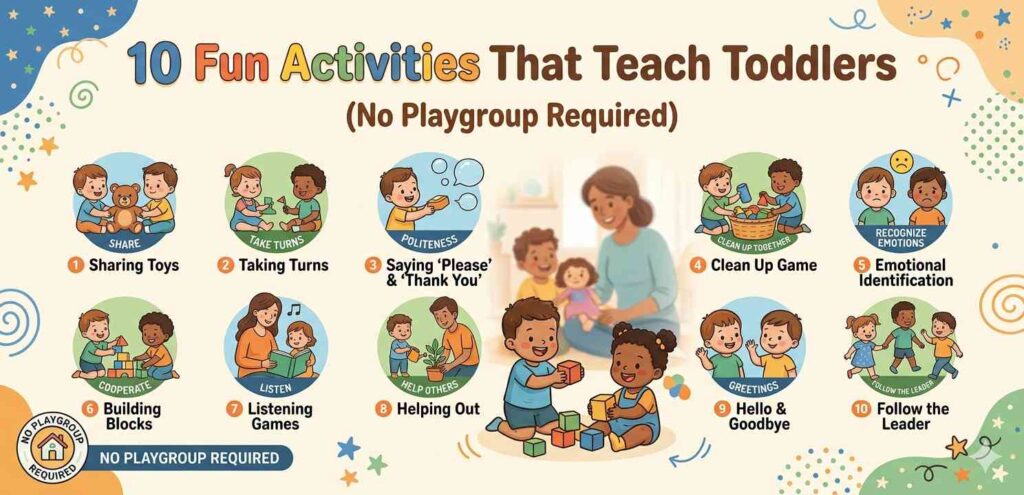

If you’ve been searching for toddler social skills activities that actually work without signing up for an expensive playgroup, you’re in the right place. Most parents assume toddlers only develop social skills around other kids — but that’s not entirely true. A lot of the groundwork happens right at home, during ordinary moments, with a little intentional effort from you.
This guide walks you through 10 practical, research-backed activities that are easy to set up and genuinely enjoyable for little ones.
Why Toddler Social Skills Activities Matter Early On
Social development doesn’t wait for school. Between ages 1 and 3, kids are already picking up cues about how to interact, share, express feelings, and take turns. These early patterns shape how they handle friendships, conflicts, and group settings for years.
The good news? You don’t need a formal program. Toddler social skills activities done at home — even simple ones — can lay a really strong foundation. And honestly, children often respond better in familiar, low-pressure environments anyway.
1. Role-Playing with Stuffed Animals or Dolls
This one’s underrated. When your toddler plays “pretend” with stuffed animals, they’re actually practicing real emotional and social scenarios — greeting someone, sharing food, saying sorry, comforting a friend.
Sit down and play alongside them. Take a character, give it a voice, and create tiny social moments. “Oh no, Bear is sad because he didn’t get a turn. What should we do?” That small prompt builds empathy without any lecture.
This is one of those toddler social skills activities that feels like pure play but works quietly in the background. Try it a few times a week. You’ll notice your child starting to apply these patterns in real situations.
2. Turn-Taking Games with Simple Board Games
Games like “Snail’s Pace Race” or simple color-matching games are perfect for this age. The whole point isn’t winning — it’s the structure of: your turn, my turn, wait, repeat.
It sounds basic, but waiting is genuinely hard for toddlers. Their brains are still developing impulse control. Practicing it in a calm, fun setting makes a real difference.
Keep sessions short (10–15 minutes) and celebrate the waiting as much as the winning. “You waited so patiently! That was so kind.” That kind of reinforcement goes a long way with toddler social skills activities built around patience.
3. Cooking Together (Age-Appropriate Tasks)
This might surprise you, but kitchen time is rich with social learning. Pouring, stirring, passing ingredients — these involve cooperation, taking turns, and following simple instructions together.
Give your toddler a role: “You’re the official flour pourer.” Then you do your part, narrate what you’re each doing, and make it feel like teamwork. This is less about the food and more about building the habits of working alongside someone else.
Among toddler social skills activities, cooking-based ones tend to stick because kids feel proud of what they made — and that pride connects to the memory of cooperating with you.
4. Storytime with Emotion Check-Ins
Reading aloud is already a classic. But you can make it into one of the most effective toddler social skills activities by pausing at key moments to talk about how characters feel.
“Look at her face. Why do you think she’s crying?” or “He looks really happy here — what happened?” These pauses don’t need to be long. Just a few seconds, a quick exchange, and you move on.
Over time, this builds emotional vocabulary — which is the foundation of empathy and conflict resolution. Kids who can name feelings early tend to navigate social situations much more smoothly as they grow.
5. Sharing Practice with a Snack Ritual
Sharing is one of the hardest things for toddlers because, developmentally, they’re still figuring out that objects can go away and come back. Abstract concepts like “being generous” just don’t land yet.
What does work is routine. Create a small daily ritual — like dividing crackers between two bowls, one for your child and one for a sibling, stuffed animal, or you. Name it clearly: “We’re sharing today.”
Consistency makes this one of those toddler social skills activities that slowly reshapes how a child thinks about things belonging to multiple people at once. Don’t expect overnight results — but stay consistent and you’ll see it shift.
6. Puppet Shows and Feelings Theater
Get a couple of sock puppets or paper bag puppets, and let your toddler run a little show. Guide the story toward mini social scenarios — two puppets want the same toy, or one puppet is feeling left out.
Then ask your child: what should the puppets do? This gentle problem-solving approach lets toddlers work through social conflict in a safe, imaginative space. It’s one of the most creative toddler social skills activities out there and costs almost nothing.
You can also use it to address real-life situations your child is struggling with — like trouble at daycare — without making them feel put on the spot.
7. Mirror Play for Expression Recognition
Stand or sit in front of a mirror together and make faces. Happy, sad, confused, surprised, angry, excited. Name each one, copy each other, and laugh about it.
This builds what researchers call “emotional recognition” — the ability to read other people’s faces and understand what they might be feeling. It’s a core building block of empathy and social awareness.
As toddler social skills activities go, this one is also a great calming tool. Some kids who struggle with identifying their own emotions find it much easier when they can see their face mirrored back at them.
8. Building Projects That Require Help
Give your toddler a task they genuinely cannot do alone — building a tall block tower, putting together a simple puzzle, carrying something big. Then offer yourself as a helper.
This teaches them to ask for help (instead of just melting down), to communicate what they need, and to work alongside another person toward a shared goal. These skills directly translate to peer interactions later.
You can find ideas for collaborative building activities at Zero to Three, a fantastic resource dedicated to early childhood development. They have specific guidance on how cooperative play builds social-emotional skills in the toddler years.
Toddler social skills activities that involve a shared goal — rather than solo play — are especially powerful because they mirror what kids actually need to do in group settings.
9. “How Are You?” Morning Rituals
Start each morning with a small ritual where you ask your toddler how they’re feeling and actually wait for an answer. Don’t rush. Even if they just say “good” every single time, the habit of checking in is what matters.
Then share your own feeling too. “I’m feeling a little tired today, but also excited because we’re going to the park.” Modeling emotional check-ins shows your child that feelings are normal, shareable, and worth noticing.
Over time, this builds the internal habit of self-awareness — which is one of the most overlooked toddler social skills activities for parents to consistently do. It costs nothing and takes under two minutes a day.
10. Play Dates at Home (Even One-on-One)
You don’t need a full playgroup. Even a single one-on-one play date at home — with a neighbor’s child, a cousin, or a friend’s toddler — gives your child real practice in navigating another person’s preferences, moods, and energy.
Before the play date, have a quick chat: “We’re going to share our toys today. If you feel upset, come tell me.” After the play date, debrief gently: “What was your favorite part? Was there anything hard?”
This reflection habit is what transforms ordinary experiences into actual learning. Pairing real social interaction with gentle guidance is one of the most complete toddler social skills activities you can offer — and it doesn’t require a formal setting at all.
You can read more about how unstructured play supports social development on the American Academy of Pediatrics’ HealthyChildren.org — they have clear, parent-friendly explanations of what children need at each stage.
Building These Habits Over Time
Consistency Over Intensity
You don’t need to do all ten activities every week. Pick two or three and rotate them. What matters most is regularity — returning to the same habits consistently over months, not doing one big burst of effort and stopping.
Follow Your Child’s Lead
Some of these toddler social skills activities will click immediately. Others won’t interest your child at all — and that’s fine. Social development isn’t one-size-fits-all. Pay attention to what sparks engagement and lean into that.
For more specific guidance on social milestones and age-appropriate expectations, this internal guide on early childhood development stages is worth bookmarking. And if you’re looking for how play connects to cognitive growth alongside social skills, this overview of toddler developmental play covers the overlap really well.
Final Conclusion
Social skills don’t just appear when kids start school. They’re built through hundreds of small, repeated moments — at the kitchen table, during storytime, in front of a mirror, or over a shared snack. The toddler social skills activities in this list are designed to fit into real life, not add stress to it.
You don’t need a formal program, a curriculum, or even other kids around all the time. What you need is intention — small, consistent moments where you’re actively helping your child learn how to be in the world with other people. Start with one or two activities, see what resonates, and build from there.