
If you’ve been wondering how to raise a bilingual toddler, you’re not alone. A lot of parents today — whether they speak two languages at home or are learning one themselves — want to give their little ones the gift of dual-language ability early on. And honestly, the toddler years are one of the best windows to do exactly that.
The good news is, you don’t need a fancy curriculum or a linguistics degree. What you do need is some consistency, patience, and the right approach for your family’s situation.
Why the Toddler Years Actually Matter More Than You Think
Between ages one and three, a child’s brain is absorbing language at a pace it will never match again. Sounds, rhythms, patterns — toddlers pick all of it up almost effortlessly when they’re surrounded by it.
This doesn’t mean you’ve missed out if your child is already four or five. But it does mean that if you’re trying to raise a bilingual toddler, starting earlier gives them more time to build natural fluency in both languages without it feeling like studying.
The research backs this up too. Kids exposed to two languages from birth or early toddlerhood generally develop stronger cognitive flexibility — meaning they get better at switching between tasks and thinking from multiple angles. That’s a real-life advantage that follows them for years.
Understanding the Two Main Approaches
Before diving into the day-to-day strategies, it helps to know there are two widely-used methods families rely on when they raise a bilingual toddler.
One Person, One Language (OPOL)
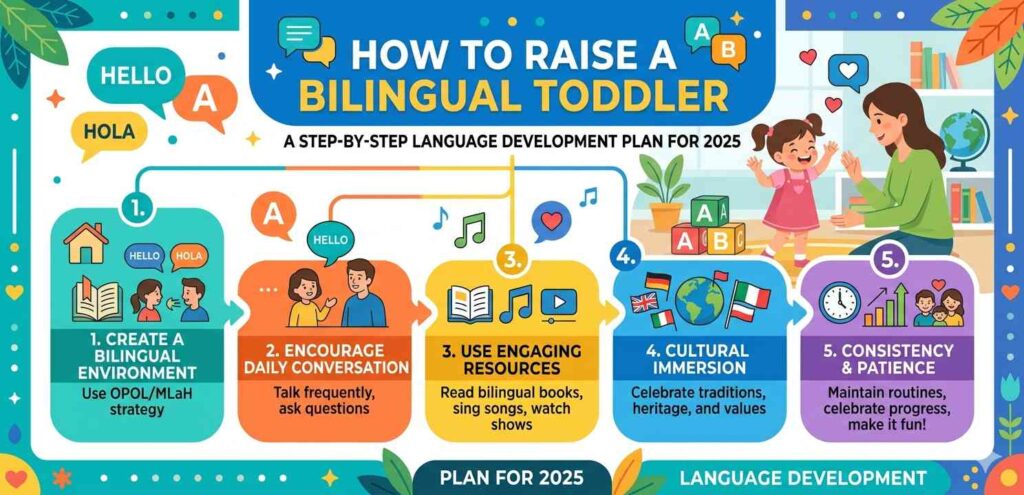
This is probably the most talked-about method. Each parent consistently speaks only one language to the child. So if one parent speaks Hindi and the other speaks English, each parent sticks to their own language — always.
It works well because the child starts to connect each language with a specific person. The boundaries are clear, and there’s less confusion about when to use which language.
Minority Language at Home (ML@H)
In this approach, the family uses the minority language — the one less common in the outside environment — at home, while the community or school handles the dominant language.
For example, if you live in an English-speaking country but your family speaks Tamil, you’d speak Tamil at home and trust that English will come naturally through daycare, school, and social life.
Both approaches work. The key is picking one and being consistent about it.
Practical Daily Habits That Actually Help
Here’s where things get real. Strategies are great, but habits are what actually shape a bilingual toddler’s development day by day.
Talk to Your Toddler — A Lot
This sounds obvious, but many parents underestimate how much narration matters. When you’re cooking, say what you’re doing. When you’re walking outside, name the things you see. Do it in both languages if you can, or in your target minority language if that’s your focus.
Toddlers learn words by hearing them in context, over and over again. Repetition isn’t boring to them — it’s actually how their brain builds vocabulary.
Read Aloud in Both Languages
Books are one of the most powerful tools when you’re trying to raise a bilingual toddler. Even simple board books, when read consistently, expose children to sentence structure, rhythm, and vocabulary in a way that feels natural and calm.
Try to have a small collection of books in each language. If you can’t find them locally, many libraries now stock multilingual children’s books, and sites like Multilingual Children’s Book Day have good resources.
Sing Songs and Nursery Rhymes
Music and rhythm help children remember sounds and words in ways that plain speech often doesn’t. Traditional songs in your home language carry cultural meaning too, which adds another layer to why they stick.
You don’t have to be a great singer. Your toddler absolutely does not care.
Handling the “Language Mixing” Phase Without Panic
One thing that trips up a lot of parents is when their toddler starts mixing languages — saying a word in Spanish mid-sentence while speaking English, for example. This is called code-switching, and it’s completely normal.
It doesn’t mean your child is confused. It usually means they know a word better in one language than the other at that moment, so they borrow it. Over time, as vocabulary builds in both languages, the mixing usually balances out on its own.
The best response? Don’t correct harshly or make it seem like a mistake. You can gently model the word in the other language without making a big deal of it.
Common Challenges When You Raise a Bilingual Toddler
Let’s be honest — it’s not all smooth sailing.
One Language Starts to Dominate
This happens a lot, especially once a child starts daycare or school and spends hours every day immersed in the dominant language. The minority language can start to feel less relevant to them.
The solution isn’t to panic or force it. It’s to deliberately create more spaces for the minority language — playdates with other speakers, weekend routines, video calls with grandparents, or even cartoons in that language.
You Don’t Speak the Second Language Yourself
Some parents want to raise a bilingual toddler in a language they themselves aren’t fully fluent in. That’s a real challenge, but not an impossible one.
In this case, it helps to bring in other speakers — family members, community groups, language playgroups, or even a bilingual caregiver part-time if that’s accessible. You can also learn alongside your child, which has its own unexpected charm.
Delayed Speech Concerns
It’s a persistent myth that bilingualism causes speech delays. Research consistently shows bilingual children hit language milestones at the same rate as monolingual children when you count across both languages combined.
That said, if you genuinely have concerns about your toddler’s speech development, always talk to a speech-language pathologist. They can assess across both languages properly. A good starting point is ASHA’s resource on bilingual language development.
Building a Language-Rich Environment at Home
Your home environment does a lot of the heavy lifting when you’re trying to raise a bilingual toddler.
Label Things Around the House
Stick simple labels on household objects in both languages. Toddlers notice these things, especially if you point to them during daily routines.
Set a “Language Time” Routine
Some families find it helpful to designate certain times of day for each language — morning routine in one, bedtime stories in another. This kind of structure is especially useful if you’re doing ML@H and want to ensure the minority language gets enough airtime.
Limit Screen Time but Make It Count
If your toddler does watch shows or use apps, make at least some of it in the minority language. This isn’t about dumping them in front of a screen — it’s about using the screen time they do have more intentionally.
Staying Consistent When Life Gets Busy
Real talk: there will be weeks where consistency goes out the window. You’re tired, routines break down, and you slip back to the easier language. That happens to almost everyone trying to raise a bilingual toddler.
The goal isn’t perfection. It’s a general pattern of consistent exposure over months and years. Missing a week doesn’t undo months of effort.
What helps most is making the minority language feel like a natural part of family life rather than an educational task. The more it’s woven into everyday moments — meals, bedtime, trips to the market — the less it feels like work.
Final Conclusion
To raise a bilingual toddler in 2025, you don’t need expensive tools or a rigid program. What you do need is intentionality, a method that suits your family, and the willingness to show up consistently even when it’s imperfect.
The toddler years pass fast. The language exposure you offer now builds a foundation that genuinely shapes how your child thinks, communicates, and connects with the world around them — in two languages, not just one.
Start where you are. Use what you have. Be patient with the process, and with yourself.