
Every parent wants their toddler to grow up talking, understanding, and loving words. And somewhere along the way, most of us start wondering — should I be sitting down and reading aloud to my child, or is it okay to just play an audiobook? The debate around reading aloud vs audiobooks for toddlers has been going on for a while now, and there’s actually more to it than most people think.
Let’s get into it — no complicated jargon, just real talk for real parents.
What Happens in a Toddler’s Brain During Language Learning?
Before comparing the two methods, it helps to understand what toddlers actually need for language development. Between ages one and three, the brain is forming neural pathways at a rapid pace. Toddlers aren’t just memorizing words — they’re learning how language feels, how it sounds in different tones, and how it connects to emotions and real experiences.
This is why the delivery of language matters just as much as the words themselves.
A toddler picking up a new word isn’t doing it mechanically. They’re absorbing it from context, repetition, facial expressions, and the emotional atmosphere around them. Any good approach to early literacy has to feed all of that, not just vocabulary count.
Reading Aloud to Toddlers: What Makes It So Powerful?
Reading aloud has been the gold standard for early childhood language development for decades. And it’s not just because it’s traditional — there are solid reasons why it works so well.
When a parent or caregiver reads aloud to a toddler, several things happen at once. The child hears new words in context. They see facial expressions that match the story. They can point at pictures and ask questions. And they feel the emotional warmth of being close to someone they trust.
That last part — the emotional connection — is something no screen or speaker can replicate.
Reading Aloud Builds Vocabulary Differently
Studies consistently show that children whose caregivers read aloud to them regularly develop larger vocabularies and stronger comprehension skills. When you’re reading aloud vs audiobooks for toddlers, one key difference is interaction. You can pause, explain a word, make a silly voice, or ask “What do you think happens next?”
That back-and-forth is called dialogic reading, and it’s genuinely one of the most effective things you can do for a toddler’s language growth.
Physical Books Add Another Layer
There’s also the tactile element. Toddlers love turning pages, pointing at pictures, and sometimes chewing on corners (we’ve all been there). A physical book creates a multisensory experience. That’s not available with an audiobook playing from a phone or smart speaker.
Audiobooks for Toddlers: Where Do They Actually Help?
Now, audiobooks aren’t without value — it’s just that their value looks different.
A well-produced audiobook with clear narration, varied voices, and good pacing can expose a toddler to rich language, expressive storytelling, and new vocabulary. For families on the go, audiobooks in the car or during quiet play time can be a helpful supplement.
The keyword there is supplement.
When Audiobooks Work Well
Audiobooks shine in a few specific situations. If a toddler is already comfortable with books and understands stories, a familiar audiobook can reinforce language they’ve already started building. It can also work during activities like drawing or puzzle time, where the child is engaged but free to listen passively.
Some toddlers with older siblings or bilingual households also benefit from hearing fluent, expressive storytelling in an audiobook format when a caregiver isn’t available.
The Limitation of Passive Listening
Here’s the issue: toddlers don’t interact with audiobooks. They can’t ask the speaker to slow down, go back, or explain a word. For very young children — especially under age two — passive audio exposure alone isn’t enough to drive meaningful language development.
This is a crucial point in the reading aloud vs audiobooks for toddlers conversation. One is active and relational, the other is largely passive.
Reading Aloud vs Audiobooks for Toddlers: A Side-by-Side Look
It helps to compare these two approaches directly so parents can make an informed choice.
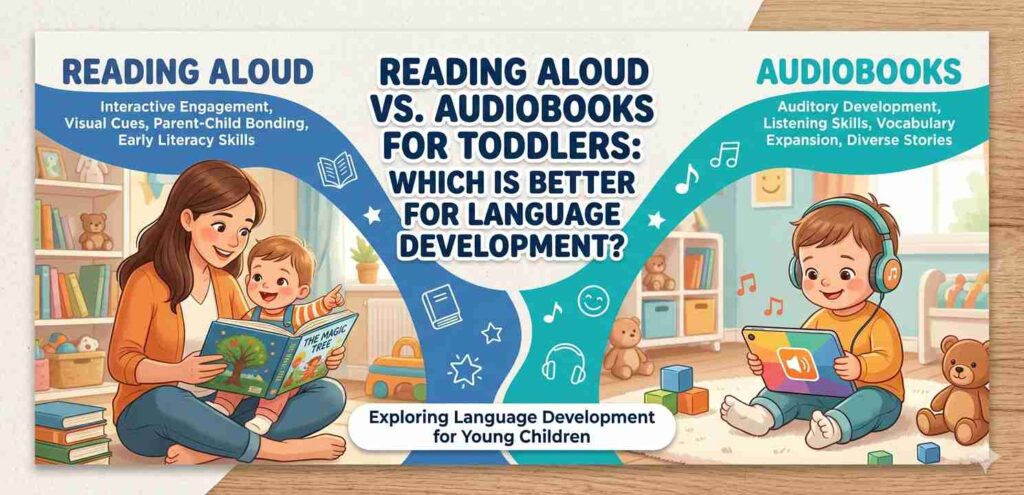
Interaction: Reading aloud allows two-way conversation and questions. Audiobooks offer one-way listening.
Emotional bonding: Reading aloud builds attachment and trust through physical closeness. Audiobooks lack that element entirely.
Vocabulary exposure: Both can introduce new words, but reading aloud allows for real-time explanation and context.
Convenience: Audiobooks win here. They’re easy to play anywhere, any time.
Age appropriateness: For children under 2, reading aloud is significantly more effective. For ages 3 and above, audiobooks can play a supporting role.
The research on reading aloud vs audiobooks for toddlers is fairly clear: shared reading experiences tend to produce better language outcomes for young children than solo listening does.
What Does Research Actually Say?
A 2019 study published in JAMA Pediatrics found that children who were regularly read to starting in infancy showed greater activation in areas of the brain related to language and comprehension. The researchers emphasized that interactive reading — not just exposure to language — was the critical factor.
The American Academy of Pediatrics also recommends reading aloud to children starting from birth, long before they understand words, because the habit builds neural connections and attachment simultaneously.
For a deeper dive into early literacy and brain development, Zero to Three offers well-researched resources specifically designed for parents of infants and toddlers.
Does the Type of Audiobook Matter?
Yes, actually. Not all audiobooks are created equal when it comes to toddlers.
Audiobooks narrated by a single flat voice without expression or variation aren’t particularly engaging or useful for language learning. But audiobooks with multiple character voices, clear pacing, and expressive narration can be meaningfully stimulating — especially for older toddlers (ages 2.5 to 4).
Interactive audio formats, where the narrator pauses and asks the child questions, are also becoming more common and do add an element of engagement missing from standard recordings.
Practical Tips for Parents: How to Combine Both
You don’t necessarily have to pick one and abandon the other. Most child language specialists would agree that the smartest approach is making reading aloud your foundation, and treating audiobooks as an occasional add-on.
Here’s how to make that work day-to-day:
Start mornings and bedtimes with read-aloud sessions. These are naturally quiet, connected moments. Use them for physical books and real conversation.
Use audiobooks during transitions. Car rides, waiting rooms, or quiet play time are natural spots for an audiobook without replacing the interactive reading experience.
Revisit audiobook stories with a physical book. If your toddler loved a story they heard, find the physical book and read it together. The familiar story creates a bridge.
Follow your child’s cues. Some toddlers are more auditory learners than others. Pay attention to whether they respond better to voices, pictures, or both.
Common Mistakes Parents Make With Both Methods
Some parents assume that any exposure to language-rich content is automatically beneficial. That’s not quite true.
Leaving an audiobook playing in the background while a toddler watches TV isn’t language learning — it’s noise. Similarly, reading aloud in a flat, rushed tone while checking your phone doesn’t create the engaged environment toddlers need.
For reading aloud vs audiobooks for toddlers to be a meaningful conversation, parents need to think about quality of engagement, not just exposure time.
Building a Long-Term Reading Habit That Sticks
The goal isn’t just better language development in the toddler years. It’s raising a child who loves reading and learning throughout their life.
That habit is built through consistency and warmth. Children who associate books with comfort, curiosity, and time with a loved one grow into readers. Audiobooks alone rarely create that emotional anchor.
Reading aloud — even just 10 to 15 minutes a day — is one of the most impactful things a parent can do. It costs nothing, needs no tech, and has compounding benefits as the child grows.
Final Conclusion
When it comes to reading aloud vs audiobooks for toddlers, the answer isn’t about choosing sides. It’s about understanding what each method actually does. Reading aloud creates connection, interaction, and real-time language building in ways audiobooks simply can’t match, especially for children under three. Audiobooks have their place — particularly as children get older and can engage with stories more independently.
If you want stronger language development for your toddler, make reading aloud a daily habit and treat audiobooks as a helpful companion, not a replacement. The words matter. But the voice reading them, and the hands holding the book, matter even more.