
Every parent has that moment — your toddler points at something, makes a sound, and you’re not quite sure what they mean. It’s both adorable and a little bit stressful. The good news is that toddler’s language development doesn’t require expensive programs or special therapy sessions for most kids. A lot of it happens right at home, through everyday moments you’re already part of.
Research in early childhood education consistently shows that what happens between ages 1 and 3 shapes a child’s communication skills for years ahead. Small habits, done daily, make a real difference.
1. Talk to Your Toddler Like They Already Understand You
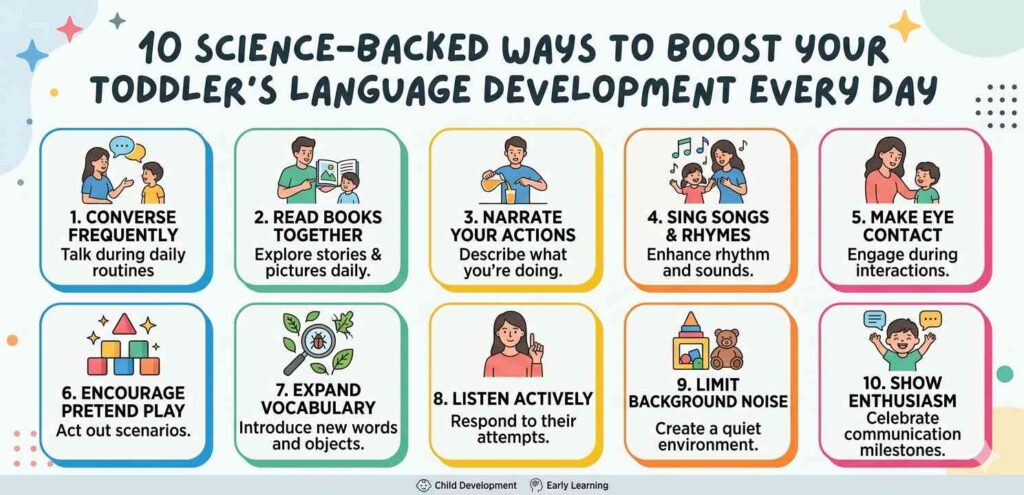
This sounds simple, but many parents talk about their toddler rather than to them. Narrating what you’re doing — “Now I’m washing the apple, see? It’s red and shiny” — directly feeds into toddler’s language development by connecting words to real objects and actions.
Studies from the University of Chicago found that the sheer quantity of words a child hears before age 3 has a measurable impact on their vocabulary size later. You don’t need to be poetic about it. Just talk.
2. Read Out Loud Every Single Day
Reading aloud is one of the most researched tools in early childhood language support. It introduces sentence patterns, new words, and storytelling — all of which build the foundation for toddler’s language development.
You don’t need long sessions. Even 10–15 minutes before bed counts. Choose books with clear pictures and simple words first, then slowly move toward stories with more complex plots as your child grows.
3. Reduce Screen Time — Especially Solo Viewing
Screens aren’t inherently evil, but passive screen time doesn’t contribute much to toddler’s language development. A child watching a cartoon alone doesn’t get the conversational back-and-forth that real language learning requires.
The American Academy of Pediatrics recommends limiting solo screen use for children under 2 to almost nothing, and co-viewing with a parent when it does happen. If you’re watching together and talking about what’s on screen, that’s different — you’re turning passive media into an interactive experience.
For more detailed guidance, check the AAP’s official screen time guidelines.
4. Respond to Their Babbling — Every Time
When a 14-month-old babbles something that sounds like “dah-dah-boo,” many adults just smile and move on. But responding as if it were real speech — “Oh really? Tell me more!” — is actually one of the most effective ways to encourage toddler’s language development.
This back-and-forth, often called “serve and return,” has been studied extensively by Harvard’s Center on the Developing Child. It teaches toddlers that communication is a two-way street before they even have the words to prove it.
You can read more about serve-and-return interaction here.
5. Expand What They Say — Don’t Just Repeat It
There’s a technique called “expansion” used by speech-language therapists, and you can do it naturally at home. When your toddler says “ball,” you say, “Yes! That’s a big red ball.”
This approach directly supports toddler’s language development by modeling richer sentences without correcting or overwhelming the child. You’re not telling them they’re wrong. You’re just showing them what a fuller sentence sounds like.
Over time, kids absorb these expanded versions and start using them on their own.
6. Sing Songs and Nursery Rhymes
Music does something interesting to the brain. Songs have rhythm, repetition, and predictable patterns — all things that make it easier for young children to absorb language. That’s why toddler’s language development tends to get a real boost from music-rich environments.
Simple songs like “Twinkle Twinkle,” “Old MacDonald,” or even made-up songs about daily routines work well. Don’t worry about being a good singer. Your toddler genuinely doesn’t care.
7. Ask Questions That Need More Than Yes or No
As your toddler gets closer to age 2 or 2.5, start shifting some questions from yes/no to open-ended. Instead of “Did you like the soup?” try “What did the soup taste like?”
They might not have the words yet — and that’s fine. The goal is to create space in conversation where toddler’s language development can stretch. Pause. Wait. Let them try. Resist the urge to fill every silence immediately.
8. Use Real Words — Avoid Baby Talk for Long
There’s nothing wrong with some baby talk early on. But sticking with it too long can actually slow down toddler’s language development. If your 2-year-old always hears “wa-wa” for water, they miss the chance to learn the real word.
Aim to model correct words clearly and warmly. “You want some water? Here’s your water.” Pronunciation doesn’t need to be perfect — just say real words.
9. Create Routines That Include Language
Predictable routines aren’t just comforting — they’re language learning opportunities. Morning routines, bath time, mealtimes — all of these are chances to repeat the same vocabulary every day in a natural context.
Consistent repetition is a major driver of toddler’s language development. When a child hears “Let’s wash your hands before we eat” every single evening, they start anticipating the words, processing them faster, and eventually using them.
10. Limit Background Noise When Talking
This one often gets overlooked. When the TV is on in the background, or music is playing loudly, toddlers have to work harder to tune in to speech. This extra noise can actually interfere with toddler’s language development, especially during key conversational moments.
Researchers call this the “noise problem” in early language exposure — it reduces the quality of word input even when adults are speaking. Quiet environments during reading, playtime, and meals help kids pick up speech more accurately.
It doesn’t mean your home needs to be silent all the time. Just be thoughtful about noise levels when you’re actively talking to your toddler.
What If Your Toddler Seems Behind?
It’s worth mentioning — every child is different. Some toddlers are naturally quieter. Some explode in vocabulary right after age 2. But if your child isn’t saying any single words by 12 months or isn’t putting two words together by 24 months, it’s worth talking to your pediatrician. Early support for toddler’s language development, when needed, is genuinely effective.
You can also look into early intervention programs in your area through the CDC’s “Learn the Signs. Act Early.” initiative.
Final Conclusion
Supporting your toddler’s language development doesn’t mean buying flashcard sets or enrolling in special classes — though those can help too. Mostly, it comes down to being present, talking naturally, reading regularly, and responding consistently to your child’s attempts to communicate.
The science is clear: the early years are a window of enormous opportunity. What you do during everyday moments — a walk to the store, a bath before bed, a meal together — feeds directly into how confidently your child will speak, listen, and connect with the world.