
Introduction
Choosing the right early education approach for your child is one of those decisions that can feel genuinely overwhelming. Walk into any parenting forum and you’ll see parents passionately debating Waldorf vs. Montessori like it’s a football rivalry. Both philosophies have strong communities, decades of research behind them, and real success stories.
But here’s the thing — they’re quite different in how they think about child development. If you’re trying to figure out which one actually supports your child’s developmental milestones better, this guide will walk you through both, side by side, without the jargon.
What Is the Montessori Method?
The Montessori method was developed by Dr. Maria Montessori in the early 1900s. It’s built on one core idea: children learn best when they’re free to explore at their own pace within a carefully prepared environment.
In a Montessori classroom, you won’t see a teacher standing at the front giving lectures. Instead, kids move around, choose their own activities from a set of specially designed materials, and work independently or in small groups. The teacher’s role is more like a quiet guide who steps in when needed.
Key Features of Montessori Learning
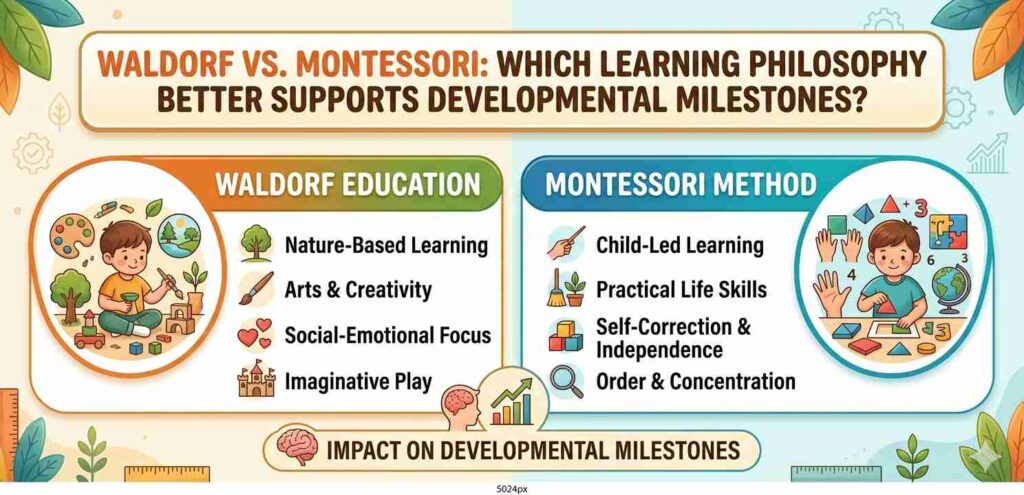
- Self-directed activity: Children choose what they want to work on.
- Hands-on materials: Everything is concrete and tactile — beads for math, sandpaper letters for reading.
- Mixed age groups: Usually 3-year spans (3–6, 6–9, 9–12), so older kids mentor younger ones naturally.
- No grades or tests: Progress is tracked through observation and portfolio work.
Montessori is particularly well-known for supporting early developmental milestones in areas like fine motor skills, concentration, and independence.
What Is the Waldorf Philosophy?
The Waldorf approach, created by Rudolf Steiner in 1919, operates from a very different starting point. Steiner believed childhood should unfold in stages — and that rushing children into academic learning too early actually harms development.
Waldorf education is organized around three seven-year phases of development. The first phase (birth to age 7) focuses almost entirely on play, imagination, and sensory experience. Formal reading and writing instruction typically doesn’t begin until around age 7 in a Waldorf school — which surprises a lot of parents.
Key Features of Waldorf Learning
- Play-based early childhood: The first years are about stories, crafts, music, and movement.
- Arts integration: Every subject — even math and science — is taught through artistic expression.
- No screens or technology: Waldorf philosophy actively discourages digital media, especially in early years.
- Consistent classroom community: Children often stay with the same teacher for multiple years.
In the Waldorf vs. Montessori debate, Waldorf stands out for its deep focus on emotional and creative development during early childhood.
How Each Approach Handles Developmental Milestones
This is really the heart of the question. Let’s look at specific milestone categories.
Cognitive Development
Montessori introduces cognitive concepts early — and concretely. A three-year-old in a Montessori classroom might be sorting objects by size, counting beads, or tracing letter shapes. The materials are designed to be self-correcting, so children figure out their own mistakes without needing constant teacher feedback.
Waldorf takes a slower approach. Cognitive development in the early years happens through imaginative play, storytelling, and rhythm-based routines. Academic reading and arithmetic are introduced gradually after age six or seven, once Steiner believed the child’s “thinking faculty” was more mature.
Neither is wrong — they just reflect different beliefs about when the brain is ready.
Social and Emotional Development
Here, Waldorf’s community-centered model shines. Keeping the same children and teacher together for years creates deep social bonds and emotional security. Kids develop empathy, cooperation, and conflict resolution skills through consistent relationships rather than structured lessons.
Montessori also supports social development, but through a slightly different route. Mixed-age classrooms naturally encourage children to help and teach each other. A six-year-old explaining a concept to a four-year-old builds both social awareness and confidence.
When you’re comparing Waldorf vs. Montessori on this front, both methods score well — just in different ways.
Physical and Motor Development
Waldorf puts a lot of emphasis on whole-body movement and crafts. Children knit, draw with beeswax crayons, do eurythmy (a kind of expressive movement), and work with natural materials. This supports fine and gross motor development in a very organic, art-driven way.
Montessori addresses motor milestones through its structured materials — pouring exercises, bead stringing, tracing, and practical life activities like sweeping or buttoning clothes. These are incredibly effective for fine motor development, particularly in the 3–6 age range.
Language and Communication Milestones
Montessori introduces phonemic awareness early using sandpaper letters and moveable alphabets. Many children in Montessori programs begin reading independently between ages four and five. For parents focused on early literacy, this is a significant draw.
Waldorf doesn’t rush this. Language development in early Waldorf classrooms happens through rhymes, songs, storytelling, and rich oral language — not print. Written language comes later, typically around first grade (age 6–7). The belief is that deep oral fluency actually supports stronger literacy in the long run.
Waldorf vs. Montessori: Classroom Environment
Walk into a Montessori classroom and you’ll notice order. Materials are arranged carefully on low shelves. Everything has a place and a purpose. The space is designed to support independent work and calm focus.
A Waldorf classroom feels warmer and more like a home. Soft colors on the walls, natural materials, fairy tale illustrations, and cozy corners for imaginative play. There’s more sensory richness — and often a fire or candles during morning gatherings in older grades.
The Waldorf vs. Montessori contrast in environments reflects their core philosophies: structured freedom versus nurturing imagination.
The Role of Technology
This is a major practical difference for modern families.
Montessori doesn’t have a strict stance against technology. In fact, some Montessori schools — especially for upper elementary and middle school — incorporate digital tools thoughtfully as learning aids.
Waldorf is firmly anti-screen, especially in the early years. Families choosing Waldorf are often asked to limit media at home as well. This can be a dealbreaker for some and a huge selling point for others.
Which Philosophy Better Supports Developmental Milestones?
Honestly? It depends on which milestones you’re prioritizing — and at what age.
If early academic milestones matter most to you — reading, writing, numeracy, independent problem-solving — Montessori has a strong track record, particularly in the 3–6 year range.
If you’re more concerned with emotional security, creative development, imaginative play, and a slow, gentle entry into academics, Waldorf makes a compelling case, especially for children under seven.
Some parents split the difference — Waldorf in early childhood (ages 3–6), then Montessori or a hybrid approach in the elementary years. It’s not a one-size-fits-all answer.
You might also find it useful to read about how early childhood education impacts long-term learning outcomes or explore how developmental psychology informs educational philosophy — both are well-regarded resources.
What Parents Often Get Wrong
In the Waldorf vs. Montessori conversation, a common misconception is that one is “academic” and the other is “just play.” That’s too simplistic.
Waldorf isn’t just art and stories — it has a rigorous, sequenced curriculum that challenges children in meaningful ways over time. And Montessori isn’t all worksheet drills — it’s deeply exploratory and child-led.
Another mistake is assuming either approach works for every child. Some kids thrive in Montessori’s structured independence. Others feel more grounded in Waldorf’s rhythmic, community-based environment. Your child’s temperament matters as much as the philosophy itself.
Practical Considerations Before Choosing
- Visit both schools if possible. Observe a morning, not just a tour.
- Talk to other parents whose kids have attended for at least two years.
- Ask about teacher training. Both Waldorf and Montessori require specialized certification — make sure teachers are properly trained.
- Consider your family’s values. If you’re anti-screen, Waldorf aligns naturally. If you want early literacy, lean Montessori.
- Think about transitions. If your child will later move to a conventional school, Montessori’s academic pace may ease that transition more smoothly.
Final Conclusion
The Waldorf vs. Montessori debate doesn’t have a universal winner. Both philosophies genuinely care about child development — they just prioritize different things at different times. Montessori tends to build independence and academic readiness early. Waldorf nurtures creativity, emotional depth, and a slower, more imaginative entry into learning.
What matters most is knowing your child. Watch how they play, what excites them, how they handle new situations. The right learning environment is the one that fits who they already are — and who they’re becoming.
Take your time with this decision. Visit schools, ask questions, and trust your instincts. Both approaches have helped generations of children grow into thoughtful, capable people.