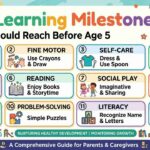
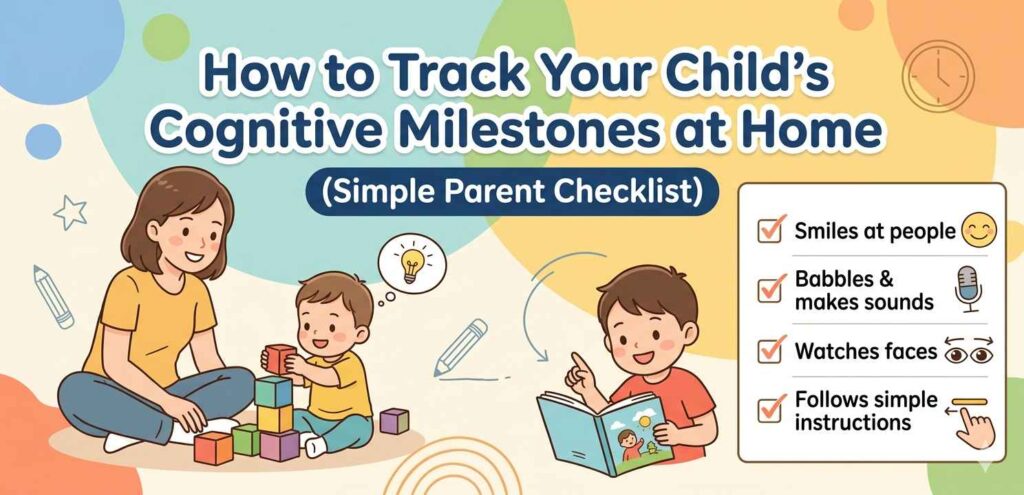

Every parent, at some point, wonders: “Is my child developing the way they should?” It’s one of the most common — and most valid — questions in early childhood. Tracking your child’s cognitive milestones doesn’t require a degree in psychology or a clinic visit every month. With the right understanding and a simple checklist, you can observe meaningful progress right at home.
This guide walks you through what cognitive milestones actually mean, how to spot them in everyday life, and what to do if something seems off. Let’s get into it.
What Are Cognitive Milestones, Exactly?
Cognitive milestones refer to the mental and thinking skills a child develops over time — things like problem-solving, memory, attention span, language understanding, and the ability to recognize patterns or cause-and-effect relationships.
These are different from physical milestones (like walking or holding a spoon). Cognitive development is all about how your child processes the world around them.
It’s worth knowing that cognitive milestones exist on a range. Two children the same age can both be “on track” while developing at slightly different speeds. The goal of tracking isn’t to compare your child to others — it’s to understand your child’s unique growth pattern.
Why Tracking at Home Actually Matters
Parents are with their children far more than any pediatrician or specialist. That means you’re in the best possible position to notice small but important changes in how your child thinks, responds, and interacts.
Spotting a delay in cognitive milestones early gives children the best chance at getting support before a small gap becomes a bigger challenge. According to the CDC’s developmental monitoring resources, early identification leads to better outcomes across the board.
Tracking doesn’t mean being anxious every week. It means paying thoughtful attention — and knowing what to look for.
Cognitive Milestones by Age: A Practical Parent Checklist
Ages 0–12 Months
Infants are already developing cognitively from day one. Here’s what to watch for:
- Follows moving objects with eyes (by 2–3 months)
- Recognizes familiar faces and reacts differently to strangers (by 4–6 months)
- Looks for a dropped toy — shows early object permanence (by 8–10 months)
- Responds to their name being called (by 9–10 months)
- Imitates simple gestures, like waving or clapping (by 12 months)
These early cognitive milestones are often overlooked because babies seem “too young” to be doing much. But each of these signals that the brain is building important connections.
Ages 1–2 Years (Toddler Stage)
This is when the thinking really starts to show up in visible ways.
- Points to body parts when asked (nose, eyes, ears)
- Understands simple instructions like “Give me the ball” or “Sit down”
- Starts pretend play — feeding a doll, pretending a block is a car
- Sorts objects by shape or color with help
- Uses 2-word phrases or more to communicate needs
Pretend play is one of the strongest early cognitive milestones to watch for. When a child pretends, they’re demonstrating symbolic thinking — which is foundational for reading and math later on.
Ages 2–3 Years
- Counts to 3 or higher and understands “more” vs. “less”
- Completes 3–4 piece puzzles without assistance
- Remembers simple stories and can retell them roughly
- Understands “mine,” “his,” “hers” and basic ownership concepts
- Groups similar objects together (all the animals in one pile, all the cars in another)
At this age, cognitive milestones often show up in play. Watch how your child approaches toys — do they experiment? Try different ways to solve a problem? That’s thinking in action.
Ages 3–4 Years
- Understands the concept of “same” and “different”
- Counts objects up to 10
- Draws a person with at least 3 body parts
- Understands past vs. present (“We went to the park yesterday”)
- Follows 3-step instructions without reminders
This is also when children begin to understand that other people have different thoughts and feelings than they do — a concept called “theory of mind.” It’s a critical cognitive milestone that supports empathy and social learning.
For a more detailed developmental reference, check out ZERO TO THREE’s developmental milestone guide.
Ages 4–5 Years
By this stage, children should be approaching kindergarten readiness.
- Counts to 20 or more
- Recognizes letters and some written words
- Retells stories in correct sequence
- Understands the concept of time (morning, afternoon, tomorrow)
- Solves simple problems with minimal adult help
- Draws detailed pictures with context (a house with a door, windows, and sky)
These cognitive milestones at ages 4–5 set the foundation for formal learning. If your child is showing solid skills here, they’re likely ready for the structure of school.
How to Actually Use This Checklist at Home
Reading the list is one thing. Applying it practically is another. Here are a few simple strategies that work well in daily life.
Keep a Simple Observation Journal
You don’t need a fancy app. A notes app on your phone works perfectly. When your child does something new — solves a puzzle differently, connects two ideas, asks “why” for the first time — jot it down with the date.
Over time, you’ll have a clear picture of how their cognitive milestones are progressing. This also becomes really useful if you ever need to talk to a pediatrician.
Turn Everyday Activities Into Milestone Checks
You don’t need to set up “tests.” Cooking dinner together, sorting laundry, or reading a bedtime story are all natural windows into your child’s cognitive development.
Ask questions during these moments: “Which pile has more socks?” or “What do you think happens next in the story?” Their responses tell you a lot about where they are with key cognitive milestones.
Watch Play, Not Just Answers
Children reveal the most during unstructured play. Notice how they approach problems — do they try again when something doesn’t work? Do they invent rules for their games? Do they talk to themselves while playing (a sign of healthy inner language development)?
This kind of play observation is one of the most reliable ways to track cognitive milestones without pressure or anxiety for either of you.
Red Flags Worth Discussing With a Doctor
Most delays are mild and resolve with time and support. But some patterns are worth raising with a professional.
Consider speaking with your pediatrician if your child:
- Isn’t babbling or pointing by 12 months
- Shows no interest in pretend play by age 2
- Loses skills they previously had at any age
- Doesn’t follow 2-step instructions by age 2.5
- Can’t sort objects by color or shape by age 3
These aren’t automatic warning signs — context always matters. But when in doubt, bring it up. Early support is always better than a “wait and see” approach when real concerns exist.
Also worth reading: How screen time affects early childhood development and Simple language activities for toddlers at home
What Influences Cognitive Development at Home?
Tracking cognitive milestones is important, but so is understanding what helps children reach them.
Language-rich environments — where adults talk, read, and describe things out loud — consistently produce stronger cognitive outcomes. You don’t need expensive toys. You need conversation.
Play-based learning still matters even as children get older. Building blocks, art supplies, simple puzzles, and imaginative play all support the cognitive skills that show up in cognitive milestones checklists.
Consistent sleep and nutrition are underrated. A tired, poorly nourished child won’t perform cognitively at their true level. Before worrying about milestones, look at sleep and diet.
Final Conclusion
Tracking your child’s cognitive milestones at home is less about passing tests and more about staying genuinely tuned in to how your child thinks and grows. The checklist in this guide gives you a practical, age-by-age reference — but your daily observations are just as valuable as any formal assessment.
Trust what you notice. Use the list as a guide, not a grading system. And remember, your consistent attention, language, and play with your child are the most powerful tools for healthy cognitive development — no specialist required.