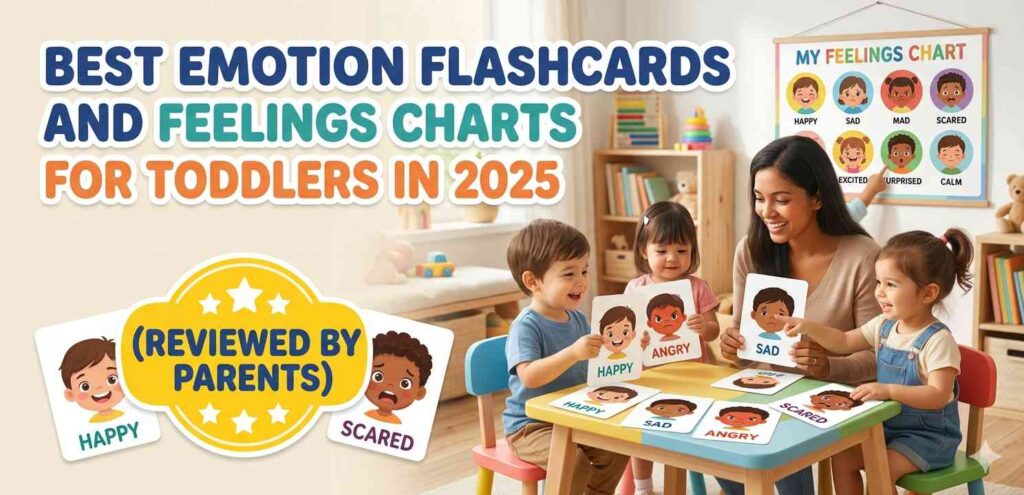

Raising a toddler means dealing with big feelings in a small body — and most parents figure that out pretty quickly. One thing that actually helps is using emotion flashcards for toddlers from an early age. In this guide, we’ve pulled together the best options available in 2025, based on real parent reviews and what actually works in everyday home life.
Why Emotion Flashcards for Toddlers Actually Matter
A lot of parents think teaching emotions is something that just happens naturally. And to some extent, yes — children pick up cues from their surroundings. But toddlers between ages 1 and 4 don’t have the vocabulary or the mental tools yet to explain what they’re feeling.
That’s where emotion flashcards for toddlers come in. They give children a visual reference point. When your two-year-old is melting down and can’t say why, showing them a card with a sad face or a frustrated expression can open the door to communication.
It’s not magic. But it’s genuinely useful.
What to Look For Before Buying
Before jumping into product options, here’s what actually matters when choosing emotion flashcards for toddlers:
Card Size and Durability
Toddlers are not gentle. Cards need to be thick, laminated, or made from board material. Anything flimsy will be bent, torn, or chewed within a week.
Illustration Style
Photographic cards work well for older toddlers (3+), because real faces are more relatable. Illustrated or cartoon cards tend to work better for younger ones, since the expressions are cleaner and easier to read.
Number of Emotions Covered
Some sets cover just five or six basics — happy, sad, angry, scared, surprised, tired. Others go up to 30+ emotions including embarrassed, proud, jealous, and lonely. For toddlers under three, keep it simple. You can expand as they grow.
Additional Features
Look for cards that include an emotion name, a sentence prompt (like “I feel ___ when ___”), and sometimes a body signal (like “my tummy feels tight when I’m nervous”). These extras make the cards much more useful.
Top Emotion Flashcards for Toddlers in 2025
1. Highlights Learning Feelings & Emotions Flash Cards
These have been consistently popular with parents of 2–5 year olds. The illustrations are bright and clear, and each card pairs an emotion with a relatable scenario. Parents mention that their kids started identifying feelings in books and TV shows after just a couple weeks of using these.
The set covers 26 emotions, which is comprehensive without being overwhelming. Cards are sturdy and wipe-clean, which is a real plus with toddlers.
One mom in an online forum mentioned: her son started telling her he felt “left out” at daycare after just a month of using these — something he’d never been able to express before.
These emotion flashcards for toddlers are widely available at major retailers and are a solid starting point for most families.
2. The Learning Journey Talking Flash Cards – Feelings Edition
These talking cards are a step up in terms of technology. Press a button and the card says the emotion name aloud. For toddlers who aren’t reading yet, hearing the word and seeing the face simultaneously helps with retention.
Parents say the audio feature keeps kids engaged far longer than regular cards. A few noted that their toddler would sit and press each card repeatedly, which is repetitive — but that repetition is actually how learning sticks at this age.
They’re a bit pricier but worth it if your child responds better to audio learning. These are some of the best emotion flashcards for toddlers for auditory learners.
3. Barefoot Books Yoga Pretzels Cards (Emotion Variation)
Not technically a pure flashcard set, but parents rave about how these incorporate body movement with emotion recognition. Each card connects a feeling to a body activity, which helps toddlers understand that emotions live in the body — not just the head.
If your child is active and has trouble sitting still for traditional cards, this format might land better.
4. Do2Learn Feelings Flash Cards
These are a more clinical set, often recommended by speech therapists and child development specialists. They use simple photographs of real children making facial expressions. For toddlers on the autism spectrum or those with communication delays, real faces tend to be more effective than illustrations.
They’re straightforward — no gimmicks — but very effective at teaching emotion flashcards for toddlers in a structured, consistent way.
How Feelings Charts Work Differently Than Flashcards
A feelings chart is usually a poster or printed sheet that lives on the wall. Instead of a stack of cards your child interacts with, a feelings chart is always visible — part of the environment.
Many parents use both. Flashcards for active learning time, and a feelings chart mounted in the playroom or bedroom for passive exposure throughout the day.
Some popular feelings chart styles include:
- Emotion wheels — a circular design with faces showing different intensities of the same feeling
- Traffic light charts — red (angry/frustrated), yellow (unsure/nervous), green (calm/happy)
- Check-in charts — used to start the day, where kids move a clothespin to show how they feel
These visual tools work best when they’re at the child’s eye level and part of a regular routine, like checking in before breakfast or after school pickup.
Best Feelings Charts for Toddlers in 2025
Conscious Discipline Feeling Buddies Poster
This is a large, laminated chart with illustrated characters each representing a different emotion. It’s designed for classroom use but works well at home too. The characters are consistent, which helps kids form a mental association over time.
Zones of Regulation Chart
Commonly used by occupational therapists, this chart groups emotions into four color zones. It’s slightly more abstract for very young toddlers (under 3), but for ages 4 and up, it’s genuinely effective. Many parents transition to this after using basic emotion flashcards for toddlers in the earlier years.
Printable Emotion Charts (Free Options)
There are excellent free printable feelings charts available from teacher resource websites like Teachers Pay Teachers. Many parents laminate these themselves, which gives full control over size and placement. You can find options tailored to different age groups and learning styles.
How to Actually Use These Tools at Home
Buying the cards is the easy part. Here’s how to make them work in real life.
Start Small
Don’t introduce 30 emotions at once. Pick five — happy, sad, angry, scared, and tired — and use those until your child is comfortable. Expand from there.
Make It Part of a Routine
Use emotion flashcards for toddlers at predictable times — after waking up, after daycare pickup, or before bedtime. Routine helps toddlers engage more readily.
Narrate Your Own Emotions
Say things like “I’m feeling frustrated right now because I dropped my keys” while pointing to the relevant card. This models the skill you’re teaching.
Don’t Force It
If your child isn’t interested one day, put the cards away. Forcing the activity creates resistance. Short, frequent sessions — even two minutes — work better than one long session a week.
The Link Between Emotional Vocabulary and Behavior
Here’s something worth knowing: toddlers who have more words for their feelings tend to have fewer tantrums. This isn’t a guarantee, obviously — toddlers will tantrum regardless. But research in child development consistently supports the idea that naming an emotion helps regulate it.
The American Academy of Pediatrics notes the importance of early emotional learning for children’s long-term social development. Tools like emotion flashcards for toddlers are one practical, accessible way to support this at home.
For parents who want to go deeper on the science, the Center on the Social and Emotional Foundations for Early Learning (CSEFEL) at Vanderbilt University has free evidence-based resources on this topic.
Zero to Three, a nonprofit focused on infant and toddler development, also offers helpful guidance on emotional development for parents and caregivers.
Common Mistakes Parents Make With Emotion Tools
A few things that tend to reduce how effective these tools are:
- Using them only during meltdowns. By then it’s too late. Use them when your child is calm and receptive.
- Expecting immediate results. This is a slow build. Think in weeks and months, not days.
- Not following through on feelings language. If your child points to the “angry” card, acknowledge it. Say “You’re angry. That makes sense.” Don’t dismiss it.
The cards and charts are just tools. The real work is in the follow-through.
Age-by-Age Guide for Using Emotion Flashcards for Toddlers
Ages 12–18 months: Focus on happy and sad only. Point to faces during daily interactions. Keep sessions under 60 seconds.
Ages 18–24 months: Add angry and scared. Begin simple labeling games.
Ages 2–3 years: Introduce check-in routines. Start using feelings charts alongside flashcards.
Ages 3–5 years: Expand vocabulary to 10–15 emotions. Introduce body signals (tight chest, hot face). Begin talking about why emotions happen.
You can find more on developmental milestones connected to these ages on CDC’s developmental resources page as a reliable external reference.
Final Conclusion
If you’re looking for a practical, low-pressure way to support your toddler’s emotional development, emotion flashcards for toddlers are genuinely worth your time and a small investment. They’re not a magic solution, but when used consistently as part of daily routines, they build something important — a vocabulary for feelings that will serve your child for years.
The best set is the one your child will actually engage with. Start simple, stay consistent, and follow your toddler’s lead. Whether you go with a premium talking card set or a laminated printable from a teacher website, the key is using it regularly and making emotional language a natural part of your home life.