
Introduction
If you’ve ever watched a three-year-old stack blocks and then knock them down — over and over again — you’ve already seen play-based learning in action. It doesn’t look like studying. It doesn’t look structured. But something very real is happening in that little brain.
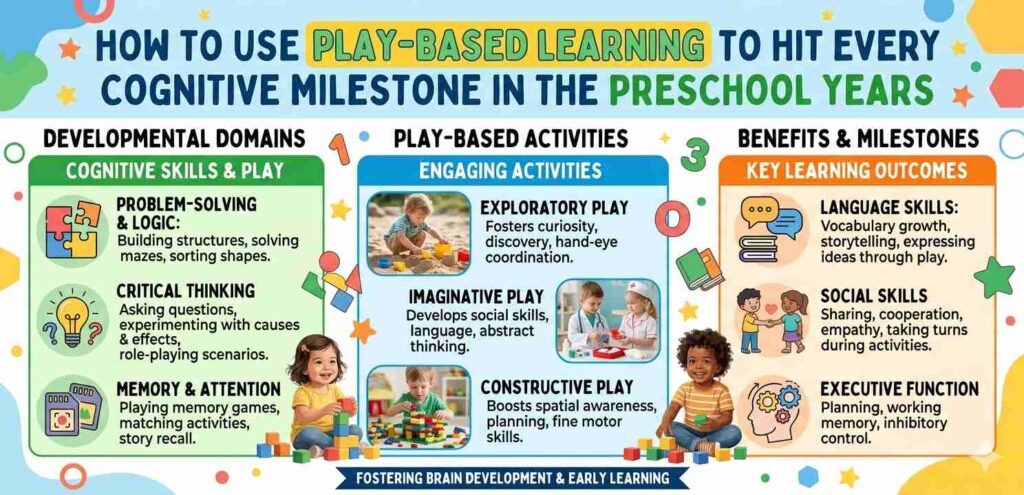
Play-based learning is one of the most natural and effective ways young children develop thinking, language, memory, and problem-solving skills. During the preschool years (roughly ages 3 to 6), the brain grows faster than at almost any other point in life. What children do with their time during these years genuinely matters — and play is right at the center of it.
This article will walk you through how play-based learning supports each major cognitive milestone in the preschool years, with real examples you can try at home or in a classroom setting.
What Play-Based Learning Actually Means
A lot of parents confuse play-based learning with “just letting kids play.” That’s not quite right.
Play-based learning is intentional. It means designing or choosing activities where children naturally explore, question, and discover — but where those experiences are connected to real developmental goals. It’s less about sitting at a desk and more about giving children the right materials, environment, and freedom to engage their minds.
Think of it this way: when a child pours water from one container to another, they’re learning about volume, cause and effect, and even early math concepts. That’s play-based learning. No worksheet needed.
Why the Preschool Years Are So Important for Cognitive Growth
Between ages 3 and 6, children go through rapid changes in how they think, reason, and understand the world. Cognitive milestones during this period include things like:
- Sorting and categorizing objects
- Understanding “more” and “less”
- Following two-step instructions
- Beginning to understand cause and effect
- Developing early memory and attention skills
- Learning to think symbolically (pretending a banana is a phone, for example)
These aren’t small achievements. They form the foundation for reading, math, and social understanding later on.
Play-based learning is one of the most reliable ways to reach these milestones without pressuring children into formal academic work too early.
How Play-Based Learning Supports Memory Development
Memory is one of the first cognitive skills to blossom in the preschool years. And play is surprisingly good at strengthening it.
When children play games that involve repetition — like singing the same song, repeating a story, or playing simple matching games — they exercise working memory without even realizing it. The engagement that comes from play makes the brain hold onto information much more effectively than passive instruction does.
Try This: Simple Memory Card Games
Take about 10 pairs of picture cards (animals, fruits, household objects). Lay them face down and ask your child to find matching pairs. This game directly builds play-based learning skills tied to visual memory and concentration.
Don’t worry if your 3-year-old struggles at first. That struggle is actually where the learning happens.
Language and Vocabulary Growth Through Play
Preschool children absorb language at a remarkable rate. By age 5, most children have a vocabulary of around 2,000 words — and a large portion of that comes through play-based learning experiences, not formal lessons.
When children play pretend — setting up a “restaurant,” acting as a doctor, or building a “house” — they’re using language in real, purposeful ways. They negotiate, describe, narrate, and problem-solve. This kind of rich verbal play does more for vocabulary development than flashcards typically can.
The Role of Storytelling Play
Ask your child to tell you the story of what their stuffed animals are doing. Or make up a story together about a toy car that goes on an adventure.
This is play-based learning applied directly to language development. You’re building narrative skills, sequencing ability, and expressive language — all essential cognitive milestones — through something that feels completely natural and fun.
Building Problem-Solving Skills With Open-Ended Play
One of the most important cognitive milestones in preschool is early problem-solving. Children this age are just beginning to understand that problems have solutions and that you can try different approaches to figure something out.
Open-ended play — where there’s no fixed “right” answer — is perfect for this. Building blocks, sand, water, playdough, and even cardboard boxes all qualify.
When a child builds a tower and it falls, they think about why. They try again. Maybe they put the bigger blocks at the bottom this time. That’s genuine problem-solving happening in real time.
Play-based learning through open-ended materials lets children experiment without fear of failure. That mindset is actually one of the most valuable things a preschool-age child can develop.
How Pretend Play Develops Abstract Thinking
Here’s something that surprises many parents: pretend play is one of the most cognitively demanding things a preschooler can do.
When a child pretends a stick is a spoon or that they’re a firefighter putting out a pretend fire, they’re using symbolic thinking. This is the cognitive ability to let one thing stand for another — and it’s directly connected to how children eventually understand letters (a symbol for a sound) and numbers (a symbol for a quantity).
Play-based learning that incorporates pretend or dramatic play is laying the mental groundwork for literacy and numeracy, even when it looks like pure silliness.
Set Up a Pretend Kitchen
Give your preschooler some old pots, plastic cups, and a few safe “ingredients” (dried pasta, water, sand). Let them cook a meal for you.
Watch how they narrate, categorize, and sequence steps. They’re doing serious cognitive work in a completely joyful context.
Math Concepts Hidden Inside Everyday Play
You don’t need workbooks to introduce early math. Play-based learning covers a surprising amount of early numeracy, often without children even noticing.
Sorting toys by color or size teaches classification. Counting steps while walking builds number sense. Dividing snacks equally introduces the concept of fair sharing — a precursor to division. Even filling and emptying containers builds intuitive understanding of measurement.
These are all real cognitive milestones that show up in official early childhood development frameworks, and they can all be reached through everyday play-based learning activities.
A Few Simple Ideas
- Sort a pile of buttons by color, size, or shape
- Count out loud during cleanup (how many blocks went in the bin?)
- Use a balance scale with small toys to explore heavier and lighter
None of these require a lesson plan. They just require a little intention from the adult guiding the play.
Social Cognition: Learning to Think About Others
This one is often overlooked in conversations about cognitive development — but it matters enormously. Social cognition is the ability to understand that other people have different thoughts, feelings, and perspectives than your own.
Preschool children are just beginning to develop this skill, which researchers call “theory of mind.” And group play is one of the best ways to build it.
When children play together — especially in unstructured settings like a park or playroom — they encounter disagreements, take turns, negotiate roles in pretend games, and navigate frustration. Each of those moments is a micro-lesson in seeing the world from someone else’s point of view.
Play-based learning that involves cooperation and social interaction isn’t just good for social development — it’s cognitively stimulating in ways that solo tasks often aren’t.
How Parents and Teachers Can Support Play-Based Learning
Supporting play-based learning doesn’t mean hovering or directing every moment. In fact, too much adult intervention can actually reduce the cognitive challenge and make play less effective.
The best approach is what educators sometimes call “playful scaffolding.” You set up the environment, provide interesting materials, and occasionally ask open-ended questions. Then you step back.
Questions like “What do you think will happen if…?” or “Can you find another way to do that?” push children to think more deeply without taking away their agency.
What to Avoid
Don’t turn every play session into a quiz. Don’t rush to solve problems for your child. Don’t redirect them toward “more educational” activities every time they seem to be playing freely. Free, child-directed play is enormously valuable — and it IS educational, even when it doesn’t look like it.
Choosing the Right Materials to Support Cognitive Milestones
Not all toys are equally useful for play-based learning. The most cognitively rich toys are usually the simplest.
Open-ended materials — blocks, clay, sand, water, loose parts like buttons and sticks — invite more creative thinking than toys that do the playing for the child.
High-stimulation electronic toys with lots of flashing lights and sounds tend to reduce the child’s role to passive observer. The child watches and reacts. Open-ended materials require the child to create and decide.
For hitting cognitive milestones in the preschool years, go simple. A set of wooden blocks will outperform most “educational” tech toys in terms of cognitive engagement.
Outdoor Play and Its Cognitive Benefits
There’s a tendency to think of cognitive development as something that happens at a table with puzzles or pencils. But outdoor play-based learning is genuinely powerful.
Nature gives children open-ended, unpredictable environments that challenge the brain in unique ways. A child navigating uneven ground, picking up rocks to compare their weight, or watching how water flows in a stream is doing real cognitive work.
Research consistently shows that outdoor play supports attention, executive function, and creativity — all of which are key cognitive milestones in the preschool years.
Even a simple walk outside, if guided by curiosity (“I wonder why the leaves on this tree are different colors?”), becomes a powerful play-based learning experience.
Final Conclusion
Play isn’t a break from learning — it is learning. Especially in the preschool years, when the brain is wiring itself at remarkable speed, the experiences children have through play shape how they think, reason, and engage with the world for years to come.
Play-based learning gives children the chance to develop memory, language, problem-solving, math concepts, and social thinking — all at once, all naturally, and all in ways that feel meaningful to them. You don’t need expensive curricula or structured lessons to hit every cognitive milestone. You need good materials, a thoughtful environment, and the willingness to let your child explore.
Start where you are. Even small, playful moments — a sorting game with buttons, a made-up story at bedtime, a walk outside with an open question — are already play-based learning in action.