
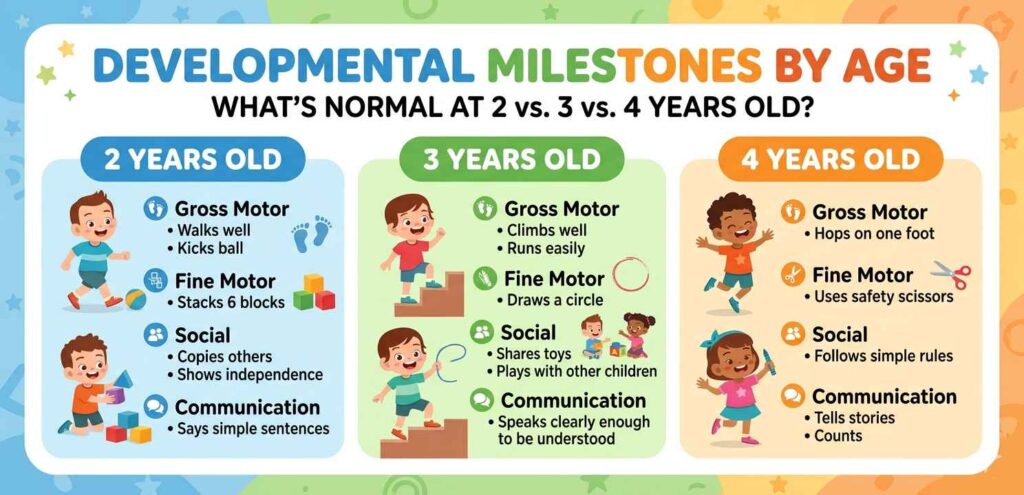

If you’ve ever watched your toddler and quietly wondered, “Is this normal for their age?”—you’re not alone. Every parent does it. Understanding developmental milestones by age helps you see your child’s growth more clearly, not through worry, but through genuine knowledge.
This guide breaks things down simply: what most children can do at age 2, what shifts at age 3, and what you can reasonably expect by age 4. Keep in mind, these are general patterns—not a checklist your child must pass.
Why Developmental Milestones by Age Actually Matter
Milestones aren’t just boxes to tick on a pediatrician’s form. They’re patterns that researchers and child development specialists have observed in thousands of children over decades. When parents understand developmental milestones by age, they’re better equipped to notice both typical growth and areas where a child might benefit from extra support.
The early years—ages 2 through 4—are particularly important. The brain grows faster during this window than at almost any other time in life. Language, social awareness, physical coordination, and problem-solving all develop in overlapping, sometimes surprising ways.
It’s also worth noting: boys and girls often hit certain milestones at slightly different times. Firstborn children sometimes develop speech a little earlier than younger siblings. None of this means something is wrong—it just means children are different.
Developmental Milestones at Age 2: The Busy Toddler Phase
Two-year-olds are fascinating. One minute they’re hugging you; the next they’re throwing a toy across the room because you cut their sandwich the wrong way. Welcome to toddlerhood.
Language and Communication at 2
Most 2-year-olds are starting to put two words together—”more juice,” “daddy go,” “big dog.” Some kids this age have a vocabulary of 50 words or more, while others are still building. If your child uses fewer than 50 words or isn’t combining any words at all by 24 months, that’s worth mentioning to your pediatrician.
They’re also beginning to follow simple two-step directions, like “Pick up the ball and bring it here.” Pointing to pictures in books when you name them is another skill that tends to emerge around this time.
Physical Skills at 2
Running, climbing, and kicking a ball are typical for this age. Most 2-year-olds can walk up and down stairs while holding your hand. They can stack four to six blocks and start scribbling with crayons—usually big circular or back-and-forth lines rather than anything recognizable.
Fine motor control is still developing. Turning pages in a book, spooning food (albeit messily), and starting to undress themselves are all part of developmental milestones by age two.
Social and Emotional Development at 2
This is when parallel play becomes obvious. Two-year-olds tend to play next to other children rather than with them. They’re not being antisocial—it’s developmentally appropriate. True cooperative play comes a bit later.
Separation anxiety can still be strong at this age. It’s normal for a 2-year-old to cry when a parent leaves, even briefly. Tantrums are also completely typical—they’re not a sign of bad behavior, but of a brain that doesn’t yet have the tools to regulate big emotions.
Developmental Milestones at Age 3: When Things Start Clicking
Age 3 often feels like a leap. Kids who seemed like babies just months ago are suddenly holding conversations, making friends, and asking “why” approximately four hundred times a day.
Language Growth at 3
By age 3, most children are speaking in three- to four-word sentences. Their vocabulary is expanding rapidly—often into the hundreds of words. Strangers should be able to understand about 75% of what a 3-year-old says, even if the pronunciation isn’t perfect.
Questions are a defining feature of this age. “Why is the sky blue?” “Where does rain come from?” “Why do dogs bark?” This curiosity isn’t just cute—it’s a sign that cognitive and language development are progressing well.
Storytelling starts emerging too. Children at this age begin to retell simple events from their day, sometimes with surprising accuracy and sometimes with creative embellishments.
Physical Milestones at 3
Three-year-olds are getting steadier. They can usually ride a tricycle, balance briefly on one foot, and throw and catch a large ball with more control than before. Climbing playground equipment with less assistance is common.
In terms of developmental milestones by age three, hand skills get noticeably finer. Children can draw a rough circle, start to use child-safe scissors, and may begin drawing people—often a head with legs sticking out, sometimes called a “tadpole person.” It looks simple, but it represents real cognitive and motor progress.
Emotional and Social Shifts at 3
Real friendships start to form around age 3. Children begin playing with others rather than just alongside them. Imaginative play takes off—kids become dragons, doctors, chefs, or superheroes. This kind of play is deeply important for developing empathy, problem-solving, and creativity.
Three-year-olds also start to show more awareness of other people’s feelings. They might offer a hug to a crying friend or look guilty after taking a toy. Emotional regulation is still a work-in-progress, but progress is visible.
For more on supporting emotional development during this phase, this overview from the CDC’s developmental monitoring resources is a helpful reference.
Developmental Milestones at Age 4: The Preschool Leap
Four-year-olds can sometimes feel like small adults—until they dissolve into tears because their sock feels “too lumpy.” They’re capable of impressive reasoning one moment and completely baffling behavior the next.
Language and Literacy at 4
By age 4, most children speak in full sentences and can tell you a story with a beginning, middle, and end—even if the logic doesn’t always hold up. They use words like “because,” “if,” and “when,” which shows early logical thinking.
Some 4-year-olds begin recognizing letters, especially the ones in their own name. Others aren’t there yet, and that’s fine. Early literacy readiness is part of developmental milestones by age four, but it looks different for every child.
Rhyming is another common skill at this stage. If a child can play with words—making up silly rhymes or noticing that “cat” and “hat” sound the same—that’s a positive sign for future reading development.
Motor Skills at 4
Four-year-olds can usually hop on one foot, pump their legs on a swing, and navigate stairs without holding on. They’re also getting better at tasks that require precision: drawing recognizable shapes, cutting along lines, and dressing themselves with only occasional help.
Drawing at age 4 becomes more intentional. Many 4-year-olds can draw something that looks like a person with a head, body, arms, and legs. They might also draw simple houses, suns, or trees.
Thinking and Problem-Solving at 4
This is a big area of growth. Four-year-olds are starting to understand that other people have thoughts and feelings that differ from their own—called “theory of mind” in developmental psychology. This underpins empathy and social skills.
They can sort objects by color, shape, or size. They understand basic concepts of time—”yesterday,” “today,” “tomorrow”—even if they still mix them up occasionally. Counting to ten or beyond is typical for many kids this age, though understanding what numbers actually mean (called number sense) is still developing.
For a deeper look at cognitive growth during the preschool years, the American Academy of Pediatrics’ developmental resources offer evidence-based guidance for parents and caregivers.
When to Talk to a Doctor About Developmental Milestones by Age
Knowing the range of what’s typical also means knowing when to seek input. Most variation in development is completely normal, but there are some patterns worth flagging.
At age 2, talk to your child’s doctor if they: don’t use at least 15–20 words, don’t point to things to show interest, have lost skills they previously had, or don’t seem to notice when you leave or return.
At age 3, consider a conversation with your pediatrician if they: can’t be understood by strangers at all, aren’t interested in other children, have frequent falls or difficulty climbing, or aren’t using simple sentences.
At age 4, a check-in makes sense if they: can’t tell a short story, show no interest in pretend play, are very hard to understand even by family, or seem unable to separate from parents for brief periods.
None of these mean something is definitely wrong—but early evaluation leads to early support, which makes a real difference.
Also worth noting: learning about developmental milestones by age helps parents advocate for their children during routine checkups. You know your child better than anyone.
A Few Things That Don’t Change the Milestone Picture
Sometimes parents worry about things that genuinely don’t affect development. Screen time (within reason), speaking two languages at home, or having a shy temperament don’t typically change when a child hits developmental milestones by age two, three, or four.
Bilingual children might seem to mix languages or have a slightly different vocabulary distribution across languages, but their overall language development is completely typical.
Children who are quieter or more cautious by nature aren’t necessarily delayed—they may just need more warm-up time in social situations.
Final Conclusion
Understanding developmental milestones by age is less about measuring your child and more about understanding them. The journey from a messy, wobbly two-year-old to a curious, story-telling four-year-old is remarkable—and it happens differently for every child.
Watch for patterns over time rather than single moments. Celebrate the little leaps. And when something genuinely concerns you, trust your instincts and talk to a pediatric professional.
Growth isn’t a race. But knowing what to look for helps you show up for it with confidence.