

The truth is, child learning milestones aren’t just checkboxes on a pediatrician’s form. They’re meaningful signals about how your child’s brain, body, and social world are developing together. And when you understand what to look for, you can support your child far more effectively than any app or flashcard ever could.
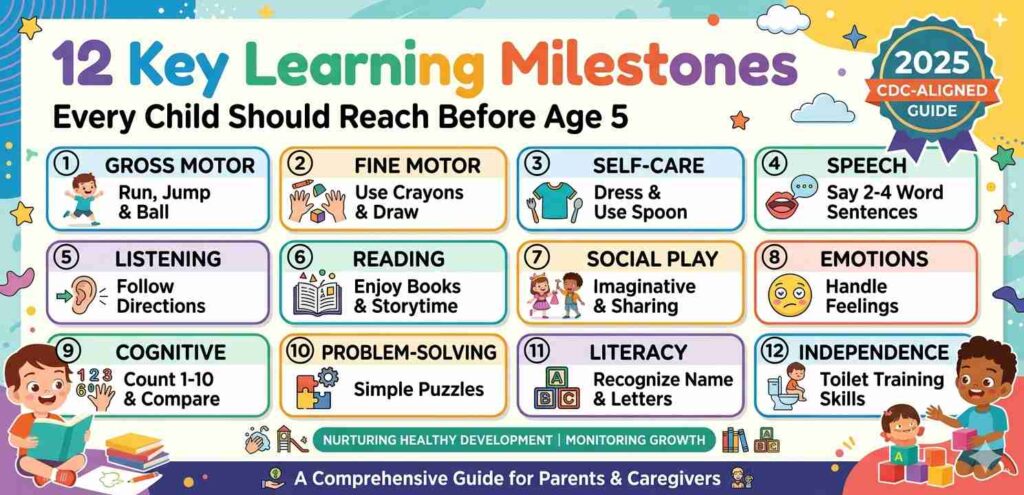
This guide covers 12 key child learning milestones aligned with the updated 2025 CDC developmental guidelines — broken down by age range, with practical examples you can observe right at home.
Why Child Learning Milestones Matter More Than You Think
A lot of parents think milestones are about comparison — “my neighbor’s kid walked at 10 months, why hasn’t mine?” But that’s not really the point.
Child learning milestones are about patterns. They give doctors and parents a shared language for spotting when development might need a little extra support — and when everything is going just fine.
The CDC updated its milestone checklists in 2022, and those revisions have carried into 2025 guidance. One major shift: the benchmarks are now more realistic and inclusive, moving away from vague ranges toward clearer, observable behaviors at specific ages.
Milestone 1 – Responds to Name by 9 Months
Around 6–9 months, most babies will turn their head or look up when you call their name. This is one of the earliest child learning milestones tied to social awareness and early communication.
If a baby consistently doesn’t respond to their name by 9 months, it’s worth mentioning to your pediatrician — not to panic, but to stay proactive.
Milestone 2 – Points to Objects or Pictures by 12 Months
Pointing might seem simple, but it’s actually a big cognitive and social leap. When a baby points at a dog in a book or reaches toward something they want, they’re showing what experts call “joint attention” — the ability to share focus with another person.
This is one of the early child learning milestones that lays the groundwork for language development. You can encourage it just by pointing at things yourself and narrating your day.
Milestone 3 – Says 2–3 Words Besides “Mama” and “Dada” by 12 Months
By the time a child reaches their first birthday, most will have at least a couple of meaningful words in their vocabulary. “More,” “dog,” “up” — these count.
This particular child learning milestone is about intentional communication, not just mimicking sounds. If your child says a word and looks at you to see your reaction, that’s intentional.
Milestone 4 – Walks Independently by 12–15 Months
Motor development is just as much a part of child learning milestones as language is. Walking independently — even with a wobbly gait — signals major neurological maturity.
Most children take their first independent steps somewhere between 9 and 15 months. The CDC’s 2025 guidance sets 15 months as the clearer benchmark, meaning a child not walking by then should be evaluated.
Milestone 5 – Follows Simple 1-Step Instructions by 18 Months
“Give me the ball.” “Come here.” “Sit down.”
By 18 months, a child should be able to understand and follow simple, single-step instructions — especially with a gesture to help. This milestone connects directly to how language comprehension develops before speaking ability.
It’s worth noting: following instructions without a gesture (just words alone) comes a bit later, usually around 24 months.
Milestone 6 – Uses at Least 50 Words by Age 2
This is one of the most watched child learning milestones — and one that surprises many parents by how achievable it actually is. By age 2, most children have a vocabulary of around 50 words and are starting to put two words together, like “more milk” or “daddy go.”
If a child has fewer than 20 words at age 2, a speech evaluation is recommended. Early intervention, when needed, works best the sooner it starts. You can learn more about typical speech development at the American Speech-Language-Hearing Association (ASHA), which offers free, parent-friendly resources.
Milestone 7 – Engages in Pretend Play by Age 2–2.5
Pretend play — feeding a stuffed animal, “talking” on a toy phone, pretending to cook — is actually one of the most important child learning milestones for cognitive growth.
It shows that a child can hold a mental image of something that isn’t literally in front of them. That’s a significant abstract thinking skill, and it directly supports later reading and math learning.
Milestone 8 – Can Be Understood by Strangers 50% of the Time by Age 2
Parents almost always understand their own toddler’s speech — we’ve learned to decode it. But a child’s speech clarity to unfamiliar listeners is a useful developmental marker.
By age 2, strangers should be able to understand roughly half of what a child says. By age 3, that jumps to about 75%. By age 4, most children are understood nearly all the time by people outside the family.
This is one of those child learning milestones that’s easy to overlook because parents compensate without realizing it.
Milestone 9 – Sorts Objects by Color or Shape by Age 3
Cognitive child learning milestones become more visible around age 3. Sorting toys by color, grouping shapes, or separating “big” from “little” — these seem like play, but they’re actually early categorization skills that directly feed into math readiness.
A good activity: give a child a pile of blocks in two colors and ask them to “put the red ones here and the blue ones there.” Most 3-year-olds can do this with a little practice.
Milestone 10 – Uses Sentences of 4–5 Words by Age 3
By age 3, children should be stringing together short but meaningful sentences. “I want the red cup.” “The dog is sleeping.” “Where did daddy go?”
This milestone reflects growth in grammar, memory, and social communication all at once. According to the CDC’s developmental milestones page, children who aren’t using 4-word sentences by age 3 should be referred for a speech-language evaluation.
Milestone 11 – Draws Simple Shapes and Copies Lines by Age 3–4
Fine motor child learning milestones often get less attention than language ones, but they matter a lot for school readiness. By age 3–4, most children can draw a rough circle, copy a vertical line, and attempt basic shapes when shown.
These skills feed directly into handwriting and early writing readiness. You don’t need special materials — a piece of paper and some crayons are all it takes to practice.
Milestone 12 – Understands and Follows 2-Step Instructions Without Gestures by Age 4–5
By the time a child approaches age 5, they should be able to handle instructions like “go to your room and bring me your shoes” — without needing pointing or gestures to guide them.
This milestone reflects working memory, listening comprehension, and sequencing ability. All three are foundational skills for kindergarten success.
Children who still need visual cues for two-step tasks by age 4.5–5 may benefit from some additional support, which early childhood educators can help identify.
How to Support Child Learning Milestones at Home
You don’t need a curriculum or a structured program. Most of the best support for child learning milestones happens naturally through:
- Talking and narrating — describe what you’re doing as you cook, walk, shop
- Reading aloud — even brief picture books build vocabulary and attention
- Unstructured play — building, pretending, exploring
- Responsive interaction — answering questions, following a child’s curiosity
The most powerful developmental tool any child has is a consistent, engaged adult who talks with them, not just at them.
For deeper guidance on supporting early development, the Zero to Three Foundation has excellent, research-backed resources designed specifically for parents and caregivers.
When to Talk to Your Pediatrician
It’s easy to feel anxious reading milestone lists. A few things to keep in mind:
Milestones are ranges, not deadlines. Most children hit them at slightly different times, and that’s okay. The goal of tracking child learning milestones isn’t to worry — it’s to know what to notice.
Red flags worth mentioning to a doctor include: no words by 16 months, no two-word phrases by 24 months, any loss of skills at any age, or a child who avoids eye contact consistently.
Bringing it up early is always better than waiting. Pediatricians would rather hear a concern that turns out to be nothing than miss something that needed attention.
Final Conclusion
The early years of a child’s life are genuinely remarkable — a period of growth that no other time in life quite matches. Understanding the core child learning milestones before age 5 gives parents a practical way to stay engaged and informed, not anxious.
Each milestone builds on the last. Language supports social skills. Motor skills support independence. Pretend play supports abstract thinking. Nothing develops in isolation, and nothing happens on a perfectly identical timeline in every child.
What matters most is consistent attention, responsive interaction, and knowing when to ask for a little extra support. You don’t need to be a child development expert — you just need to be present, curious, and willing to learn alongside your child.