

Introduction
If you’ve been searching for a good screen-free audio player for your little one, chances are you’ve come across the Yoto Player vs Tonie Box for toddlers debate more than once. Both products have become really popular with parents who want their kids to enjoy stories, music, and learning content — without handing them a tablet or phone.
But here’s the thing: these two devices feel similar on the surface, yet they work quite differently. Choosing the wrong one could mean spending money on something your toddler barely uses, or missing out on features that really could’ve helped with early learning.
So let’s break it down — honestly, clearly, and without the marketing fluff.
What Is the Yoto Player?
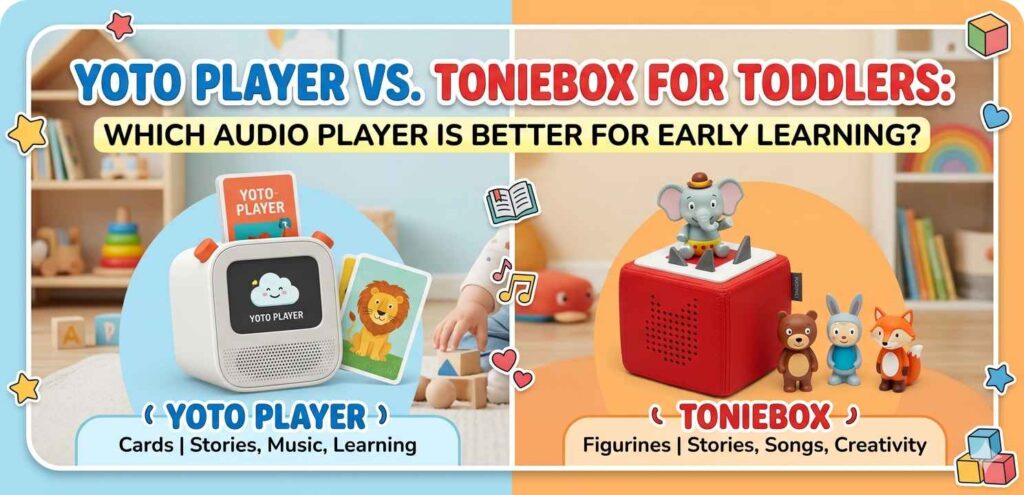
The Yoto Player is a screen-free audio device designed for children. It plays content through small cards that you slot into the device. Each card holds a story, a podcast, a music album, or an educational activity.
What makes Yoto interesting is that parents can also create their own cards using the Yoto app. You can record a bedtime story in your own voice, add a lullaby playlist, or even load up a language learning track you’ve personally selected.
The device has a small pixel display on the front — not a screen for watching videos, but more like an icon that reacts to what’s playing. It lights up and shows simple animations, which toddlers actually find quite engaging.
The physical design is straightforward: chunky enough to handle toddler hands, with a simple dial and card slot. The speaker quality is genuinely good for a kids’ product.
What Is the Tonie Box?
The Tonie Box (also called Tonies) works on a similar concept — audio content played through physical figures. Instead of cards, you place small painted character figures (called Tonies) on top of the box, and it automatically plays the associated content.
Each Tonie figure is connected to a specific piece of content — a story, a song collection, or an audiobook. The figures are colorful and tactile, which is a big part of their appeal for very young children. Toddlers love picking up a figure, turning it in their hands, and placing it on the box themselves.
The box has no screen at all — not even a small icon display. Content plays immediately when the figure is placed on top. It’s genuinely simple to use, even for a two-year-old.
Yoto Player vs Tonie Box for Toddlers: Design and Ease of Use
When you’re comparing the Yoto Player vs Tonie Box for toddlers, physical design matters a lot. Toddlers aren’t known for being gentle with things.
The Tonie Box wins slightly here for the very youngest kids (ages 1–3). The large, colorful figures are intuitive — there’s something deeply satisfying about placing a figurine and hearing your favorite character’s voice immediately. No buttons, no fiddling. Even 18-month-olds can figure this out quickly.
The Yoto Player requires inserting a card into a slot, which is slightly more of a fine motor challenge for very young toddlers. Kids around age 3 and up handle it well, but younger children may need help. On the plus side, those cards are durable, small, and easy to store.
Both devices are well-built. Neither feels cheap or fragile, which matters when you’re spending real money on something a toddler is going to carry around, drop, and occasionally throw.
Content Library: Which Has More to Offer?
This is probably where the Yoto Player vs Tonie Box for toddlers comparison gets really interesting.
Yoto Player Content
Yoto’s content library is large and includes recognizable titles — Roald Dahl stories, Peppa Pig, nursery rhyme collections, sleep meditations for kids, and even BBC podcasts designed for children. The cards cover a wide age range too, so as your toddler grows, Yoto grows with them.
One standout feature is the Make Your Own cards. Parents can use the Yoto app to load custom content — your own voice, homemade recordings, or independently sourced audio. This is surprisingly useful for early learning because you can add content in your home language, record vocabulary practice, or create personalized bedtime stories.
Tonie Box Content
The Tonie figures also cover popular titles — Disney characters, fairy tales, nursery rhymes, and popular children’s authors. The content is well-curated and generally high quality in production.
However, you can’t easily add custom content unless you buy a specific type called a “Creative Tonie,” which is a blank figure you can record content onto via the Tonies app. It’s a nice option, but it costs extra and the setup is a bit less flexible compared to Yoto’s system.
Price and Ongoing Costs: An Honest Look
Let’s talk money, because this is where the Yoto Player vs Tonie Box for toddlers decision often gets made.
The Yoto Player Mini (the smaller version) typically retails around $60–$70, while the standard Yoto Player is around $100. Individual Yoto cards cost roughly $5–$15 each.
The Tonie Box starts around $80–$90, and individual Tonie figures cost roughly $14–$17 each. Here’s the tricky part — those figures add up fast. If your toddler wants a new story every week (and they will), you could easily spend $50–$70 a month just on new Tonies.
Yoto cards are slightly cheaper on average, and you can also access a Yoto Club subscription for additional audio content. That said, neither device is inexpensive once you factor in building a content library.
If budget is a concern, Yoto tends to offer slightly better long-term value, especially with the custom card option.
Early Learning Value: Which Actually Helps Development?
Parents who are genuinely thinking about early childhood development — not just entertainment — should look at this carefully.
Audio and Language Development
Both devices support early language development well. Listening to stories builds vocabulary, comprehension, and imagination. This applies to both Yoto and Tonie, and both have quality narrations that kids respond to positively.
Independent Play and Autonomy
The Yoto Player vs Tonie Box for toddlers comparison shifts here. The Tonie Box’s figurine system encourages a kind of independent “choose your own experience” play that feels very organic for toddlers. They pick up a figure, they decide what they want to hear, they feel a sense of control. That’s genuinely valuable for developing autonomy and decision-making.
Yoto also encourages independence — children learn to handle and swap cards themselves — but the physical satisfaction of holding a character figure is harder to replicate.
Sleep Routines and Calm Time
Both devices are marketed for bedtime use, and honestly, both work well for this. The Yoto Player has a dedicated sleep timer and a night light feature on some models. The Tonie Box doesn’t have built-in sleep features but plays through its content naturally.
If building a consistent sleep routine matters to you, the Yoto Player has a slight edge here.
Connectivity and Parental Controls
The Yoto app is well-designed and gives parents real control — managing content, setting usage limits, and monitoring what your child is listening to. Updates and new content arrive over Wi-Fi.
The Tonies app is also decent but slightly more limited in terms of content management. Both require Wi-Fi to register and sync, though neither device needs internet connectivity to actually play content once it’s loaded.
For parents who are intentional about what their toddler listens to, Yoto’s app feels a bit more parent-friendly overall.
Which Is Better for Different Ages?
- Ages 1–2: Tonie Box is easier to use and the tactile figures are more engaging at this age
- Ages 3–5: Both work well; Yoto becomes more versatile with its wider card library
- Ages 5+: Yoto clearly grows better with the child, especially with educational content and podcasts
Final Conclusion
So, when it comes to the Yoto Player vs Tonie Box for toddlers, there’s no single winner — it really depends on your child’s age, your priorities, and your budget.
If your toddler is very young and you want something intuitive and tactile that they can operate completely on their own from day one, the Tonie Box is a wonderful choice. The figurines are charming, the experience is magical, and kids genuinely love it.
If you’re thinking longer-term, want more content flexibility, prefer custom options, or care about features like sleep timers and parental controls, the Yoto Player offers better overall value and grows with your child in a way the Tonie Box doesn’t quite match.
Either way, you’re making a genuinely good choice by investing in screen-free audio play. Both devices support early learning, imagination, and healthy listening habits — and that’s worth a lot.