
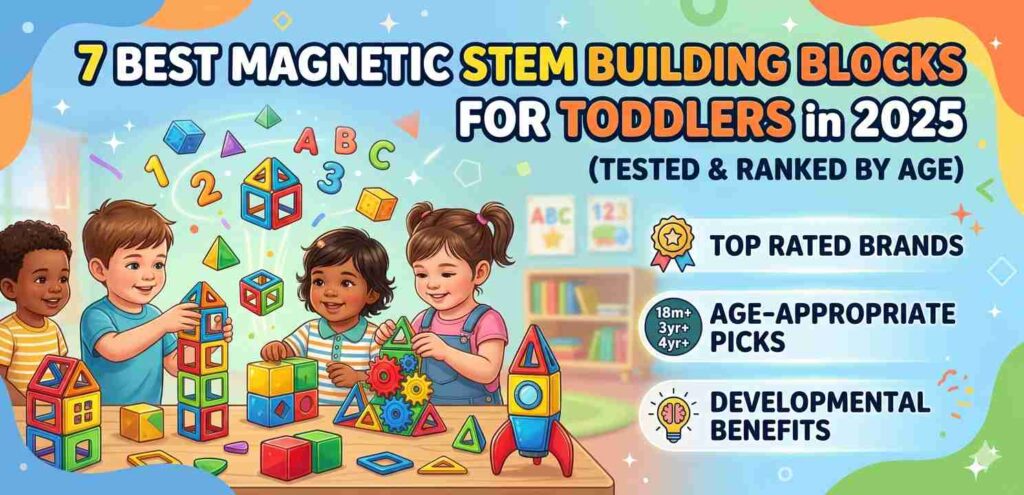

If you’ve ever watched a toddler spend twenty minutes stacking blocks just to knock them over with pure joy, you already understand why magnetic STEM building blocks for toddlers are such a big deal right now. These aren’t just fun toys — they quietly introduce kids to shapes, balance, spatial thinking, and basic physics, all before they even start school.
But the market is crowded. There are dozens of sets with similar-looking packaging, and most parents (understandably) have no idea what actually makes one better than another. That’s exactly why this guide exists.
We looked at seven of the most popular options available in 2025, evaluated each one by age suitability, magnet strength, build quality, and how genuinely educational they are. No fluff, no sponsored rankings — just honest breakdowns.
Why Magnetic STEM Building Blocks for Toddlers Actually Work
There’s a reason child development experts keep coming back to open-ended construction toys. When toddlers play with magnetic STEM building blocks, they’re not just building towers — they’re learning cause and effect, developing fine motor skills, and starting to understand how shapes fit together in three-dimensional space.
The magnetic component adds something extra. A child quickly figures out that some sides attract and others repel. That’s magnetism, introduced naturally through play. No lesson plan required.
According to research supported by PBS LearningMedia, hands-on building play in early childhood strongly correlates with stronger spatial reasoning skills later in school — particularly in math and science subjects.
What to Look for Before You Buy
Before jumping into the list, it helps to know what actually separates a quality set from a frustrating one.
Magnet strength matters a lot. Weak magnets mean structures collapse easily, which discourages younger kids fast. You want pieces that click together with enough force to hold simple structures but aren’t so powerful that small hands struggle to pull them apart.
Size of the pieces. For toddlers under 3, larger tiles are safer and easier to grip. Smaller sets are better for 4-year-olds and up who have better hand coordination.
Durability. Toddlers are rough. Tiles with good edge sealing and ABS plastic frames survive a lot better than cheaper alternatives.
How many pieces come in the box. A 32-piece set sounds great until you realize 12 of those are tiny connector rods. Always check how many actual tiles you’re getting.
7 Best Magnetic STEM Building Blocks for Toddlers in 2025
1. Magformers Classic Set (Ages 3+)
Magformers has been around for years and there’s a reason it keeps showing up on best-of lists. The translucent plastic tiles are vibrant, the magnets are consistently strong, and the pieces snap together satisfyingly without being too stiff for small hands.
This is one of the best magnetic STEM building blocks for toddlers if your child is just getting started. The shapes are limited to squares and triangles in the basic set, which actually makes it easier for beginners. Less to think about, more room to experiment.
Best for: Ages 3–5 Piece count: 30 What we liked: Durability and consistency across pieces Watch out for: Pricier than most alternatives
2. PicassoTiles 100-Piece Set (Ages 3+)
PicassoTiles offer a lot of pieces at a reasonable price, which makes this one of the more popular magnetic STEM building blocks for toddlers sets on the market. The tiles are color-coded by shape, which helps children recognize patterns more intuitively.
The 100-piece count means there’s enough variety to build more ambitious structures, but it also means more to sort and store. A storage bag comes included, which is a practical touch most competitors miss.
The magnets are slightly weaker than Magformers, so very elaborate builds can sometimes wobble. For the age group, that’s usually not an issue.
Best for: Ages 3–6 Piece count: 100 What we liked: Value for money, variety of shapes Watch out for: Magnet strength dips with some individual tiles
For a deeper look at how building toys support early childhood learning, the American Academy of Pediatrics has published helpful guidance on play-based development you might find useful.
3. Connetix Tiles Rainbow Set (Ages 2+)
Connetix is a newer brand that’s built a strong reputation quickly, and it’s easy to see why. The magnets are genuinely excellent — strong, balanced, and consistent. The acrylic tiles have a slightly higher-quality feel than most competitors, and the colors are especially vivid in sunlight.
What makes this a standout set for younger toddlers is the size. The pieces are on the larger side, easier to grip, and the magnets engage smoothly even with uncoordinated little hands.
If you’re looking for magnetic STEM building blocks for toddlers around age 2 to 3, Connetix is one of the few sets we’d genuinely recommend for that younger end of the range.
Best for: Ages 2–5 Piece count: 64 What we liked: Magnet quality, beginner-friendly size Watch out for: On the expensive side for a 64-piece set
4. Magna-Tiles Clear Colors 32-Piece Set (Ages 3+)
Magna-Tiles is arguably the most well-known brand in this space, and the Clear Colors set is their flagship. The transparent tiles work beautifully with light — kids love holding them up to windows and watching colors mix.
For the STEM angle, this set works especially well. Parents can use the light-play aspect to introduce basic color theory and shadow experiments, which naturally extends the learning beyond just building.
The downside is piece count. Thirty-two pieces is on the lower end, and if your child wants to build anything ambitious, they’ll hit the ceiling quickly. Many parents end up buying expansion packs.
Best for: Ages 3–7 Piece count: 32 What we liked: Light play, brand reliability, consistent magnets Watch out for: Limited pieces, expansion packs add up
5. LEGO DUPLO Classic Brick Box with Magnetic Starter Pack (Ages 2+)
LEGO DUPLO’s magnetic-enhanced starter options bridge the gap between traditional interlocking blocks and magnetic tiles. While not a pure magnetic tile set, the hybrid approach works really well for the youngest toddlers who benefit from the physical click of DUPLO alongside the magnetic connection experience.
This is a great entry point for magnetic STEM building blocks for toddlers who are on the younger end — around 2 to 3 years — and still developing the grip strength and coordination needed for pure tile-based sets.
Best for: Ages 2–4 Piece count: Varies by bundle What we liked: Familiar DUPLO compatibility, gentle learning curve Watch out for: Not a traditional magnetic tile experience
6. Geomag Mechanics Gravity Set (Ages 4+)
Geomag’s Mechanics line is a step up in complexity, which makes it a better fit for older toddlers moving into the preschool stage. The set introduces gears, wheels, and pulleys alongside the standard rod-and-ball magnetic system, which opens up a genuinely different kind of play.
This isn’t the easiest set to start with, but for a curious 4 or 5-year-old who’s already comfortable with basic magnetic building, it’s a meaningful upgrade. The magnetic STEM building blocks for toddlers concept scales here into actual mechanical thinking.
Best for: Ages 4–7 Piece count: 44 What we liked: Introduces mechanical concepts early Watch out for: Steeper learning curve, small parts
7. Playmags 100-Piece Super Set (Ages 3+)
Playmags competes directly with PicassoTiles on price and piece count, but edges it out in one area: the included activity cards. Each set comes with illustrated building challenges that give children a starting point rather than a blank canvas, which is genuinely helpful for kids who freeze up with too many options.
The magnets are solid, the tiles are colorful, and the activity cards extend the educational value meaningfully. For parents specifically looking for magnetic STEM building blocks for toddlers that come with built-in structured learning prompts, Playmags is the strongest pick on this list.
Best for: Ages 3–6 Piece count: 100 What we liked: Activity cards, solid value, good magnet strength Watch out for: Some tiles have slightly inconsistent magnet alignment
Age-Based Quick Reference Guide
Not sure which set fits your child’s age? Here’s a simple breakdown:
Ages 2–3: Connetix Tiles, LEGO DUPLO Magnetic Starter — larger pieces, strong magnets, easy grip
Ages 3–5: Magformers Classic, PicassoTiles, Magna-Tiles Clear Colors — good all-rounders with reliable construction
Ages 4–6: Playmags 100-Piece, Geomag Mechanics — more complex building, structured challenges, mechanical thinking
You can also check out our guide to sensory toys for early learners and top educational toys by developmental stage for more age-specific recommendations.
Safety Considerations You Shouldn’t Skip
Magnetic toys carry a specific safety note worth mentioning. High-powered magnets — the rare-earth kind used in some adult building sets — are genuinely dangerous if swallowed. Always check that any magnetic STEM building blocks for toddlers you buy are specifically rated for the child’s age and that the magnets are fully sealed inside the tiles.
All seven sets on this list passed that check. But if you’re ever shopping outside this list, look for ASTM F963 or EN71 certification labels on the packaging.
Final Conclusion
Choosing the right magnetic STEM building blocks for toddlers really comes down to three things: the child’s age, how much play variety you want, and your budget. For the youngest kids (2–3 years), Connetix or DUPLO hybrid sets make the smoothest entry point. For 3–5-year-olds, Magformers and PicassoTiles offer the best balance of quality and value. And for curious 4-to-6-year-olds ready for more challenge, Playmags and Geomag push learning in genuinely interesting directions.
Whatever set you choose, the most important thing is that your child gets consistent time to explore freely. These toys work best when kids are allowed to build, fail, rebuild, and figure things out on their own — with you nearby, not directing.