

Every parent has been there. Your child is on the floor, screaming, refusing to move, and you have no idea what to do. Is this a tantrum? A meltdown? Does it even matter?
Actually, yes — it matters a lot. Understanding the difference between tantrums vs meltdowns is one of the most practical things a parent can learn. Because the way you respond to each one is completely different, and responding the wrong way can actually make things worse.
This guide breaks it all down simply, without the jargon.
What Is a Tantrum?
A tantrum is a behavioral outburst that happens when a child doesn’t get what they want. It’s goal-directed. The child is upset, yes — but somewhere in the back of their mind, they’re aware of what they’re doing and why.
Tantrums are most common in children between ages 1 and 4. Around this age, kids are developing independence but don’t have the words or emotional tools to express frustration properly. So they cry, scream, throw things, or go limp.
Here’s the key thing about tantrums: they usually stop when the situation changes. If your child is crying because you said no to ice cream and you give them the ice cream, the tantrum ends. That’s a tantrum — behavior with a purpose.
Signs You’re Dealing with a Tantrum
- The child keeps checking to see if you’re watching
- The intensity changes depending on your reaction
- It stops suddenly when they get what they want
- They can still respond to questions or simple instructions
- There’s no physical danger to themselves or others
What Is a Meltdown?
A meltdown is very different. It’s not about getting something — it’s about a complete nervous system overload. The child isn’t trying to manipulate anyone. They genuinely cannot control themselves.
Meltdowns are common in children who experience sensory processing differences, ADHD, or autism — but they can happen in neurotypical children too, especially when they’re overstimulated, exhausted, or emotionally overwhelmed.
Understanding tantrums vs meltdowns is crucial here because meltdowns don’t respond to discipline. The child’s brain is in full “fight or flight” mode. Logic doesn’t reach them.
Signs You’re Dealing with a Meltdown
- The child seems completely out of control — not performing for an audience
- They don’t make eye contact or respond to their name
- Physical symptoms: rocking, covering ears, scratching skin
- The intensity doesn’t change even if you give them what they want
- It takes a long time to calm down, even after the trigger is gone
- There may be self-injurious behavior like head-banging
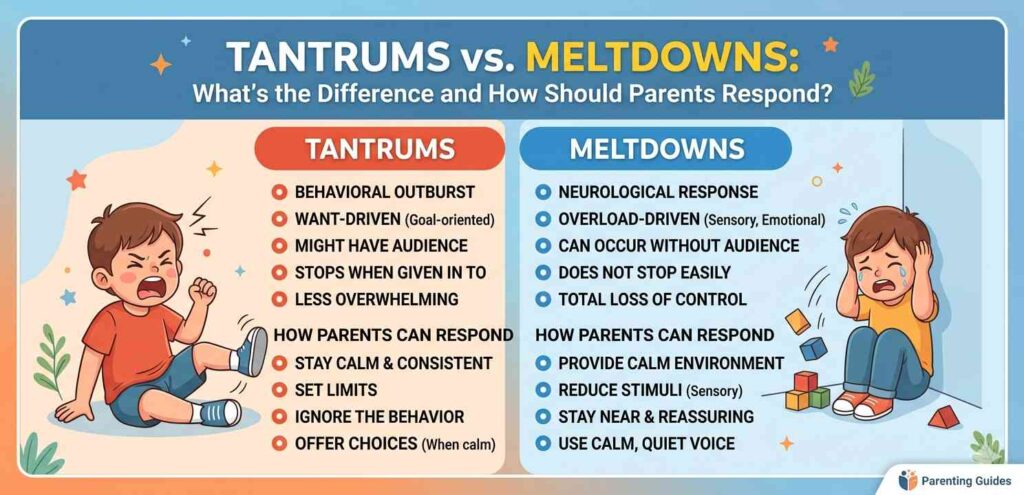
Tantrums vs Meltdowns: Side-by-Side Comparison
One of the most helpful ways to understand tantrums vs meltdowns is to look at them together:
Trigger: Tantrums are triggered by unmet wants. Meltdowns are triggered by sensory or emotional overload.
Goal: Tantrums have a goal (get the toy, avoid bedtime). Meltdowns have no goal — it’s pure overwhelm.
Audience awareness: During a tantrum, the child often watches your reaction. During a meltdown, they’re not aware of the audience at all.
Response to changes: Tantrums can stop if you resolve the trigger. Meltdowns don’t stop just because the trigger is removed.
Recovery: Tantrums end relatively quickly. Meltdowns often leave children exhausted and need a long recovery period.
This side-by-side view helps parents make better decisions in the moment.
How Should Parents Respond to a Tantrum?
The golden rule for tantrums is this: don’t give in, and don’t escalate.
Stay Calm and Don’t Negotiate Mid-Tantrum
Children having tantrums are still somewhat rational. But negotiating in the middle of a tantrum teaches them that outbursts work. It’s better to stay firm without being harsh.
Say something brief like, “I hear you. We’re not getting the toy today.” Then stop talking about it.
Let It Run Its Course
Tantrums burn out on their own when they don’t get a reward. Giving attention (even negative attention) can accidentally reinforce the behavior.
Some parents find it helpful to stay in the room but not engage directly — just a calm, quiet presence. Others prefer to give the child a little space (as long as they’re safe).
Talk About It After
Once your child has calmed down, this is actually a great teaching moment. Not a lecture — just a simple conversation. “You were really upset earlier. Can you tell me what happened?” This helps build emotional vocabulary over time.
How Should Parents Respond to a Meltdown?
This is where tantrums vs meltdowns really diverges in terms of parenting response. Meltdowns need a completely different approach — one focused on safety and sensory regulation, not discipline.
Don’t Try to Reason or Punish
During a meltdown, the child’s prefrontal cortex — the part of the brain responsible for logic — is basically offline. Trying to talk them through it, explaining consequences, or raising your voice will do nothing helpful. It usually makes things worse.
This is probably the hardest thing for parents to accept. The instinct is to take control. But control isn’t the goal here — safety and calm are.
Reduce Sensory Input
If possible, move to a quieter, less stimulating space. Turn off bright lights. Lower noise levels. Give them something comforting like a weighted blanket or a familiar toy if they respond well to those.
Some children want physical contact during a meltdown — a firm hug can feel grounding. Others cannot be touched at all. You’ll need to learn what works for your specific child.
Stay Nearby and Speak Softly
You don’t need to say much. Just being present and calm sends a powerful signal to a dysregulated nervous system. A soft “I’m here, you’re safe” repeated slowly can help. Avoid long sentences.
After the Meltdown: Recovery Matters
After a meltdown, children are often genuinely exhausted — physically and emotionally. This isn’t the time for a discussion about behavior. Let them rest, eat something, drink water. They may not even remember what triggered the meltdown.
Why Getting This Wrong Can Backfire
A lot of parents accidentally use meltdown-response strategies on tantrums, and tantrum-response strategies on meltdowns.
Punishing a child for a meltdown — sending them to their room, taking away privileges — doesn’t teach them anything. They weren’t choosing to act out. They were overwhelmed. Punishment adds shame to an already exhausted child.
On the flip side, trying to soothe and comfort a tantrum the way you would a meltdown can accidentally reward the behavior. The child learns that escalating emotions gets them extra attention and softness.
This is exactly why tantrums vs meltdowns is such an important distinction for parents to understand.
When to Seek Extra Support
If meltdowns are happening frequently, lasting a long time, involving self-harm, or significantly affecting daily life — it may be worth speaking to your child’s pediatrician or a child psychologist. This is especially true if meltdowns continue past the age of 7 or 8 without improvement.
For children with known sensory or developmental differences, working with an occupational therapist can also make a huge practical difference. They can help identify specific triggers and create a sensory plan. Resources like the CDC’s developmental milestones page and the American Academy of Pediatrics are solid places to start exploring professional guidance.
You can also read more about how to build emotional regulation skills in young children and managing big feelings at different developmental stages if you want to go deeper into related topics.
Final Conclusion
At the end of the day, understanding tantrums vs meltdowns comes down to one question: is your child acting out to get something, or are they completely overwhelmed and unable to help themselves? The answer changes everything about how you should respond.
Tantrums need calm boundaries and consistency. Meltdowns need safety, reduced stimulation, and a patient presence. Neither requires yelling, threats, or shame.
The more clearly you can read what’s happening, the more confident you’ll feel — even in those moments when your child is on the floor and everyone in the supermarket is staring.