
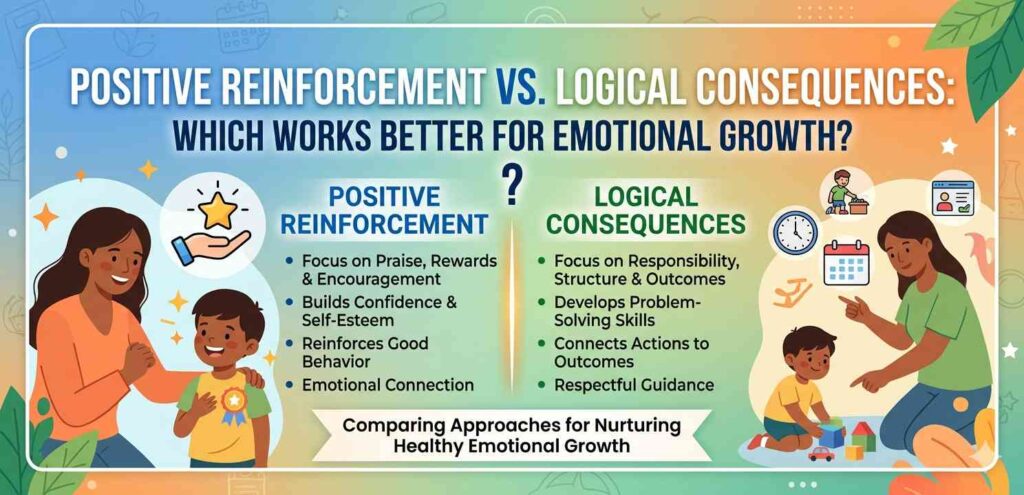

When it comes to raising emotionally healthy children, few debates are as persistent — or as genuinely confusing — as positive reinforcement vs logical consequences. Parents ask it at dinner tables. Teachers bring it up in staff meetings. And honestly, there’s no one-size-fits-all answer. But understanding how each approach actually works, and when to use which, can make a real difference in a child’s emotional development.
Let me walk you through both sides, with the kind of clarity that comes from actually thinking about this stuff in real-world terms — not just theory.
What Is Positive Reinforcement, Really?
Positive reinforcement means adding something rewarding after a behavior to encourage that behavior to happen again. That’s the textbook version. In practice, it looks like praising a child when they share their toys, giving them a sticker when they finish homework without being reminded, or even just saying “I noticed you stayed calm when you were frustrated — that was really mature.”
The key word here is adding. You’re not removing a punishment. You’re putting something good into the equation.
This approach is rooted in behavioral psychology, going back to B.F. Skinner’s work in the mid-20th century. But it didn’t stay in laboratories. Parents, schools, and therapists adopted it because, frankly, it works — especially with younger children who respond strongly to acknowledgment and warmth.
Why Positive Reinforcement Builds Emotional Confidence
One thing that’s easy to overlook: when a child receives consistent positive feedback tied to their behavior (not just who they are), they start building an internal map of what’s good. They learn I can handle hard things. People notice when I do well. That kind of internal dialogue is the foundation of emotional resilience.
It also reduces anxiety. Children who are mostly met with criticism or punishment become hypervigilant — always watching for the next mistake. Positive reinforcement shifts that pattern, giving them mental breathing room to actually try new behaviors.
What Are Logical Consequences?
Logical consequences are different from punishment, even though they’re sometimes confused with it. The difference is important. A logical consequence connects directly to the behavior in a meaningful, reasonable way.
If a child leaves their bike outside in the rain and it rusts, that’s a natural consequence — nobody planned it. But if a parent says, “Since you left your bike out, you won’t be able to ride it this weekend while it dries out,” that’s a logical consequence. It’s connected, it makes sense, and it teaches something.
This approach is often associated with Rudolf Dreikurs and Alfred Adler’s work on democratic parenting. The idea is that children learn responsibility when they experience real-world-style outcomes, not just adult-imposed punishments that can feel random or unfair.
Logical Consequences and Emotional Learning
The emotional growth potential of logical consequences is real — but it depends heavily on how they’re delivered. When a consequence feels humiliating or overly harsh, the child stops thinking about what they did and starts thinking about how unfair the adult is.
But when a consequence is calm, clear, and genuinely connected to the behavior, it activates a different kind of thinking. The child starts to understand that choices have outcomes. That’s a hugely important life skill — and it contributes to emotional maturity in a way that’s different from what reinforcement offers.
Positive Reinforcement vs Logical Consequences: Where They Differ Most
At their core, positive reinforcement vs logical consequences represent two different theories about what drives behavior change in children.
Positive reinforcement says: give children a reason to want to do the right thing.
Logical consequences say: give children the experience of what happens when they don’t.
Neither is wrong. They’re targeting different parts of how children learn. The challenge is knowing which one actually serves emotional growth better — and in what situations.
How Age Changes Everything
This is something parenting books don’t always say clearly enough: the same strategy doesn’t work the same way at every age.
For Younger Children (Ages 2–6)
Very young children are still developing the brain structures that handle cause-and-effect thinking. Abstract consequences — even logical ones — often don’t connect the way we hope. What does work at this age is warmth, praise, and consistent positive feedback.
If a three-year-old shares a toy, and you kneel down and say “that was so kind of you — I love watching you take care of your friend,” that lands. A consequence tied to a behavior they barely remember having? Not so much.
So for early childhood, positive reinforcement tends to be the more emotionally supportive approach.
For Older Children and Teens (Ages 9–17)
Older kids are building a more sophisticated emotional world. They’re developing a sense of fairness, identity, and personal responsibility. At this stage, logical consequences often resonate more — especially when they’re framed respectfully.
A teenager who breaks a curfew and loses car privileges for a week understands the connection. It’s still unpleasant, but it feels fair in a way that pure punishment often doesn’t.
That said, even older teens need positive reinforcement. Everyone does. The key is balance.
When Positive Reinforcement Falls Short
It’s worth being honest here. Positive reinforcement is not magic. If used without any structure or consequence system, it can lead to what some researchers call “praise dependency” — where children stop doing things unless they’re rewarded for them.
There’s also the problem of inflated or vague praise. Telling a child “you’re so smart!” after every small thing they do doesn’t actually build emotional resilience. In some cases, it creates fragility — because the child starts to believe effort isn’t the point, just the outcome.
Effective reinforcement is specific (“I noticed you kept trying even when it was hard”), tied to effort and behavior, and given at a meaningful moment — not constantly sprinkled everywhere.
When Logical Consequences Miss the Mark
Logical consequences can also backfire. One common mistake is using them as a disguise for punishment. If the consequence feels arbitrary, excessive, or designed to make the child feel bad rather than learn something, it’s not really “logical” anymore — it’s just punishment with better branding.
Consequences also don’t work well when a child is in the middle of an emotional flood — a full meltdown, a panic moment, or a deep shame spiral. In those moments, the rational brain is offline. Trying to deliver a lesson right then usually escalates things. The consequence needs to come later, calmly, when the child can actually receive it.
What the Research Suggests
Most child development researchers today don’t frame this as an either/or question. The positive reinforcement vs logical consequences debate is somewhat of a false dichotomy.
Studies on authoritative parenting — which is consistently linked to better emotional outcomes — show that it blends both. Authoritative parents use warmth, validation, and positive feedback regularly. They also hold boundaries and apply reasonable, connected consequences when needed. Neither alone produces the same results as the two together.
A 2019 review published in Developmental Psychology found that children raised in environments with high warmth and consistent (not punitive) structure showed better self-regulation, empathy, and emotional problem-solving than those in either highly permissive or highly punitive homes. That’s a fairly strong argument for integration.
Practical Tips for Using Both Approaches Together
You don’t have to choose one and abandon the other. Here’s a sensible way to think about combining them:
Lead with reinforcement. Make it your default mode. Children who feel seen and appreciated for the right behaviors are more open to guidance overall — including consequences when things go sideways.
Use logical consequences for meaningful moments. Not everything needs a consequence. Save them for patterns of behavior that need addressing, not every little stumble.
Separate the consequence from the emotion. If you’re frustrated when you deliver a consequence, it usually lands as punishment rather than learning. Calm delivery matters enormously.
Be consistent. The most emotionally destabilizing thing for a child is unpredictability. Whether you’re reinforcing or applying a consequence, doing it consistently gives children a secure framework to grow within.
What Emotional Growth Actually Requires
At the end of the day, emotional growth in children isn’t about technique. It’s about relationship. Both positive reinforcement and logical consequences work better inside a warm, trusting relationship between an adult and child.
A child who trusts that the adult genuinely cares about them can receive a consequence without feeling rejected. A child who feels seen and valued will respond to positive reinforcement without becoming dependent on it.
So when parents and educators ask which works better for emotional growth, the real answer might be: whichever one is delivered from a place of genuine connection and consistency.
That said, in the early years, lean toward reinforcement. As children grow, blend in logical consequences with care. And always, always, keep the relationship central.
Final Conclusion
The debate around positive reinforcement vs logical consequences is worth having — not because one side wins, but because thinking through it makes you a more intentional parent or educator. Both approaches have real value. Both have real limits. Used together, with developmental awareness and emotional attunement, they create an environment where children don’t just behave well — they actually grow.
Emotional maturity isn’t something you can punish or praise a child into. It’s something that develops, over time, through consistent, caring, and reasonably structured relationships. Understanding how these two strategies serve that process is one of the most practical things any caregiver can do.