
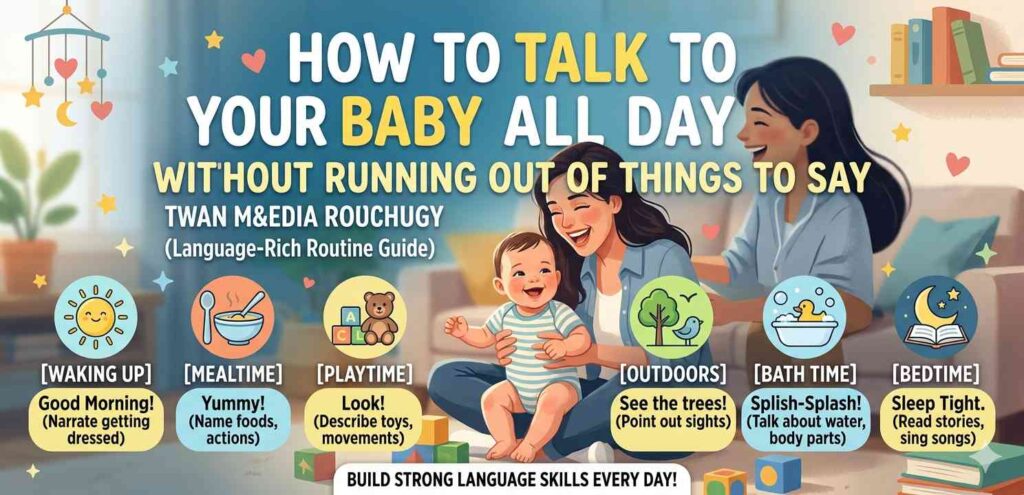

Most new parents know they’re supposed to talk to your baby often. But after a while, you genuinely run out of things to say. You’ve narrated the diaper change twice already. You’ve described the ceiling fan. Now what?
The good news is, you don’t need clever scripts or a teaching plan. Babies don’t need perfectly structured conversations — they need consistent, warm exposure to your voice, words, and reactions. This guide is built around your daily routine, so you always have something natural to say.
Why It Matters So Much to Talk to Your Baby Every Day
Babies begin absorbing language from the very first days of life. Research in early childhood development consistently shows that the number of words a baby hears in their first three years has a direct impact on vocabulary, reading readiness, and even school performance later on.
When you talk to your baby regularly, you’re not just filling silence. You’re building the neural pathways that will eventually support their speech, comprehension, and emotional intelligence.
The key thing here is quantity and quality. It’s not about one long educational session — it’s about dozens of small, natural conversations woven through your day.
How to Talk to Your Baby During Morning Routines
Narrate the Wake-Up
From the moment you walk into the room in the morning, start describing what you’re doing and what your baby is experiencing.
“Good morning, sweetheart. Oh, you’re awake! Let’s open the curtains — look at that sunshine coming in. It’s going to be a warm day.”
This sounds simple, almost too simple. But that kind of running commentary is exactly what helps you talk to your baby naturally without feeling forced or awkward.
Describe the Diaper Change Step by Step
Diaper time is a surprisingly rich opportunity. Narrate every step:
“Okay, let’s get you changed. I’m opening the tabs now — one side, two sides. Oh, it’s a wet one. Now I’m lifting your little legs… there we go. Clean diaper going on now.”
You’re doing the task anyway. Adding words costs nothing and gives your baby a steady stream of language connected to real, physical experiences.
Talk About What You See Together
Hold your baby near the window, or take them to a new room, and describe what’s there. “See the tree outside? The leaves are moving. That’s the wind.” You don’t need anything fancy. Everyday objects are endlessly useful when you’re building early language.
During Feeding: One of the Best Times to Talk to Your Baby
Feeding — whether breast, bottle, or solids — is a natural bonding moment, and it’s one of the easiest times to keep up a gentle conversation.
During Breastfeeding or Bottle Feeding
Talk softly about what’s happening. “You’re so hungry this morning. There you go, drinking away. You’re doing such a good job.” Babies at this age love the rhythm of your voice. The actual words matter less than the tone, warmth, and consistency.
You can also name body parts, talk about how full or warm the milk is, or just describe your own feelings. “I love these quiet morning feeds with you. It’s so peaceful, isn’t it?”
When Introducing Solids
This is a goldmine of new language. Every food is a new word. Every texture is an experience worth describing.
“This is sweet potato. It’s orange — can you see that colour? It’s soft and smooth. Here comes the spoon… what do you think? Is it good?”
Wait a second after asking questions, even if your baby can’t answer yet. That pause teaches conversational rhythm — the back-and-forth that will shape their speech later on. This is how you talk to your baby in a way that builds real communication instincts.
Using Playtime to Build Language Without Running Out of Ideas
Describe What Your Baby Is Doing
When your baby is on a play mat or exploring toys, narrate their actions in real time.
“Oh, you grabbed the red ring! You’re shaking it — listen to that sound. Now you’re looking at it. That’s right, look at it closely.”
This kind of commentary helps your baby understand cause and effect — that their actions have names, meanings, and responses.
Ask Questions and Pause
Even before your baby can respond verbally, ask them questions and genuinely pause.
“What colour do you like better — the blue block or the yellow one? Hmm, you picked the blue one. Good choice.”
This isn’t pretend conversation. It’s teaching conversational structure in a deeply real way.
Read Simple Books Together
You don’t need to stick to the text. Point at pictures and describe them. Make sounds. Ask “what’s that?” even for things you both already know. Books give you fresh vocabulary to talk to your baby with, so you’re not recycling the same twenty words all day.
Outdoor Walks: An Underrated Language-Rich Moment
Getting outside resets your own energy and gives you a completely new environment to narrate.
Describe the Sensory World
“Feel that breeze? It’s a little chilly today. Look at that dog — it’s brown and fluffy. It’s wagging its tail. Dogs wag their tails when they’re happy.”
Everything outside is new to your baby: birds, clouds, puddles, cars, other people, different textures underfoot. You’ll never run out of material when you’re outdoors.
Connect Words to Emotions
As you walk, talk about how things make you feel and invite your baby to respond.
“That flower smells lovely. Do you want to smell it? Oh, you made a face — maybe you don’t like it as much as I do! That’s okay.”
This kind of talk to your baby helps them start connecting language with inner experiences — which is foundational to emotional literacy.
Bath Time, Bedtime, and Everything in Between
Bath Time Is Perfect for Sensory Language
Water, bubbles, splashing, warmth — bath time is rich with sensory vocabulary.
“The water is warm today. Is that nice? We’re washing your tummy… now your arms… now your little toes. One, two, three, four, five toes. All clean!”
Counting naturally during bath time is also a great way to introduce numbers without making it feel like a lesson.
The Bedtime Wind-Down
As you talk to your baby before sleep, slow your voice down and use the moment to review the day.
“We had such a good day today, didn’t we? We went for a walk in the morning. You had your green beans at lunch — you weren’t too sure about those. Then we played with your blocks.”
This kind of narrative recap is genuinely powerful for language development. It teaches sequencing, memory, and story structure.
Practical Tips When You Feel Like You’ve Run Out of Things to Say
This happens to every parent. The tank just empties. Here are a few strategies that actually help:
Switch to describing your own thoughts. “I’m wondering what to make for dinner tonight. Maybe soup? It’s a bit cold outside.” Your baby doesn’t care about soup — but they care about your voice.
Use what’s around you. Pick up any nearby object and describe it. Colour, shape, texture, what it’s used for. A simple mug can give you a two-minute monologue if needed.
Sing instead of talking. Songs count too. Even making up silly rhymes about what you’re doing — “now we’re putting on your sock, tick tock tick tock” — keeps the language flowing without taxing your brain.
Don’t pressure yourself to be educational. You don’t have to sound like a children’s TV presenter. Just talk the way you’d talk to a friendly adult in a relaxed moment. That naturalness is what matters.
Also, if you’re looking for developmental guidance on language milestones, the NHS baby and toddler development pages are a helpful reference. For research-backed strategies, the Zero to Three organization offers evidence-based guidance on early language exposure.
What to Avoid When You Talk to Your Baby
A few habits are worth being aware of:
- Avoiding baby talk entirely isn’t necessary, but try to mix in real words alongside simplified ones. “Da-da” is fine, but also say “That’s Daddy.”
- Don’t turn every moment into a quiz. Asking “what colour is that?” every thirty seconds gets exhausting for both of you. Mix questions with plain narration.
- Screen time as a substitute for your voice. Passive audio and video don’t build language the same way live conversation does. Your voice — responsive, warm, personal — is irreplaceable.
Keeping It Sustainable — Talk to Your Baby Without Burning Out
Here’s something worth saying clearly: you don’t have to narrate every single second. That’s not realistic and it’s not what the research recommends either.
What matters is consistency over time. Aim to talk to your baby during the natural anchor points of your day — feeding, changing, dressing, bathing, walking, playing. If you do those, you’re already doing more than enough.
For more on creating consistent developmental routines, you might find this related guide on building healthy baby schedules helpful, or explore our piece on simple sensory activities for babies under 12 months for more ideas to layer into playtime.
Final Conclusion
Learning how to talk to your baby all day isn’t about finding clever things to say — it’s about weaving your voice into the fabric of your existing routine. Morning wake-ups, mealtimes, walks, bath time, and bedtime all offer natural moments to narrate, describe, question, and connect.
Your baby doesn’t need perfectly chosen words. They need your presence, your warmth, and the steady rhythm of your voice meeting them in the ordinary moments of every day. Start small, stay consistent, and trust that even simple words — “there’s your sock,” “look at that bird,” “I love you so much” — are quietly building something extraordinary.