
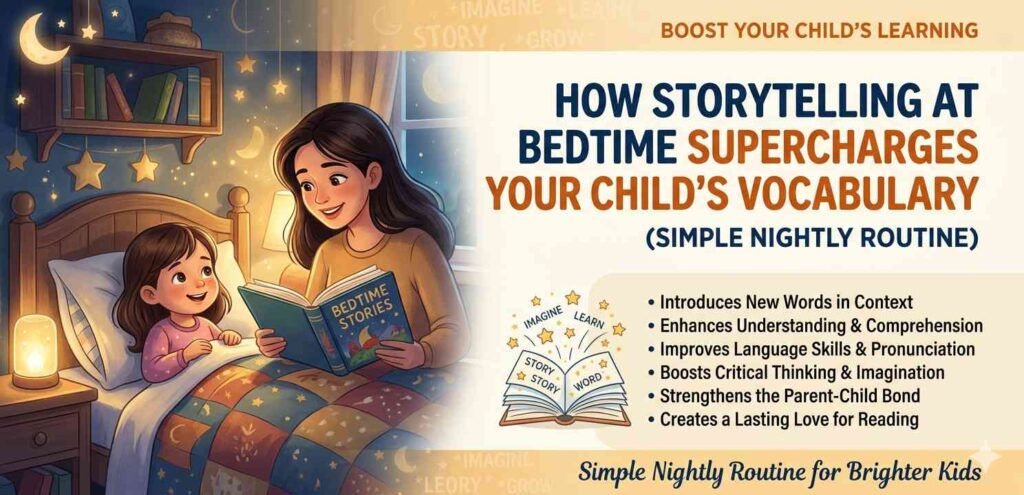

If you’ve ever watched a child light up when someone starts a story, you already know there’s something special happening in that moment. Bedtime storytelling isn’t just a sweet tradition — it’s quietly one of the most effective vocabulary-building habits a parent can build into their child’s day. And the best part? You don’t need to be a great storyteller to make it work.
Most parents assume vocabulary grows mainly in the classroom. But research, and plain everyday observation, tells a different story. The words children hear at home — especially in relaxed, comfortable moments — stick far longer than anything taught during a formal lesson.
Why Bedtime Is the Best Time for Storytelling
There’s a reason bedtime storytelling has stayed popular across generations. When the lights dim and the day winds down, a child’s mind shifts into a softer, more receptive state. They’re not distracted by toys or screens. They’re calm, cozy, and fully tuned in to your voice.
This is actually a well-understood pattern in how the brain processes language. Words heard just before sleep get a kind of extra processing pass during the night. So when you use a slightly unusual word in a story — say, “magnificent” instead of “great” — your child’s brain holds onto it in a way daytime conversation rarely achieves.
Bedtime storytelling creates a low-pressure environment where children feel safe to ask, “What does that word mean?” That small question is worth more than a week of flashcard drills.
How Bedtime Storytelling Builds Vocabulary Without Feeling Like a Lesson
It Introduces Words in Context, Not in Isolation
Vocabulary lists are forgettable. But a word heard inside a story — attached to a character, an emotion, a vivid moment — becomes memorable. When you tell your child that the old dragon was “reluctant” to share his gold, the word “reluctant” arrives wrapped in meaning. They don’t just learn the definition; they feel what it means.
Bedtime storytelling works this way naturally, without any effort on your part to “teach.” You’re just telling a story. The vocabulary comes along for the ride.
Repeated Story Elements Reinforce Word Learning
Good stories repeat. The brave knight faces three challenges. The curious fox tries three times to cross the river. This repetition isn’t lazy writing — it’s deeply effective for young learners. Every time the same word appears in a slightly different moment, it gets a little more solid in a child’s memory.
You don’t need to repeat words mechanically. Just tell stories with satisfying structure and let the natural rhythm do the work.
Questions and Curiosity Expand the Learning
The real magic of bedtime storytelling often happens after a story ends. Children ask questions. “Why did she do that?” “What’s a labyrinth?” “Is a merchant like a shopkeeper?” These spontaneous questions are golden vocabulary moments.
Don’t rush past them. A two-minute conversation about a word your child just encountered in a story can plant that word permanently in their vocabulary.
Building a Simple Bedtime Storytelling Routine That Actually Sticks
Start Small — Even Five Minutes Counts
One of the biggest mistakes parents make is thinking they need to perform an elaborate story every single night. You don’t. Even a five-minute bedtime storytelling session, told in a calm, unhurried voice, is genuinely effective.
Start with what you know. A simple story about a child who found something strange in the garden. A tale about an animal who learned something new. You don’t need drama or complexity — you need consistency.
Use “Stretch Words” Naturally in Your Stories
A stretch word is simply a word that’s slightly above your child’s current vocabulary level — not so hard it’s confusing, but just unfamiliar enough to prompt curiosity. Good bedtime storytelling naturally includes a few of these every night.
Instead of saying the princess was “happy,” say she was “overjoyed” or “relieved.” Instead of “a big storm,” try “a fierce, relentless storm.” You’re not showing off — you’re giving your child vocabulary material to grow into.
Keep a mental note of two or three stretch words you use each week. If your child picks one up and uses it later — even incorrectly — celebrate it. That’s learning in action.
Let Your Child Co-Create the Story
One of the most underused techniques in bedtime storytelling is simply asking your child to help build the story with you. “What should happen next?” “What does the creature look like?” “What’s the young inventor’s name?”
When children contribute to a story, they invest in it. And when they’re invested, they pay close attention to the words being used — including the new ones they haven’t heard before.
The Role of Picture Books vs. Told Stories
Both have real value, but they work differently. Picture books are great for introducing professionally crafted language — authors choose their words carefully, and reading aloud from a quality picture book exposes children to writing that’s richer than typical conversation.
Told stories (made up on the spot or from memory) give you more flexibility. You can slow down when your child looks puzzled, swap in a stretch word whenever you feel like it, and follow tangents your child finds interesting.
A good bedtime storytelling routine often blends both. Read a picture book two or three nights a week. Make up a story the other nights. The variety keeps children engaged and exposes them to different styles of language.
For parents looking for quality picture book recommendations, the American Library Association’s book lists are a genuinely useful, non-commercial resource. They update annually and cover all age ranges.
What Parents Often Get Wrong About Storytelling and Vocabulary
Skipping Unfamiliar Words
Some parents automatically simplify — if a word seems too hard, they swap it for something easier. This is understandable, but it actually limits your child’s vocabulary growth. When you encounter a hard word, pause and explain it simply. “Peculiar means strange — like when something is a bit odd and unexpected.” That’s all it takes.
Making It Feel Like Homework
The moment bedtime storytelling starts to feel like a structured lesson, children disengage. Keep it playful. Get dramatically quiet during suspenseful moments. Use funny voices. Laugh at your own mistakes. The relaxed, slightly silly atmosphere is actually part of what makes the vocabulary stick — positive emotion and memory are closely linked in how children learn.
Being Too Consistent With the Same Stories
Repetition of favourite stories is wonderful, but only repeating familiar stories limits vocabulary exposure. Children need to hear new stories, new settings, new characters — because each brings new words with it. Try to introduce at least one fresh story every week alongside the familiar favourites.
Practical Tips to Make Bedtime Storytelling a Nightly Habit
- Keep story time at the same point in the bedtime routine — after teeth brushing, before lights out works well for most families
- Don’t worry about being a perfect storyteller; your child wants your voice, not a polished performance
- If you run out of ideas, use a simple prompt: “Once there was a [animal] who could [unusual ability]…”
- For older children (ages 7–10), try leaving stories unfinished and asking them to continue the next night
- Resources like Reading Rockets offer evidence-based tips on read-aloud strategies that complement your bedtime storytelling routine
You can also explore our guide on building a home reading environment that supports what your child experiences during story time.
How Long Before You See Vocabulary Growth?
This is a fair question, and the honest answer is: it varies. Some children start using new words within days of hearing them in stories. Others absorb quietly for weeks before the words begin appearing in their own speech.
What’s consistent across most children is that regular bedtime storytelling — done even imperfectly, even informally — produces measurable vocabulary gains within a few months. Teachers often notice. So do grandparents who haven’t seen a child in a while.
The key word is regular. Three or four nights a week of bedtime storytelling will do more for your child’s vocabulary than an occasional elaborate story session once a month.
Bedtime Storytelling for Different Age Groups
Ages 2–4: Simple Language, Vivid Images
At this age, focus on clear, expressive language. Describe things richly — colours, textures, sounds. Repeat key words. Keep plots simple. The goal is exposure and enjoyment, not complexity.
Ages 5–7: Introduce Mild Complexity
Children in this range can follow longer stories with subplots and multi-step events. This is the ideal age to start using stretch words more deliberately in your bedtime storytelling routine.
Ages 8–10: Stories With Ideas
Older children benefit from stories that contain ideas — moral dilemmas, surprising perspectives, cause and effect. Bedtime storytelling at this age can introduce abstract vocabulary naturally: words like “consequence,” “dilemma,” “resilience,” and “perspective” land well inside a good story.
For more on age-appropriate vocabulary development, our article on building early literacy habits covers the foundational stages clearly.
Final Conclusion
Bedtime storytelling is one of those rare habits that feels like a gift but works like a tool. It’s warm and memorable for children, and at the same time, it builds vocabulary in a way that classroom instruction often can’t replicate — through context, emotion, repetition, and genuine curiosity.
You don’t need special training, expensive books, or a perfect speaking voice. You need consistency, a few stretch words tucked into your stories each night, and the willingness to let your child ask questions and help shape where the story goes.
Start tonight. Even a five-minute made-up story about a small creature with a big problem is enough. The words will follow, and so will the habit.