
If you’re a parent wondering why your toddler isn’t talking as much as other kids the same age, you’re definitely not alone. Speech development varies a lot from child to child, and sometimes the right kind of play can make a real difference. That’s where speech-boosting toys for toddlers come in — not as magic fixes, but as tools that create more opportunities for kids to hear words, respond, and eventually start using language on their own.
This guide is based on what actually tends to work, combining input from parents, speech-language pathologists, and child development research. No fluff, no hype — just honest picks worth considering.
Why Play Matters More Than You Think for Speech Development
Toddlers don’t learn language from sitting still. They learn it through interaction — asking, pointing, naming, pretending. When a toy encourages that kind of back-and-forth engagement, it becomes more than just entertainment. The best speech-boosting toys for toddlers are ones that naturally invite a parent or caregiver into the play, creating moments of real conversation.
It’s worth noting that no toy replaces human interaction. But the right toy can make those interactions happen more often — and that’s the whole point.
What Makes a Toy Truly Speech-Boosting?
Before jumping into the list, it helps to understand what separates a genuinely useful toy from one that just has “educational” printed on the box.
Key Features to Look For
- Open-ended play: Does the toy encourage pretend play, storytelling, or problem-solving?
- Simple but engaging: Is it interesting enough to hold a toddler’s attention without being overwhelming?
- Encourages labeling: Can a parent naturally say “What’s this?” or “What does it do?” during play?
- Age-appropriate: Is it realistic for a 12-month-old vs. a 3-year-old?
Keep these in mind as you go through the picks below.
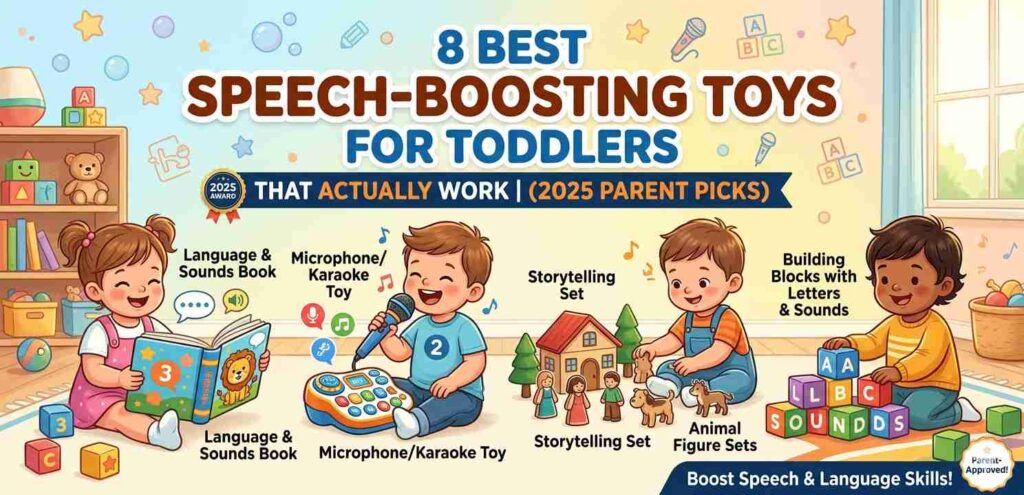
8 Best Speech-Boosting Toys for Toddlers in 2025
1. Melissa & Doug Farm Stand Play Set
This classic set is loved by speech therapists for good reason. The fruit, vegetables, and play money create tons of chances to name objects, ask questions, and have pretend conversations. Kids can “sell” things to you, you can ask for specific items, and suddenly there’s a real back-and-forth happening.
It works well as one of the top speech-boosting toys for toddlers because it doesn’t talk for the child — it invites the child to talk.
Best for: Ages 2–4
What makes it work: Role play naturally builds vocabulary
2. LeapFrog Learning Friends 100 Words Book
This interactive book introduces words through music and sound effects in a way that feels engaging rather than boring. But what really makes it useful is how parents can use it — pause the audio, point to a picture, and ask your toddler what they see.
One thing to keep in mind: let the child respond before pressing the button. That pause is where the language learning actually happens.
Best for: Ages 1–3
What makes it work: Combines visuals with audio for multi-sensory word exposure
3. Pretend Doctor Kit
A doctor kit might seem simple, but for a toddler, it’s a world of language opportunities. “What hurts?” “Let me check your ears.” “You need medicine.” These are real sentences that kids pick up fast during pretend play.
Among speech-boosting toys for toddlers, props like these are particularly useful because the play scenarios are familiar. Kids have been to the doctor — so they already have context for the words.
Best for: Ages 2–4
What makes it work: Familiar scenarios = faster vocabulary pickup
4. Mega Bloks First Builders Big Building Bag
Blocks might not seem like a speech tool, but think about it. “Put the blue one here.” “Make it taller.” “Uh oh, it fell down!” Building with blocks creates a constant stream of natural commentary — and that’s exactly how toddlers absorb language.
You’re narrating, they’re listening, and eventually, they start narrating back. Simple but effective.
Best for: Ages 1–3
What makes it work: Open-ended play with endless narration opportunities
5. VTech Roll & Learn Activity Cube
This is one of the more popular speech-boosting toys for toddlers for the under-2 crowd. It introduces shapes, colors, animals, and numbers through interactive panels. Unlike some electronic toys that talk too fast or use complex sentences, this one keeps it slow and clear.
Parents can follow along: “Did you hear that? A cow! What does a cow say?”
Best for: Ages 1–2
What makes it work: Introduces core vocabulary with repetition, which is key for early language
6. Animal Sound Puzzle (Wood or Foam)
Puzzles that match animals to their sounds are surprisingly powerful for early talkers. The act of picking up a piece, placing it correctly, and hearing or saying the sound creates a clear cause-and-effect loop that toddlers love to repeat.
Repetition is how early words stick. And speech-boosting toys for toddlers that build in that repetition naturally are worth every penny.
Best for: Ages 18 months – 3 years
What makes it work: Repetitive play locks in sound-word associations
7. Little Tikes Cook ‘n Store Kitchen Set
Kitchen play is one of the all-time greats for language development. You’ve got food names, actions (stir, pour, boil, wash), and natural role-play built right in. A toddler playing kitchen will almost always start “talking” to whoever’s nearby — even if it’s just babble at first.
This set is a standout among speech-boosting toys for toddlers because the play scenarios feel real and purposeful to a child. They’re doing what they see adults do every day.
Best for: Ages 2–5
What makes it work: Imitation of real-world activities triggers language naturally
8. Stacking Rings with Colors and Sizes
One of the oldest toys in the book — and still one of the best. Stacking rings teach concepts like big/small, first/last, and color names in a hands-on way. These are the kinds of concept words that often show up late in toddlers with language delays.
When you play alongside your child and narrate what you’re doing, this simple toy becomes a genuine speech-boosting toy for toddlers without any bells or whistles needed.
Best for: Ages 12–30 months
What makes it work: Basic concepts are the building blocks of more complex sentences later
How to Use These Toys for Maximum Language Growth
Buying the right toy is only half the equation. How you play with your toddler matters just as much. Here are a few things that actually help:
Follow the child’s lead. Don’t take over. Let them explore and then comment on what they’re doing.
Narrate without quizzing. Instead of “What color is that?” every few seconds, try “Oh, you picked the red one!” It feels less like a test.
Wait. After asking a question, give your toddler a full 5–10 seconds to respond. That silence can be uncomfortable, but it’s exactly when kids start reaching for words.
Read about these strategies more deeply at the American Speech-Language-Hearing Association’s official parent resource page, which covers early communication milestones in plain, accessible language.
You can also explore the Zero to Three organization’s language tips for practical advice on building a language-rich environment at home.
For more on choosing age-appropriate learning toys, check out our guide on how to pick developmental toys by age and our overview of sensory play ideas for toddlers with speech delays.
When Should You Talk to a Speech-Language Pathologist?
Toys help, but if you have real concerns, don’t wait. A few general signs that it’s worth getting a professional evaluation:
- Your child isn’t babbling consistently by 12 months
- No single words by 16 months
- No two-word phrases by 24 months
- You’ve noticed a loss of skills they had before
Early intervention makes a significant difference. There’s no downside to getting an evaluation early — and there can be real costs to waiting.
Final Conclusion
Speech development isn’t a race, and no toy is going to do the work all by itself. But the right speech-boosting toys for toddlers can genuinely create more moments of engagement, more chances to hear and use words, and more reasons for a toddler to try communicating. The eight picks on this list are practical, reasonably priced, and trusted by parents and professionals alike.
What ties them all together is that they require a child to be an active participant — not just a passive observer. That’s the real secret. When kids are engaged and playing alongside a caring adult who narrates, responds, and waits, language begins to grow.
Start with what your child already loves, introduce one or two of these toys, and most importantly — keep talking to them. That never goes out of style.