
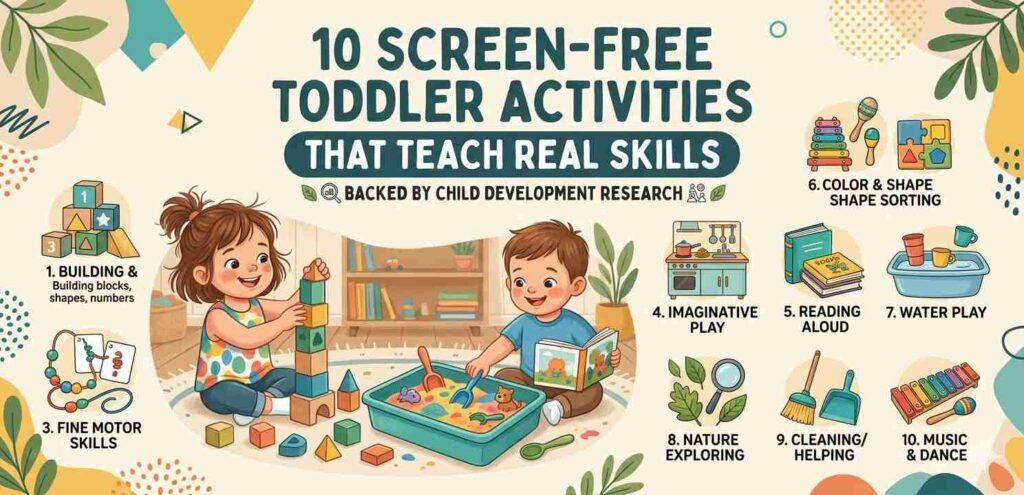

If you’ve ever handed your toddler a tablet just to get five minutes of quiet, you’re not alone — most parents have been there. But lately, more families are looking for genuine screen-free toddler activities that do more than just keep kids busy. The good news? Some of the simplest, most low-cost activities you can do at home are actually backed by solid child development research.
This guide walks through 10 activities that genuinely build skills — not just cute moments for Instagram. Each one is rooted in what researchers know about how toddlers between ages 1 and 4 learn, grow, and develop critical abilities like language, coordination, problem-solving, and emotional regulation.
Why Screen-Free Time Actually Matters for Toddlers
Before jumping into the list, it’s worth understanding why screen-free toddler activities have such a strong backing from researchers and pediatricians alike.
The American Academy of Pediatrics recommends limiting screen use for children under 2 to video chatting only, and keeping screen time to under an hour per day for kids aged 2–5. The reasoning isn’t just about “too much screen time is bad.” It’s more specific: toddler brains develop fastest through physical touch, movement, real human interaction, and sensory exploration. These are things a screen simply cannot provide.
When a toddler plays with blocks, mud, water, or even dry pasta, they’re doing something genuinely complex — making predictions, testing outcomes, adjusting, and learning from failure. That’s scientific thinking at its earliest stage.
The 10 Best Screen-Free Toddler Activities (With Real Skill Outcomes)
Sensory Bins Fine Motor + Sensory Processing
A sensory bin is just a container filled with something interesting — rice, dried lentils, kinetic sand, water beads, or even crumpled newspaper. You add small objects inside and let your toddler explore with their hands, spoons, or cups.
Research in sensory processing development shows that tactile play in early childhood strengthens neural pathways responsible for coordination and focus. It also helps toddlers who struggle with sensory sensitivity to gradually build tolerance. One of the most accessible screen-free toddler activities around, sensory bins require very little setup and keep kids engaged for surprisingly long stretches.
Tip: Use dried pasta or oats for toddlers still mouthing objects — much safer than beads or buttons.
Water Play with Pouring Tools Math + Cause & Effect
Set up a shallow bin or bathtub with a few cups, funnels, and spoons. Let your toddler pour, measure, splash, and experiment. This is one of those screen-free toddler activities that looks like pure fun but hides serious learning underneath.
Pouring develops early math concepts like volume, comparison (more/less), and sequencing. A 2017 study from Vanderbilt University found that toddlers who engaged regularly in informal measurement play showed stronger pre-math skills by kindergarten. The mess is worth it.
Playdough and Clay Sculpting Fine Motor + Creativity
Making shapes, pressing objects into clay, rolling snakes, squishing — all of this builds hand strength that directly supports future writing ability. Occupational therapists often recommend playdough work as one of the most effective screen-free toddler activities for kids who are struggling with grip or coordination.
You can make homemade playdough with flour, salt, cream of tartar, and food coloring. It takes 10 minutes and costs almost nothing. The toddler gets the bonus sensory experience of helping “cook” it too.
Stacking and Sorting Games Cognitive Development + Problem Solving
Simple wooden blocks, stacking rings, or even plastic containers from your kitchen — sorting by size, color, or shape is one of the earliest logic-building screen-free toddler activities you can offer.
Piaget’s theory of cognitive development points to this age as when toddlers are actively building schemas — mental frameworks for categorizing the world. Every time they figure out that the big ring doesn’t fit over the small one, that’s a genuine “aha” moment of learning spatial reasoning. You don’t need expensive toys for this. A muffin tin and some colored pompoms works perfectly.
Reading Aloud Together Language + Emotional Development
This one seems obvious, but it bears repeating because the research is so strong. Reading aloud to toddlers — even before they can understand all the words — builds vocabulary at a rate that no other activity matches.
A landmark study published in Pediatrics found that children who were read to daily from infancy entered kindergarten knowing approximately 1.4 million more words than those who weren’t. Among all screen-free toddler activities, shared reading also has the unique advantage of building emotional bonding and teaching children to recognize emotional cues through illustrated characters’ faces.
You don’t need to read perfectly or even finish the book. Pointing at pictures, asking “what’s that?”, and letting your toddler turn pages all count as meaningful engagement. For book recommendations, Reading Rockets has excellent age-by-age guides for parents.
Obstacle Courses and Movement Play Gross Motor + Spatial Awareness
Pillows, cushions, low stools, tunnels made from chairs and blankets — an indoor obstacle course is one of those screen-free toddler activities that wears kids out in the best possible way while simultaneously building gross motor coordination and spatial awareness.
Child development research consistently shows that physical movement is deeply tied to cognitive development. When a toddler decides whether to crawl through or step over an obstacle, they’re making real-time spatial calculations. Regular active play also helps regulate mood and supports better sleep — a win for the whole family.
You can also include this in your broader daily routine. More ideas on Zero to Three, a leading child development resource, including how to encourage outdoor movement safely.
Pretend Play and Role-Playing Social + Emotional Skills
Kitchens, tool sets, doctor kits, dress-up clothes — pretend play is one of the most researched and validated screen-free toddler activities in the field of developmental psychology. It’s also one of the most important.
When a toddler “cooks dinner” or “examines a stuffed animal,” they’re practicing perspective-taking — trying to understand what someone else might need or feel. This is the foundation of empathy, which researchers consider one of the most critical social-emotional skills developed in early childhood.
Don’t redirect or over-structure this one. The messier and more elaborate the imaginary world, the better the learning.
Simple Cooking and Food Prep Life Skills + Math Concepts
Letting a toddler wash vegetables, pour pre-measured ingredients, or stir a batter teaches real-world skills while also touching on sequencing, measurement, and following instructions — all foundational academic concepts. This ranks among the most underrated screen-free toddler activities for teaching life competence early.
Beyond the cognitive benefits, involving toddlers in food prep has been shown to reduce picky eating. When kids have a hand in making food, they’re far more likely to eat it. Start with low-risk tasks: washing fruit, tearing lettuce, or mashing a banana.
Nature Walks and Outdoor Exploration Scientific Thinking + Sensory Development
Even a short walk around the block becomes an educational adventure for a toddler when you slow down and notice things together. Picking up leaves, spotting bugs, touching tree bark, listening for birds — these are genuine screen-free toddler activities that build scientific curiosity in its most organic form.
Research from the University of Illinois found that time in nature significantly reduces stress hormones in children and improves attention span. This is sometimes called “nature deficit disorder” in reverse — when kids get regular outdoor time, their ability to focus indoors actually improves too.
Music and Simple Instruments Language + Mathematical Rhythm
Banging on pots, shaking a container of dried beans, clapping to a beat, singing simple songs — music is among the most neurologically rich of all screen-free toddler activities. Neuroscience research shows that early musical engagement activates more areas of the brain simultaneously than almost any other activity.
Rhythm specifically supports phonological awareness — the ability to hear and distinguish sounds in language — which is a direct predictor of reading ability. You don’t need instruments. A wooden spoon and a pot will do just fine.
How to Make Screen-Free Toddler Activities a Daily Habit
The biggest challenge most parents face isn’t finding ideas — it’s consistency. A few things that help: keep materials accessible at toddler height so kids can self-initiate play, rotate activities weekly so things stay fresh, and genuinely participate when you can rather than just supervising from a distance.
Even 30–45 minutes of focused, intentional screen-free toddler activities each day builds up significantly over weeks and months. It doesn’t need to look perfect or Pinterest-worthy. Messy, imperfect, child-led play is often the most developmental of all.
Final Conclusion
Raising a toddler in a screen-saturated world takes genuine intentionality. But the encouraging reality is that the most powerful things you can give your child — language, curiosity, coordination, emotional intelligence — don’t require any gadgets at all.
These 10 screen-free toddler activities aren’t just ways to fill time. Each one builds something real and lasting. And the beautiful irony? They tend to be just as enjoyable for parents as they are for kids. Start with one or two this week. The research is on your side.