
Young children learn more through play than almost anything else. If you’ve ever watched a three-year-old pretend to cook dinner or comfort a stuffed animal, you already know there’s something deeper going on beneath the surface. These moments of imaginative play aren’t just fun — they’re building the social and emotional foundation that kids will carry for years.
Role-play scenarios for preschoolers are one of the most effective tools available to parents and educators. They give children a low-stakes space to try on different perspectives, practice saying “I’m sorry,” and figure out how to share without being forced to. When kids step into a role — a doctor, a shopkeeper, a friend in need — they naturally start asking, “What would this person feel?” That question is the seed of empathy.
Why Role-Play Works So Well at This Age
Preschoolers between the ages of 3 and 5 are in a fascinating stage of development. They’re becoming more aware of other people’s feelings, but they still need lots of practice. They can recognize when a friend looks sad, but they don’t always know what to do about it.
Role-play scenarios for preschoolers create a bridge between knowing a feeling exists and knowing how to respond to it. It’s learning through doing, not through lectures or flashcards.
There’s also something important about the distance that pretend play provides. A child who struggles to say “I made a mistake” in real life might find it easier to say it through a puppet or a character. That practice still counts. It builds the same mental habit.
Scenario 1: The Doctor’s Office
Setting up a simple doctor’s office with a toy kit, a waiting chair, and a patient (a stuffed animal or a willing sibling) teaches children several things at once.
What This Teaches
The “doctor” learns to ask questions like “Where does it hurt?” and “Are you feeling scared?” The “patient” practices expressing discomfort and trusting someone to help. Both roles require listening, which is the core skill behind empathy.
This is one of those role-play scenarios for preschoolers that naturally comes up in real life too. Many young children are nervous about medical visits. When they’ve already practiced being both the helper and the person being helped, that anxiety often shrinks a little.
Scenario 2: The Grocery Store
A pretend grocery store — even just a few empty boxes and a basket — opens up a lot of social learning. One child plays the cashier, another is the shopper, and they have to cooperate to make the transaction work.
Building Cooperation Through Everyday Tasks
What makes role-play scenarios for preschoolers like this so valuable is that they mirror real situations. Children see adults doing these things constantly. When they play it out, they practice patience (waiting in line), fairness (taking turns at the register), and communication (asking for help finding an item).
If you add a small challenge — like the “store is out” of something a child wants — you create a mini lesson in handling disappointment without a tantrum. And it happens through play, not scolding.
Scenario 3: Feelings Check-In Between Stuffed Animals
This one is quieter and more reflective. Line up a few stuffed animals and ask your child to guess how each one is feeling and why.
Using Characters to Explore Emotional Vocabulary
Preschoolers often have limited emotional vocabulary. They know “happy,” “sad,” and “mad,” but feelings like “left out,” “nervous,” or “proud” take more time to develop. Role-play scenarios for preschoolers that involve giving voices to toys or dolls help expand that range.
You can prompt with simple questions: “Why do you think the bear looks worried today?” or “What could we do to make the bunny feel better?” These conversations are low pressure, and kids often open up more freely when talking about a toy than about themselves.
For more ideas on building emotional intelligence, this guide from NAEYC on social-emotional learning is a helpful starting point.
Scenario 4: The Broken Toy Conflict
This one requires two children and a simple setup. Give them a toy and let them both want it at the same time. Then guide them — without solving it for them — toward a resolution.
Learning to Negotiate Without Adults Stepping In
One of the hardest things for young children is figuring out how to handle conflict without an adult swooping in to fix it. Role-play scenarios for preschoolers that involve controlled conflict give kids a chance to practice the skills they’ll need: using words instead of grabbing, waiting for their turn to speak, and trying to understand the other person’s point of view.
It won’t go perfectly. There will be frustrated sighs and the occasional meltdown. But each time you guide them back to the conversation instead of ending the play, you’re building a habit that carries over to the real playground, the classroom, and eventually, the workplace.
This kind of peer negotiation practice is supported by research in early childhood development. The CDC’s developmental milestones for social skills offers a useful reference for what to expect at different ages.
Scenario 5: The New Kid at School
Set up a pretend classroom or playground scene. One child is the “new kid” who doesn’t know anyone yet. The others have to decide how to make them feel welcome.
Perspective-Taking in Action
This is one of the most powerful role-play scenarios for preschoolers when it comes to building empathy. At first, many children will play this scenario without thinking much about how the new kid feels — they’ll just go about their own game. That’s actually a great teaching moment.
Pause gently and ask: “How do you think the new kid is feeling right now? What would you want someone to do if that were you?” That question flips the perspective, and you’ll often see a child’s face change as they actually imagine themselves in that situation.
Switching roles is important here. Let every child be the new kid at least once. That experience of feeling left out — even in play — builds a kind of social memory that makes children more thoughtful in real situations.
Scenario 6: Helping at Home
In this scenario, children role-play being part of a household. One person cooks, one sets the table, one takes care of a younger sibling. The point isn’t chores — it’s teamwork.
Why Cooperation Feels Natural in Family Play
Role-play scenarios for preschoolers that mirror home life work well because children already have a mental model of these routines. They’ve watched parents juggle tasks, ask for help, and say “thank you.” Now they get to practice the same behaviors.
This scenario also creates natural opportunities for noticing when someone is struggling. If the child “cooking” is overwhelmed and dropping things, does the child “setting the table” notice and offer help? That noticing — that shift in attention from self to other — is the heart of cooperation.
You don’t need to script it. Set up the scenario and step back. See what happens naturally, then reflect on it together afterward.
Scenario 7: The Apology and Repair
This is one that many adults still struggle with, so starting early matters. Set up a scenario where one child (or puppet) accidentally breaks something belonging to another, or says something hurtful.
Practicing “Sorry” Until It Means Something
A lot of preschoolers learn to say “sorry” on command without feeling much behind it. These role-play scenarios for preschoolers help children move from a reflexive apology to one that actually connects.
The key is to also practice what happens after the apology. Does the other character accept it? How do they show it? What does repair look like? These details matter because in real relationships, the moment after the apology is often the most important one.
Let children play both sides. Being the one who was hurt and has to decide whether to forgive is just as important as learning to apologize sincerely.
You can also connect this to broader lessons by reading books together that explore similar themes. Many preschool educators recommend pairing role-play with picture books about feelings to reinforce the same ideas in different formats.
A Few Tips Before You Start
You don’t need to buy anything special or set up an elaborate scene. Most of these scenarios work with what you already have at home or in a classroom. The value comes from the interaction, not the props.
Start with the scenarios your child naturally gravitates toward. If they love playing house, begin there. If they’re drawn to superhero play, find empathy opportunities within that framework. Meet children where they are, not where you think they should be.
Also, resist the urge to narrate everything or jump in the moment things get complicated. Role-play scenarios for preschoolers need a little friction to work well. That’s where the learning happens.
Final Conclusion
Play is one of the most serious things young children do. When we give preschoolers space to explore different roles, experience different feelings, and work through conflicts in a safe and imaginative setting, we’re handing them tools they’ll use for the rest of their lives.
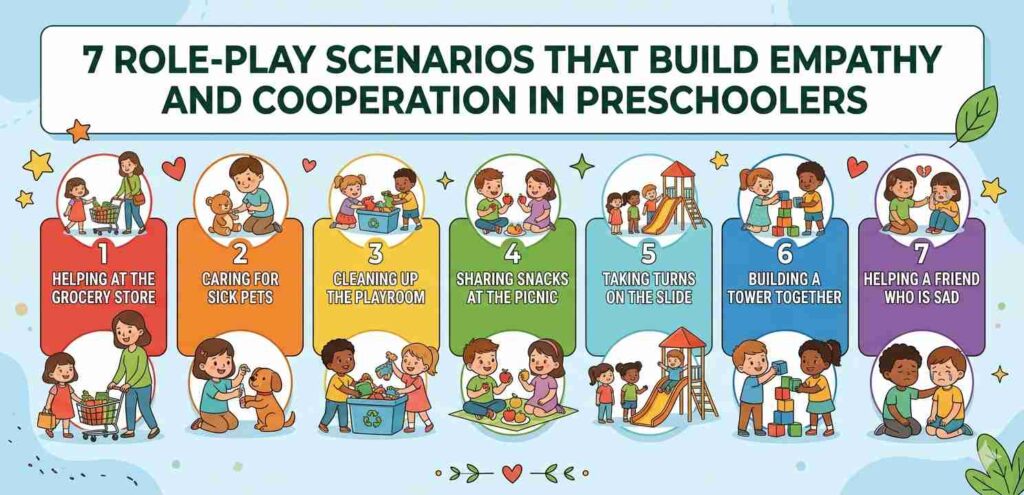
The seven role-play scenarios for preschoolers described here — from doctor visits to apologies — each target a slightly different piece of empathy and cooperation. None of them require perfection, and none of them demand that children get it right the first time. That’s the point. Practice is the whole game.
Start small, stay curious, and pay attention to what your child naturally gravitates toward. The best role-play learning often happens when adults set up the conditions and then get out of the way.